
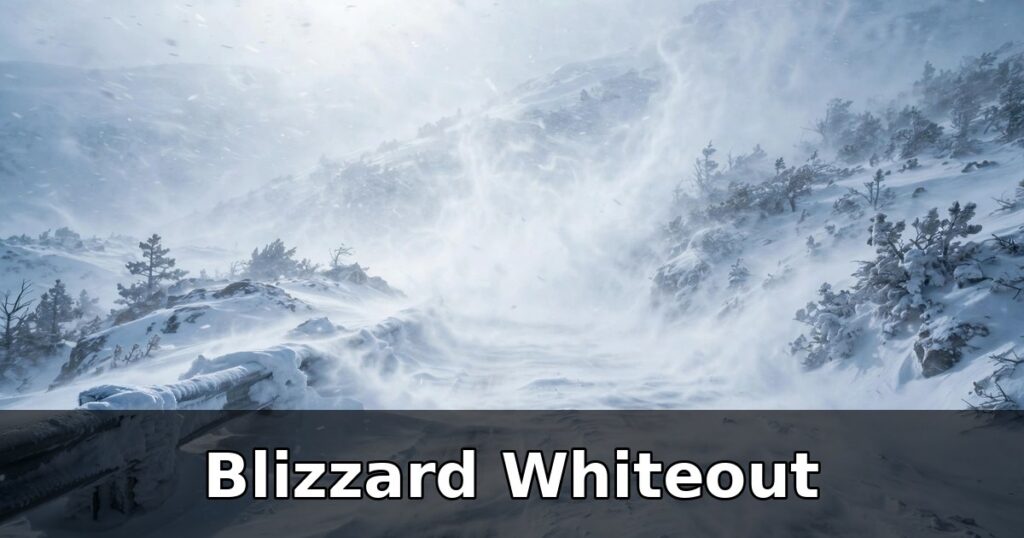
How to Stay Safe During a Blizzard Whiteout
A whiteout is one of the most disorienting experiences in nature. Snow fills the air so completely that the horizon disappears, the road vanishes, and the sky and the ground merge into a single white field with no edges, no shadows, and no points of reference. A driver caught in a whiteout can lose the road within seconds, and a person on foot can become lost within steps of shelter. The danger is not the cold alone, nor the snow alone, but the combination of wind, snow, and darkness of visibility that removes the ability to navigate. Understanding what a blizzard is, how a whiteout forms, and how to survive one is a matter of preparation, recognition, and disciplined decision-making.
Key points
- A blizzard is defined by wind and visibility, not snowfall: winds of 35 mph or more, visibility under a quarter of a mile, for at least 3 hours — and no minimum snowfall is required.
- At a wind chill of around minus 18 to minus 20 °F, exposed skin can freeze in about 30 minutes; at minus 35 °F in about 10 minutes; at minus 50 °F in about 5 minutes.
- Hypothermia begins when core temperature falls below 95 °F — and it can strike well above freezing when you are wet and exposed to wind.
- Keep your fuel tank at least half full in winter, and never run a generator inside a home or garage — keep it at least 20 feet from any door, window, or vent.
- If stranded, stay with your vehicle: run the engine about 10 minutes each hour with a window cracked open, and clear the exhaust pipe of snow regularly.
A whiteout is one of the most disorienting experiences in nature. Snow fills the air so completely that the horizon disappears, the road vanishes, and the sky and the ground merge into a single white field with no edges, no shadows, and no points of reference. A driver caught in a whiteout can lose the road within seconds, and a person on foot can become lost within steps of shelter. The danger is not the cold alone, nor the snow alone, but the combination of wind, snow, and loss of visibility that removes the ability to navigate.
What counts as a blizzard
The National Weather Service defines a blizzard by wind and visibility, not by snowfall. A blizzard requires sustained winds or frequent gusts of at least 35 miles per hour, combined with considerable falling or blowing snow that reduces visibility frequently to less than a quarter of a mile, for at least three hours. No minimum snowfall is specified, and a blizzard can occur with only a few inches of snow on the ground if the wind is strong enough to lift it.
A ground blizzard is a related phenomenon in which no new snow is falling, yet the wind lifts snow already on the ground and reduces visibility to blizzard levels. Ground blizzards are common in the days after a snowfall, when a cold front brings strong winds across a snow-covered landscape, and they can catch travellers by surprise because the sky may be clear overhead while the air at ground level is full of snow. The National Weather Service issues blizzard warnings for ground blizzards as well as for storms with falling snow, since the hazard to travel is the same.
How a whiteout forms
A whiteout occurs when the air is so full of snow that the normal visual cues for depth, distance, and direction disappear. In ordinary conditions, the eye judges distance from the size of objects, the contrast between light and shadow, and the line of the horizon. In a whiteout, the snow in the air scatters light in all directions, eliminating shadows and contrast, while the snow-covered ground reflects light upward, eliminating the horizon. The result is a uniform field of white in which the eye cannot distinguish the sky from the ground, or a nearby object from a distant one.
Wind chill, frostbite, and hypothermia
The wind that creates a whiteout also accelerates heat loss from the body, and the combination of cold and wind is far more dangerous than cold alone. Wind chill describes the rate at which exposed skin loses heat in moving air, expressed as the temperature that would produce the same rate of heat loss in calm conditions. The current wind chill index, adopted by the National Weather Service and Environment Canada in 2001, is based on experiments measuring the cooling of human faces in a wind tunnel, and it applies to air temperatures at or below 50 degrees Fahrenheit with winds above 3 miles per hour. Wind chill cannot cool an object below the actual air temperature, but it can cool exposed skin far faster than still air at the same temperature.
The frostbite thresholds on the National Weather Service wind chill chart are stark. At a wind chill of around minus 18 to minus 20 degrees Fahrenheit, exposed skin can freeze in about 30 minutes. At a wind chill of around minus 35 degrees, frostbite can occur in about 10 minutes, and at around minus 50 degrees, in about 5 minutes. These times assume exposed skin, and covered skin is protected, but the face, hands, and ears are often partially exposed, and the margin for error shrinks rapidly as the wind chill falls.
| Wind chill | Time for frostbite on exposed skin |
|---|---|
| About −18 to −20 °F | About 30 minutes |
| About −35 °F | About 10 minutes |
| About −50 °F | About 5 minutes |
Frostbite begins with redness and pain, progresses to white or greyish-yellow skin with a firm or waxy feel, and ends in numbness, and the damage can be permanent. Hypothermia, the fall of the core body temperature below 95 degrees Fahrenheit, is the more insidious danger. It can occur at temperatures well above freezing when a person is wet and exposed to wind, and its early symptoms — including shivering, exhaustion, confusion, and fumbling hands — impair the judgement needed to seek shelter.
Before the storm: preparation that makes survival possible
Survival in a blizzard is largely determined before the storm arrives. A vehicle prepared for winter travel carries a kit that can sustain its occupants for hours, and the contents of that kit are a matter of life and death when a whiteout strands a car on a road. The kit should include blankets or sleeping bags, extra warm clothing, a flashlight with spare batteries, a first aid kit, a shovel, sand or cat litter for traction, jumper cables, a tow rope, and a fully charged phone with a car charger. Food and water are essential, since a stranded driver may wait hours for rescue, and high-energy foods such as nuts, dried fruit, and energy bars are the most practical.
Driving in a blizzard: when travel cannot be avoided
The safest advice for driving in a blizzard is not to drive, and that advice should be followed whenever possible. When travel cannot be avoided, the approach must be defensive in the extreme. Speed should be reduced drastically, following distance increased to several times the normal gap, and headlights kept on low beam, since high beams reflect off the snow and reduce visibility further. Cruise control should never be used in snow or ice, since it can cause the vehicle to accelerate when traction is lost. Sudden steering, braking, or acceleration should be avoided, and the vehicle should be kept in the tracks of the vehicle ahead where possible, since the packed snow in existing tracks offers better traction than fresh snow.
Road markings, signs, and landmarks disappear in a whiteout, and the driver may lose track of the position of the road entirely. In such conditions, the correct action is to pull off the road as far as possible, away from the travelled lanes, and to stop. Stopping in the middle of the road, or on the shoulder close to traffic, risks a collision with another vehicle that cannot see the stopped car. A parking lot, a rest area, or a wide shoulder is preferable, and the hazard lights should be turned on to make the vehicle visible to other drivers.
Stranded in a vehicle: staying alive until rescue
A stranded vehicle is a shelter, and the priority is to make it visible and to conserve heat. The exhaust pipe should be cleared of snow regularly, since a blocked exhaust can cause carbon monoxide to enter the vehicle, and the engine should be run intermittently, for about ten minutes each hour, with a window cracked open for ventilation. Carbon monoxide is colourless and odourless, and it can cause sudden illness and death, so ventilation is essential even in extreme cold. The dome light should be turned on at night to make the vehicle visible to rescuers, and a brightly coloured cloth tied to the antenna or door handle serves as a distress signal during the day.
On foot in a whiteout
A person caught on foot in a whiteout faces a different set of dangers. Disorientation is immediate, since the absence of visual references removes the ability to maintain a straight line, and a person walking in a whiteout tends to drift in circles. The correct action is to seek shelter at once, in the nearest building, vehicle, or windbreak, rather than attempting to continue toward a distant destination. If no shelter is available, the person should stay in place, conserve heat, and wait for the storm to ease or for rescue, rather than walking blindly into worsening conditions.
Clothing and movement are the primary defences on foot. All exposed skin should be covered, and the person should keep moving gently to generate heat without sweating, since sweat soaks clothing and accelerates heat loss once exertion stops. Shelter can be improvised from a snow bank, a ditch, or the lee side of a building, and any windbreak reduces heat loss substantially. The person should avoid burrowing into deep snow, which can collapse, and should keep the face protected from the wind, since the face is the most vulnerable area for frostbite.
After the storm: the hidden hazards
The danger does not end when the snow stops falling. Drifting snow can block roads for hours or days after a blizzard, and emergency services may be unable to reach stranded travellers until plows have cleared the routes. Power outages are common, since the combination of heavy snow, ice, and wind brings down lines and poles, and the loss of heat during an outage creates a second emergency inside the home. A house without heat in subfreezing temperatures cools rapidly, and pipes can freeze and burst within hours, causing extensive water damage.
What this means
A blizzard whiteout is dangerous not because it is cold, but because it removes the information that people rely on to navigate and to make decisions. The road disappears, the horizon disappears, and the landmarks disappear, and the person caught in it must rely on preparation made in advance and on discipline in the moment. The National Weather Service definition of a blizzard, with its thresholds of 35 miles per hour, a quarter of a mile of visibility, and three hours of duration, is not an abstract meteorological curiosity. It describes the conditions under which travel becomes impossible and survival depends on shelter.
Raina





댓글 0
첫 댓글을 남겨보세요.