
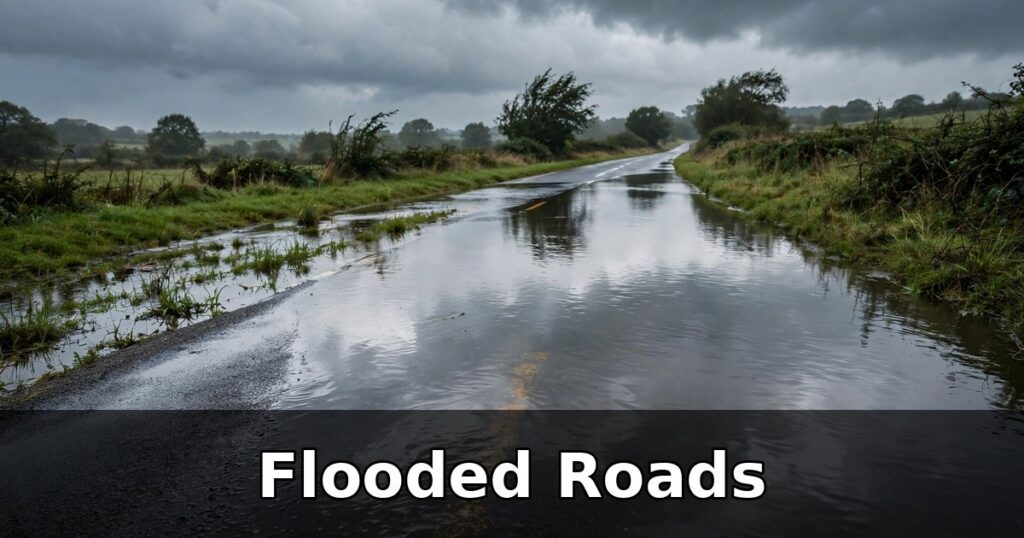
How to Drive Safely Through a Flooded Road: The Depth That Floats a Car
The safest way to drive through a flooded road is not to drive through it at all. That statement sounds like an evasion, yet it is the central finding of decades of flood safety research, and it is the conclusion of the National Weather Service, the Federal Emergency Management Agency, and the Centers for Disease Control and Prevention alike. Floodwater kills more people in the United States in an average year than any other thunderstorm-related hazard, and more than half of flood-related drownings occur when a vehicle is driven into hazardous floodwater. The danger is not a matter of bad luck or poor driving skill. It follows from the physics of water, the design of automobiles, and the inability of a driver to judge the depth of water from behind the wheel.
Key points
- Floodwater kills more people in the United States in an average year than any other thunderstorm-related hazard — and more than half of flood-related drownings happen when a vehicle is driven into floodwater.
- 6 inches of fast-moving water can knock an adult off their feet; 12 inches can carry away most cars; 2 feet can carry away SUVs and trucks.
- You cannot judge water depth from the driver’s seat — a flooded road looks the same at 3 inches or 3 feet deep.
- Never drive around a barricade blocking a flooded road — the road beyond it may no longer exist.
- If your vehicle stalls in floodwater, abandon it immediately and move to higher ground; do not wait for the water to subside or try to restart the engine.
The safest way to drive through a flooded road is not to drive through it at all. That sounds like an evasion, yet it is the central finding of decades of flood safety research, and it is the conclusion of the National Weather Service, the Federal Emergency Management Agency, and the Centers for Disease Control and Prevention alike. Floodwater kills more people in the United States in an average year than any other thunderstorm-related hazard, and more than half of flood-related drownings occur when a vehicle is driven into hazardous floodwater.
The depths that defeat a vehicle
The National Weather Service summarises the danger in three numbers that have become the standard reference for flood safety. Six inches of fast-moving water can knock an adult off their feet. Twelve inches of rushing water can carry away most cars. Two feet of rushing water can carry away sport utility vehicles and trucks. These figures describe moving water, and the distinction matters, since moving water exerts a lateral force that still water does not. Even so, still water conceals its own hazards, including a washed-out roadbed and a stalled engine, and no depth of floodwater is described by the National Weather Service as safe to drive through.
Twelve inches is a strikingly small depth. It does not reach the top of a tyre, and it barely covers the bottom of a car door. The reason so little water can move so much vehicle lies in buoyancy. A car is essentially a sealed steel container full of air, and as water rises around it, the water displaces an increasing share of the weight that the tyres would otherwise carry. Once the water reaches the level of the door sills, a large fraction of the weight is supported by the water rather than by the tyres, and the friction that allows steering and braking to work falls away. At that point the vehicle is closer to a boat than to a car, and the current, rather than the driver, determines where it goes.
| Water depth (moving water) | What it can do |
|---|---|
| 6 inches | Knock an adult off their feet |
| 12 inches | Carry away most cars |
| 2 feet | Carry away SUVs and trucks |
Why depth cannot be judged from the driver’s seat
The most dangerous feature of floodwater is that its depth cannot be judged reliably from inside a moving vehicle. Water is transparent at the surface and opaque below, and a flooded road looks the same whether the water is three inches deep or three feet deep. The surface flattens reflections, hides the crown of the road, and conceals the edges of the pavement. At night, when a large share of flood deaths occur, a flooded dip in the road can look exactly like wet pavement, and headlights reflecting off the surface give no information about what lies beneath.
The current: force, speed, and direction
Depth alone does not determine the danger of floodwater; the speed of the current matters just as much. Six inches of water moving at a walking pace is an inconvenience, while six inches of water moving at the speed of a fast river can knock an adult down and push a small car sideways. The force exerted by moving water increases with the square of its speed, so doubling the speed of the current quadruples the force. A current that looks gentle at the surface can be far stronger below, where the water is channelled by the roadbed and by drainage structures.
The direction of the current also matters. Water flowing across a road pushes a vehicle sideways, toward the shoulder and beyond, where the ground falls away and the water is deeper. Water flowing along a road, in the direction of travel, can accelerate a vehicle beyond the control of its brakes. In either case, the driver cannot counter the force with steering or braking, because the tyres have lost their grip on the road surface. The National Weather Service notes that a vehicle caught in swiftly moving water can be swept away in seconds, and that water levels and flow can change quickly during a flood.
What floodwater does to a car
Floodwater damages a vehicle in several ways, and the damage begins long before the vehicle floats. Water entering the engine intake can cause hydrostatic lock, in which the engine stops abruptly because water, unlike air, cannot be compressed in the cylinders. Water reaching the electrical system can short circuits, disable the ignition, and cut power to the windows and door locks, trapping occupants inside. Water in the exhaust system can stall the engine, and water in the brakes reduces their effectiveness even after the vehicle leaves the water.
The air intake of most passenger cars sits low, often at the level of the front bumper or the wheel arch, so that water only a foot deep can reach it. Once water enters the intake, the engine can stop within seconds, and restarting it can cause severe internal damage as the pistons attempt to compress water. The electrical system is similarly vulnerable, and modern vehicles, with their extensive electronic controls, can lose power steering, power brakes, and the ability to open windows or unlock doors when water reaches the wiring. A stalled vehicle in rising water is one of the most dangerous situations in a flood, because the occupants lose both mobility and the ability to escape through the windows.
The decision before the water: turning around
The decision that matters most in a flood is made before the vehicle reaches the water. Once the wheels enter floodwater, the options narrow rapidly, and the driver is committed to a crossing whose depth and current are unknown. The National Weather Service campaign phrase, Turn Around, Do Not Drown, captures the logic: the correct response to a flooded road is to stop, turn around, and find another route, regardless of how shallow the water appears.
Turning around requires planning. Drivers should monitor weather forecasts and flood warnings before travelling, particularly during heavy rainfall, and should avoid routes that cross low-lying areas, underpasses, and small bridges over streams. Underpasses are among the most dangerous locations in a flood, because water collects in them rapidly and the depth can rise by several feet in minutes, with no escape route once the vehicle is inside. Low-water crossings, where a road dips to cross a stream, are similarly hazardous, since the stream can rise over the road with little warning.
When a vehicle is caught: escape and survival
Despite the best planning, vehicles are sometimes caught by rising water, and the correct actions in that situation are a matter of seconds. If a vehicle stalls in floodwater, the occupants should abandon it immediately and move to higher ground, since rapidly rising water can engulf a vehicle and sweep it away. The National Weather Service advises leaving the vehicle at once rather than waiting for the water to subside or attempting to restart the engine, and the Centers for Disease Control and Prevention gives the same advice.
Escaping from a vehicle in water requires care. Seatbelts should be unfastened, and the windows should be opened or broken before the water rises high enough to prevent the doors from opening. Water pressure against a door increases rapidly with depth, and a door that can be opened easily at a few inches of water may be impossible to open at a foot or more. Electric windows may fail as water reaches the wiring, so manual action is preferable where possible, and a window-breaking tool kept within reach can be decisive. Occupants should exit through the windows if the doors will not open, and should move to the roof of the vehicle if escape to dry ground is not immediately possible.
Once outside the vehicle, the priority is to reach high ground and to avoid walking through floodwater. Six inches of fast-moving water can knock an adult down, and walking through floodwater exposes the person to the same hidden hazards as driving, including washed-out surfaces, debris, and contamination. Floodwater can also conceal downed power lines, which can electrify the water over a wide area. The correct action is to move to the highest available ground, to call emergency services, and to wait for rescue rather than attempting to wade to safety through moving water.
Night, rain, and the hidden flood
A disproportionate share of flood deaths occur at night, and the reasons are straightforward. Darkness removes the visual cues that might otherwise warn a driver, headlights reflect off the water surface without revealing depth, and the water itself is harder to see against a dark road. Rain on the windshield further reduces visibility, and the sound of rain can mask the sound of rushing water. Drivers travelling at night during heavy rain should reduce speed, increase following distance, and treat any reflective surface on the road ahead as potentially deep water until proven otherwise.
Heavy rain also creates floods in places that are not near rivers. Urban flooding, caused by rainfall overwhelming the drainage system, can flood underpasses, intersections, and low sections of highway far from any watercourse. Drivers who assume that flooding only occurs near rivers are vulnerable to this form of flooding, which can develop in minutes during an intense downpour. The National Weather Service notes that flooding kills more people each year than any other thunderstorm hazard, and much of that toll comes from flash flooding in urban and suburban areas rather than from river flooding.
The interaction between rain and driving speed also matters. At highway speeds, a vehicle can hydroplane on a thin layer of water, losing contact with the road surface entirely. Hydroplaning can occur at speeds as low as about 35 miles per hour on wet roads — a general low-speed threshold, not a figure from the National Weather Service — and the risk increases with water depth, tyre wear, and speed. Reducing speed in heavy rain, avoiding sudden steering or braking, and maintaining adequate tyre tread are basic precautions, yet they are often neglected in the urgency to reach a destination. The decision to slow down or to pull over and wait for the rain to ease is among the most effective flood safety measures available to a driver.
After the crossing: damage, health, and insurance
A vehicle that has been driven through floodwater, even shallow water, should be inspected before further use. Water in the brakes reduces stopping power, and the brakes should be tested at low speed by applying them gently to dry them. Water in the engine, transmission, or differential can cause damage that is not immediately apparent, and a vehicle that has been submerged should not be started until it has been inspected by a qualified mechanic, since attempting to start a flooded engine can cause severe internal damage. The interior should be dried thoroughly, since moisture trapped in carpets and upholstery promotes mould growth and corrosion of electrical connections.
Why the risk is growing
Raina





댓글 0
첫 댓글을 남겨보세요.