
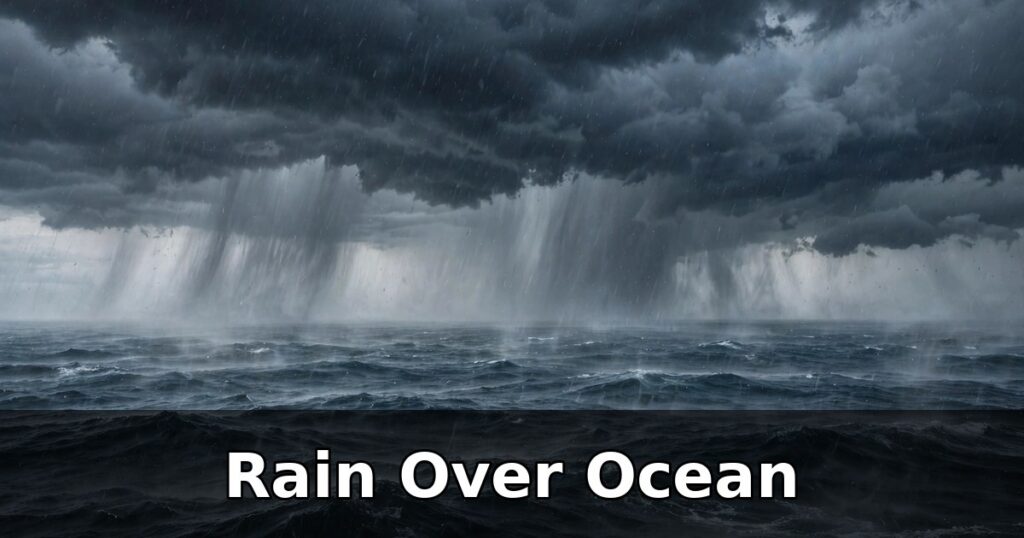
Why Does It Rain More Over the Ocean Than Over Land?
Key points
- About 78% of all precipitation falls over the oceans, and only 22% falls over land.
- The oceans supply about 85% of all evaporation: roughly 413,000 cubic kilometres a year, against 73,000 from land.
- The oceans cover 71% of Earth’s surface and hold about 97% of its water — the supply of moisture is simply larger at sea.
- Only about 40,000 cubic kilometres a year of ocean vapour reaches land, and the same amount flows back to the sea as rivers and groundwater.
It rains on the ocean. It rains a lot on the ocean — far more, in total, than it rains on land. That sounds strange at first. Rain is something people experience on land, under roofs, on roads, in fields. The ocean seems like the place water comes from, not the place it falls.
The numbers say otherwise. Roughly three quarters of all the rain and snow on Earth falls on the sea. The reason is not a mystery, but it is a chain of causes rather than a single one: the size of the ocean, the physics of evaporation, and the way the atmosphere moves moisture around the planet.
Understanding the imbalance matters, because it decides how much fresh water the land ever gets — and how little of it there is to share.
The global ledger
The most widely cited global water budget comes from Trenberth and colleagues (2007). Each year, the ocean evaporates about 413,000 cubic kilometres of water, and land surfaces return about 73,000 cubic kilometres through evaporation and transpiration from plants. Of the 486,000 cubic kilometres evaporated in total, the ocean supplies about 85%.
Most of that ocean vapour falls straight back on the ocean: about 373,000 cubic kilometres, or roughly 90% of what evaporated. Only about 40,000 cubic kilometres is carried by the wind over the continents. There it joins the vapour from land to produce 113,000 cubic kilometres of rain and snow a year. The same 40,000 cubic kilometres flows back to the sea through rivers and groundwater, closing the loop.
| Flow (cubic km per year) | Ocean | Land |
|---|---|---|
| Evaporation | 413,000 | 73,000 |
| Precipitation | 373,000 | 113,000 |
| Share of global precipitation | About 77–78% | About 22–23% |
| Water vapour carried in / out | 40,000 out to land | 40,000 back as runoff |
Put another way, the ocean evaporates more than it receives as rain, and the land receives more rain than it evaporates. The difference — that 40,000 cubic kilometres a year — is the fresh water the continents live on. Every river, lake, aquifer, farm, and city draws from it.
Why the ocean wins: supply
The first reason is the simplest: there is far more ocean than land. The oceans cover about 71% of Earth’s surface and hold about 97% of all the water on the planet. The atmosphere, by comparison, holds only about 12,900 cubic kilometres of water at any moment — roughly 0.001% of the global total.
Evaporation needs liquid water and energy. The ocean offers an effectively unlimited supply of the first, and the sun provides the second across an area of about 361 million square kilometres. Land, at about 149 million square kilometres, has less surface, and much of it is dry for much of the year. Soil dries out, plants close their pores to save water, and evaporation stops until the next rain. The ocean never dries out.
Why the ocean wins: the rain falls near its source
Water vapour does not stay in the atmosphere for long. On average, a water molecule spends only about 10 days in the air, travelling more than 1,000 kilometres from where it evaporated before falling again. That short lifetime means most rain falls near where its moisture came from — and most moisture comes from the ocean.
About 90% of the water that evaporates from the ocean falls straight back into the sea, without ever reaching land. The winds carry only about a tenth of it over the continents. Land precipitation is therefore a small leak from a much larger oceanic cycle, not the main event.
The comparison holds per square kilometre, too. Spread the totals over their areas, and the ocean receives about a metre of rain a year on average, while the land receives about three quarters of a metre. The ocean wins on total volume because it is bigger, and it also wins on depth, because it sits under the wettest parts of the atmosphere.
The atmosphere’s geography: where the rain goes
The atmosphere does not distribute rain evenly. Warm, moist air rises near the equator, in a band called the Intertropical Convergence Zone. As it rises, it cools, its water vapour condenses, and heavy rain falls. This band sits mostly over the tropical oceans, and it is the wettest place on Earth.
The air that rose at the equator then travels toward the poles, sinks at about 30 degrees latitude, and warms as it descends. Sinking air suppresses clouds and rain. That is why the great deserts — the Sahara, the Arabian, the Australian outback — sit at those latitudes, and why they sit on land. The same circulation that drenches the equatorial oceans dries out the subtropical continents.
Storm tracks add a second pattern. Mid-latitude cyclones, the storms that bring rain to Europe and North America, form and strengthen over the oceans, where the temperature contrast between cold polar air and warm tropical air is sharpest. They dump much of their rain at sea before they ever reach a coastline. Tropical cyclones do the same: a hurricane or typhoon draws its energy from warm ocean water and drops enormous amounts of rain over the sea, weakening once it moves over land.
The exceptions: land can be wetter — locally
The global average hides dramatic exceptions. Some of the wettest places on Earth are on land, not at sea. When moist ocean air is forced to rise over a mountain range, it cools and drops its water as rain on the windward slope. Coastal mountains in Hawaii, the Western Ghats of India, and the hills of Wales all receive far more rain than the ocean a short distance offshore.
Coastal land generally receives more rain than land far inland, because it is closer to the moisture source. As air travels inland, it loses water with each rainfall, and the land it crosses grows drier. The interior of a large continent, far from any ocean, can be a desert even at latitudes where the coast is wet. The contrast between coastal and inland rainfall is one of the strongest patterns in climatology.
Monsoons are the largest exception of all. In summer, the land heats faster than the sea, drawing moist ocean air deep into the continent. The Indian monsoon carries ocean moisture thousands of kilometres inland and drops it as rain over South Asia.
What the research says
The global budget above comes from Trenberth, Smith, Qian, Dai, and Fasullo (2007), published in the Journal of Hydrometeorology. Their estimates — 413,000 cubic kilometres of ocean evaporation, 373,000 of ocean precipitation, 113,000 of land precipitation — have been reproduced by later budgets with small differences. One widely used textbook budget, for example, gives 425,000 for ocean evaporation and 385,000 for ocean precipitation. The totals shift slightly between estimates, but the shape of the cycle does not: the ocean dominates both sides of the ledger.
The physics behind the imbalance is also well established. Held and Soden (2006) showed that atmospheric water vapour rises by roughly 7% for each degree Celsius of warming. Over the ocean, where the water supply is unlimited, the air stays close to saturated, so the extra moisture is real. Over land, where water is often limited, the same warming can raise demand without raising supply — and the gap shows up as drought rather than rain.
What is still uncertain
The ocean numbers are the least certain in the budget. Rain gauges sit on land. Over the ocean, rainfall is estimated from satellites, ships, and buoys, and different estimates disagree. That is why the ocean’s share of global precipitation is quoted as 77% in some budgets and 78% in others. The difference is small, but it is a reminder that the least-measured part of the cycle is also the largest.
It is not yet clear how fast the imbalance is growing. Theory says a warmer atmosphere should move more water from ocean to land and back, but measuring a small change in a huge flux is hard. The salinity signal is clear in direction and uncertain in magnitude.
Local rainfall depends on more than the global budget. Wind patterns, mountains, and sea-surface temperatures decide whether a particular coast is wet or dry. The global numbers explain why the ocean gets more rain overall; they do not predict the rain over any single city.
What this means
Fresh water is a small leak from a big cycle. The land’s entire water supply — every river, reservoir, and aquifer — comes from the 40,000 cubic kilometres a year that the wind carries from ocean to land. That is less than a tenth of what the ocean evaporates. Humanity’s water security rests on a fraction of the cycle.
Most rain is none of our business. The 373,000 cubic kilometres that fall on the ocean each year never touch a tap or a field. It is not wasted — it keeps the ocean’s surface fresh and drives circulation — but it is not available to anyone.
Where you live decides how much of the leak you get. A coastal mountain can catch metres of rain a year, while a continental interior a thousand kilometres inland gets almost none. Water scarcity is mostly a problem of geography, not of the global total.
What should change
Measure the ocean better. The largest flux in the water cycle is also the least measured. More satellite coverage and more ocean buoys would tighten the budget and give earlier warning when the cycle shifts.
Plan water as a transport problem. Since only a tenth of ocean evaporation reaches land, and it arrives unevenly, the practical questions are about capture and storage: reservoirs, groundwater recharge, and keeping the rain that does fall from running straight back to the sea.
Design for a stronger cycle, not a stable one. If wet regions get wetter and dry regions drier, then flood defences and drought plans built on twentieth-century averages will be wrong in both directions at once. Water infrastructure should be sized for the cycle that is coming, not the one that was measured.
An ocean planet, with land on the edge
It rains more over the ocean than over land because the ocean is where the water is, where the evaporation happens, and where most of the rain falls before it has time to travel anywhere else. The land gets what the wind carries inland — about a tenth of the ocean’s evaporation — and that small share is all the fresh water there is. The imbalance is not an accident of geography. It is the water cycle itself, and every river on Earth is a reminder of how little of it the land ever sees.
Raina





댓글 0
첫 댓글을 남겨보세요.