
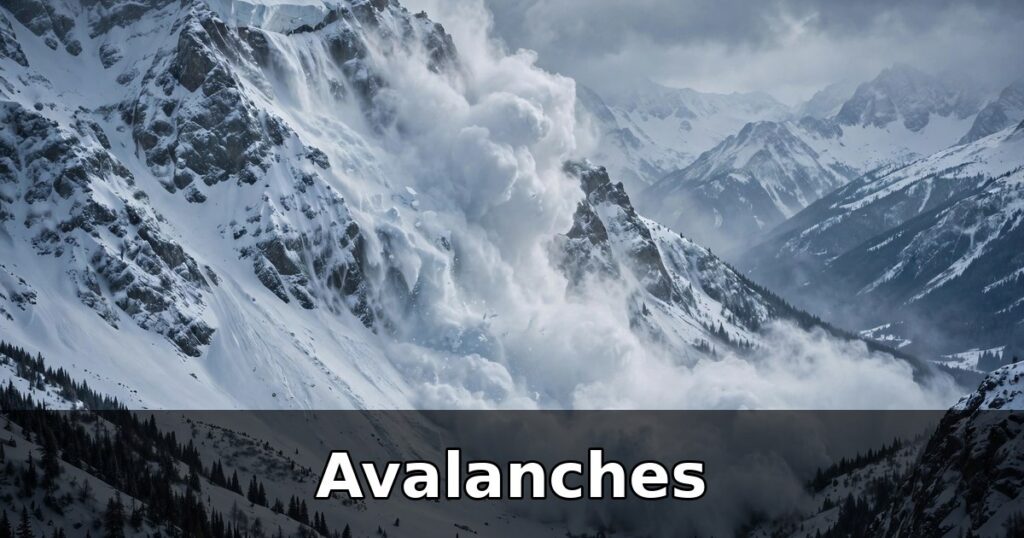
How Do Avalanches Start? The Hidden Weak Layer in the Snowpack
Key points
- Slab avalanches cause about 90% of avalanche deaths in North America and Europe — and a hidden weak layer inside the snowpack is what makes them possible.
- About 90% of avalanches that injure or kill are triggered by the victim or someone in their party.
- Most avalanches start on slopes of 30 to 45 degrees. Slopes gentler than 25 degrees rarely slide.
- A buried weak layer can stay dangerous for weeks or months after the storm that created it.
- An average of 28 people die in avalanches each year in the United States. Survival is about 90% if burial lasts less than 15 minutes, and falls to about 30% after 30 minutes.
From the surface, a snow-covered slope can look perfectly uniform. Inside the snowpack, though, layer upon layer of snow records the weather of the whole winter — and one of those layers may be too weak to hold the weight above it.
An avalanche does not start with the snow on top. It starts with the layer that fails: when a weak layer collapses, the strong, cohesive slab of snow sitting on it breaks free and slides downhill.
Three ingredients are needed: snow, a slope steep enough to slide, and a trigger — and in most fatal avalanches, the trigger is a person.
The snowpack is a layered history
A snowpack is not a single block of snow. It is a stack of layers, each one laid down by a different storm under different conditions. Each layer has its own density, temperature and crystal shape — and its own strength.
From the moment a snowflake lands, it begins to change. This process is called snow metamorphism. Warm ground, often near 0°C even in midwinter, sits beneath cold air at the surface. The temperature difference between the bottom and the top of the snowpack drives water vapour upward through the snow, and that slow migration reshapes the crystals.
When the gradient is small and temperatures stay below freezing, crystals round off and pack tightly together, and the snow grows stronger. When the gradient is large, crystals grow into angular, flat-sided shapes called facets, which cannot bond well to each other. A layer of facets is a weak layer.
The three weak layers that matter most
Forecasters watch three kinds of weak layer above all others. Each forms in different weather, and each can persist long after it is buried.
Surface hoar is frost: feathery, glittering crystals that grow on the snow surface on clear, cold, calm nights, when moist air near the surface reaches its frost point and deposits directly as ice. The crystals can grow from the size of a fingernail to the size of an oak leaf. They form only when winds are near calm, below about 10 miles per hour. Once buried by the next storm, the fragile layer can persist for months.
Depth hoar forms at the bottom of the snowpack, where the temperature gradient is steepest. In a shallow snowpack — less than about one metre deep — water vapour rising from the warm ground builds large, angular, poorly bonded crystals at the base. Depth hoar is sometimes called sugar snow, because the loose grains pour like sugar. It can last all season, mostly on shady, higher terrain. It is the classic early-season hazard: a thin November snowpack that sits through a cold, dry spell turns to facets, and a big December storm then loads a slab on top of it.
Graupel is a weak layer that falls from the sky. These soft, round pellets form when supercooled water droplets freeze onto a falling snowflake, coating it until its crystal shape disappears. A graupel layer behaves like ball bearings between snow layers: the round pellets do not interlock, so the slab above can slide easily. Graupel usually stabilises within hours or a couple of days — but not always.
Sun, rain and warm spells add a fourth hazard: crusts. When the top of the snowpack melts and refreezes, it forms a slick layer of ice. A crust can help by bridging over weaker snow, or hurt by giving new snow a slippery surface to slide on. Facets often grow just above or below a crust as temperatures swing.
| Weak layer | How it forms | How long it lasts |
|---|---|---|
| Surface hoar | Frost crystals on the snow surface on clear, cold, calm nights | Weeks to months once buried |
| Depth hoar | Faceted crystals at the base of a shallow snowpack under a steep temperature gradient | All season |
| Graupel | Soft pellets of rimed snow falling during a storm | Usually hours to days; up to 10 days documented |
| Melt-freeze crust | Surface snow melting and refreezing, or rain on snow | Persists until buried or melted out |
How a slab releases
With a weak layer in place, the stage is set. What sits on top of it is the slab: a cohesive layer of snow, often formed when wind transports snow onto a leeward slope. Wind-packed snow is dense and stiff, and it can span a wide area as a single unit.
The release begins with a collapse. When the weak layer fails — under the weight of new snow, a warming trend, or a skier crossing above — it collapses by a few millimetres. The slab above loses its support, a fracture opens at the top of the slab, and the crack races outward across the slope. Research using high-speed photography and acoustic monitoring has clocked fracture propagation at more than 100 metres per second, which is why a slab can release across an entire mountainside almost instantaneously.
Once moving, a dry slab accelerates fast, typically reaching 80 miles per hour within seconds of fracturing and 200 miles per hour before coming to rest. A slab avalanche is far more dangerous than a loose-snow sluff, in which powdery surface snow cascades downhill in a narrow, inverted V. Sluffs account for only a small share of deaths. Slabs account for most of them.
Slab avalanches usually start on slopes between 25 and 60 degrees, and are most common between 30 and 45 degrees. Below 25 degrees, gravity along the slope is generally too weak to overcome the friction holding the slab. Above 60 degrees, snow tends to sluff off before a slab can build. The 30-to-45-degree band is also the angle of many of the best ski slopes.
The trigger is usually a person
Avalanches do occur naturally — during or just after a storm, when new snow loads a weak layer past its limit, or when warming weakens the bonds holding a slab. But the deadliest ones are usually set off by the people caught in them. About 90% of avalanches that cause injuries or deaths are triggered by the victim or someone in their party, according to the Sierra Avalanche Center and the U.S. Forest Service.
More people than ever are travelling in the backcountry, on skis, snowboards and snowmobiles; in recent years snowmobilers have accounted for the greatest number of U.S. avalanche fatalities. In the last ten years, 244 people were killed in avalanches in the United States, and only 3% of them were inside the open, operating areas of ski resorts, according to the Colorado Avalanche Information Center.
A person buried by an avalanche has about a 90% chance of survival if rescued within 15 minutes; after half an hour, the rate drops to about 30%. The leading cause of death is suffocation, not trauma. That narrow window is why forecasters repeat the same advice: the best rescue is the one that never has to happen.
| Figure | Value | Source |
|---|---|---|
| Average U.S. avalanche deaths per year | About 28 | Federal Emergency Management Agency |
| Share of fatal avalanches triggered by the victim or their party | About 90% | Sierra Avalanche Center / U.S. Forest Service |
| Survival if rescued within 15 minutes | About 90% | Colorado Avalanche Information Center |
| Survival after 30 minutes buried | About 30% | Colorado Avalanche Information Center |
What the research says
The central role of persistent weak layers is not a guess; it is measured. In a study of 103 human-triggered avalanches in Canada and Switzerland, Schweizer and Jamieson (2000) found that 82% released on persistent weak layers, most often surface hoar. In southwest Montana from 1990 to 1996, 98% of human-triggered avalanches released on persistent weak layers, most often near-surface facets (Birkeland, 1998).
The persistence itself has been documented in the field. Graupel layers are usually described as short-lived, stabilising within hours or days. But a Sierra Avalanche Center study of the winter of 2017–2018 found a buried graupel layer in the Lake Tahoe area producing natural and human-triggered avalanches over an eight-day period, with remote triggering and wide propagation (Reynaud, 2018). A later case study from Mount Shasta, California, documented a graupel layer failing ten days after burial, releasing a slab averaging more than 60 centimetres deep and about 518 metres wide (Jordan et al., International Snow Science Workshop, 2026).
What is still uncertain
No forecast can see every weak layer. A weak layer can vary from one slope to the next, and even within a single slope. A pit dug on one aspect may say nothing about the slope across the valley.
Triggering is probabilistic, not mechanical. Two skiers can cross the same slope minutes apart; one triggers a slide and the other does not. The difference may be a few centimetres of slab thickness, or a weak layer one loading event away from failing.
Persistent layers can go quiet before they fail. The Mount Shasta graupel layer gave limited warning signs before failing ten days after burial. A layer that has produced no avalanches for a week is not necessarily a layer that has healed.
Climate change is shifting the baseline. Warmer winters may mean fewer cold, clear spells that build surface hoar and depth hoar, but also more rain-on-snow events and wet-snow avalanches. The net effect on avalanche risk is not yet settled.
What this means
The danger is the layer, not the storm. Fresh powder on a slope is not dangerous by itself. It becomes dangerous when it lands on a weak layer laid down days or weeks earlier, in weather nobody remembers.
Time does not always heal a snowpack. A storm slab usually settles within hours or days. A persistent slab — a slab over surface hoar, depth hoar or graupel — can be triggered remotely, from flat terrain below or beside the slope, and days after the last snowfall.
The slope angle matters more than the snow depth. Most fatal avalanches start between 30 and 45 degrees. Knowing the angle of the slope underfoot is one of the simplest and most reliable pieces of information a backcountry traveller can carry.
What should change
Check the forecast before every trip. The U.S. Forest Service runs 14 backcountry avalanche centres, and their daily forecasts name the specific avalanche problems present that day. Travelling without reading it is travelling blind.
Treat persistent weak layers as the season-long problem they are. Once a forecaster names a persistent weak layer, it should change route choices for weeks, not days.
Carry rescue gear — and practise with it. A transceiver, shovel and probe only help if everyone in the party knows how to use them fast. With survival falling from 90% to 30% between 15 and 30 minutes of burial, the rescue is measured in minutes.
A failure you cannot see
An avalanche begins long before anything moves. It begins on a clear, cold night when frost crystals grow on the snow surface, or in a shallow early-season snowpack where vapour rising from the ground builds sugar-like depth hoar, or in a storm that drops a layer of round graupel pellets. Each is buried, forgotten — and still there, a few millimetres of weakness under tonnes of snow. The slab above it may look solid. It is solid, until the weak layer collapses and the whole slope lets go at once.
Raina





댓글 0
첫 댓글을 남겨보세요.