
What to Do After a Flood: The First 48 Hours in Your Home
The water has receded, and the house stands quiet in the aftermath. The worst of the flood may be over, yet the next two days are among the most consequential in the entire recovery. The decisions made in the first 48 hours determine whether the house dries safely or develops mould, whether the insurance claim is supported by evidence or weakened by its absence, and whether the occupants stay healthy or are exposed to contaminated water, electrical hazards, and airborne spores. The work is urgent, but it is also orderly, and it follows a sequence that the Federal Emergency Management Agency, the Centers for Disease Control and Prevention, the Environmental Protection Agency, and the American Red Cross all describe in similar terms: safety first, documentation second, water removal third, and drying and cleaning fourth.
Key points
- Mould can begin growing on damp surfaces within 24 to 48 hours — the clock starts the moment the water stops rising, and items that cannot be cleaned and dried within that window should be discarded.
- Return home only when authorities declare the area safe, and never touch electrical equipment if it is wet or if you are standing in water.
- Document everything before cleanup begins: photographs, video, and a room-by-room inventory are the evidence your insurance claim depends on.
- A signed, sworn proof of loss must generally be submitted within 60 days of the flood, or the insurer can deny payment entirely.
- Mould covering more than about 10 square feet — roughly a 3-foot by 3-foot patch — should be handled by a professional, not by the homeowner.
The water has receded, and the house stands quiet in the aftermath. The worst of the flood may be over, yet the next two days are among the most consequential in the entire recovery. The decisions made in the first 48 hours determine whether the house dries safely or develops mould, whether the insurance claim is supported by evidence or weakened by its absence, and whether the occupants stay healthy or are exposed to contaminated water, electrical hazards, and airborne spores.
The work is urgent, but it is also orderly, and it follows a sequence that the Federal Emergency Management Agency, the Centers for Disease Control and Prevention, the Environmental Protection Agency, and the American Red Cross all describe in similar terms: safety first, documentation second, water removal third, and drying and cleaning fourth. The 48-hour window is not arbitrary. Mould can begin growing on damp surfaces within 24 to 48 hours, and the Environmental Protection Agency advises that water-damaged areas and items should be dried within that period to prevent mould growth. Every hour spent waiting is an hour in which mould gains ground.
Before entering: safety and the return decision
The first decision after a flood is whether to return at all. Residents should return home only when local authorities have declared the area safe, since roads may be damaged, power lines may be down, and floodwater may still be present in areas that look dry. The Federal Emergency Management Agency advises waiting for official clearance, and the advice should be followed even when the house appears undamaged from the outside. A house that looks intact can conceal a weakened foundation, a sagging floor, or a gas leak, and the hazards inside are not visible from the street.
Electricity is the most immediate danger inside a flooded house. Water and electricity are a lethal combination, and the Federal Emergency Management Agency states plainly that electrical equipment should not be touched if it is wet or if the person is standing in water. If the power has not already been shut off, it should be turned off at the main breaker or fuse box, but only if the breaker panel is dry and the person can reach it without standing in water. If the panel is wet, or if standing water blocks access, the power company should be called to disconnect the service. Appliances should be unplugged so that they do not cause a shock when the power is restored, and any appliance that has been submerged should not be used until it has been inspected by a qualified professional.
Gas is a second danger. If the smell of gas is present, or if a hissing sound is heard, the house should be left immediately, and the gas company should be called from outside the building. Matches, lighters, and other open flames should never be used inside a flooded house until it has been checked for gas leaks. Generators, pressure washers, and other fuel-burning devices should never be operated inside a home, basement, garage, or camper, even with doors and windows open, since carbon monoxide can build up to lethal levels. The Centers for Disease Control and Prevention advises keeping generators at least 20 feet from any door, window, or vent.
Documenting the damage: the claim depends on it
Once the house is safe to enter, the next step is documentation, and it should happen before anything is moved, cleaned, or discarded. The insurance claim, whether through the National Flood Insurance Program or a private policy, depends on evidence, and the evidence is strongest when it is collected before the cleanup begins. Photographs and video should be taken of every room, with wide shots showing the overall condition and close-ups showing the waterline on each wall, the damage to each item, and the serial numbers of appliances. A tape measure held against the wall beside the waterline gives scale to the photographs and helps the adjuster assess the depth of the flooding.
An inventory should be compiled room by room, listing each damaged item with its description, quantity, approximate age, and purchase price, and the make, model, and serial number for appliances and equipment. Receipts, credit card statements, and photographs taken before the flood all support the inventory, and the Federal Emergency Management Agency recommends keeping samples of damaged materials, such as carpet, flooring, and drywall, since the type and quality of the material affects its value. Items should not be discarded before the adjuster has seen them, unless they present a health hazard, since the adjuster needs to inspect the damage to assess the claim.
The National Flood Insurance Program imposes a specific deadline that should be marked on the calendar at once. A signed, sworn proof of loss, stating the dollar amount claimed, must generally be submitted within 60 days of the date of loss, and the Federal Emergency Management Agency can deny payment entirely if the deadline is missed without an official extension. Extensions are sometimes issued after major disasters, but an extension should never be assumed, and the policyholder should confirm any extension in writing.
Removing the water: pumps, vacuums, and gravity
With documentation complete, the removal of standing water begins. The method depends on the depth of the water and the equipment available. A wet and dry vacuum can remove shallow water from floors, a portable pump can remove deeper water, and a mop and bucket can handle what remains. Where the water is deep, pumping should be done gradually, removing about a third of the water per day, since pumping a basement dry too quickly can cause the walls to collapse inward under the pressure of the saturated soil outside. The Federal Emergency Management Agency and the Red Cross both caution against pumping out a flooded basement all at once, and the warning should be taken seriously in any house with a basement.
Drying the house: the race against mould
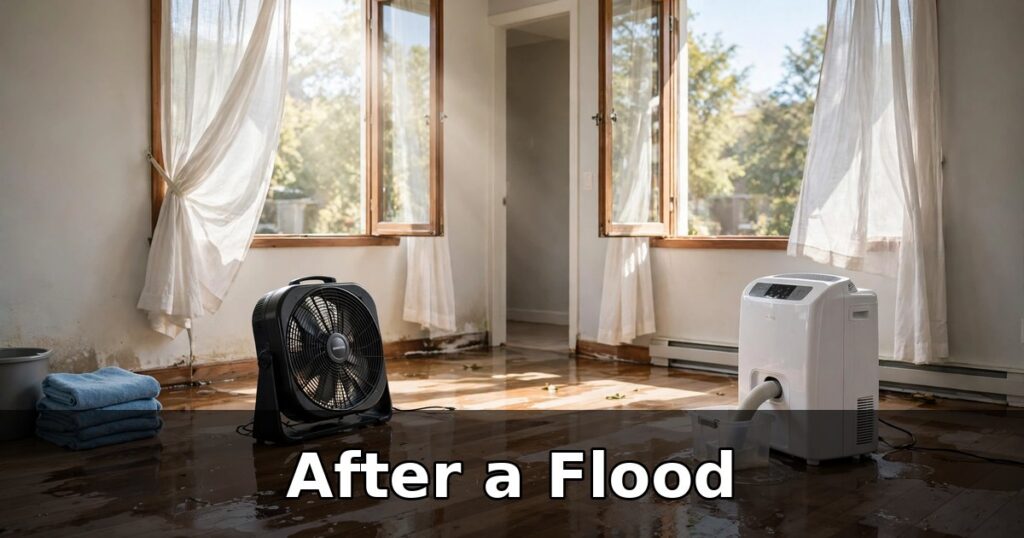
Drying is the most time-sensitive part of the recovery, and it should begin as soon as the standing water is gone. The Environmental Protection Agency advises that water-damaged areas and items should be dried within 24 to 48 hours to prevent mould growth, and the Centers for Disease Control and Prevention recommends the use of fans, air conditioning units, and dehumidifiers to achieve that goal. Windows and doors should be opened to ventilate the house, and fans should be positioned to blow air out of the building or toward open windows, carrying moist air away rather than recirculating it.
Wet materials should be removed to allow the structure to dry. Carpeting and padding should be pulled up, and wet drywall should be cut away to a height of 12 to 24 inches above the visible waterline, since water wicks upward through drywall beyond the level of the standing water. Wet insulation should be removed, since it loses its insulating value when wet and provides a substrate for mould. Baseboards and trim should be removed to expose the wall cavity, and the studs and subfloor should be allowed to dry before any rebuilding begins. The house should be monitored with a moisture meter where possible, since wood and drywall can feel dry on the surface while remaining wet inside.
Dehumidifiers are the most effective tool for drying a house, since they remove moisture from the air even when the outdoor humidity is high. Air conditioning also removes moisture, and it should be run if the system is safe to operate. Fans alone move air but do not remove moisture, and they are most effective when combined with dehumidification and ventilation. One caution from the Centers for Disease Control and Prevention is that fans should not be used if mould has already started growing, since the moving air can spread spores through the house. In that case, the affected area should be contained and cleaned before fans are used.
Cleaning and disinfecting: what to keep and what to discard
Cleaning follows drying, and the order matters. Surfaces should first be cleaned with hot water and detergent to remove dirt and silt, and then disinfected, since disinfectants are less effective on dirty surfaces. The Centers for Disease Control and Prevention recommends a bleach solution of one cup of household bleach per gallon of water for cleaning mould on hard surfaces, with goggles, an N-95 respirator, and gloves worn in a ventilated space. Bleach should never be mixed with ammonia or other household cleaners, since the combination produces toxic fumes.
| Material | After floodwater exposure |
|---|---|
| Hard, nonporous items (glass, metal, hard plastic) | Can generally be cleaned and disinfected |
| Porous items (mattresses, pillows, upholstery, carpet, stuffed toys) | Generally discard if soaked in floodwater |
| Clothing | Often salvaged by washing in hot water and detergent |
| Wet drywall and insulation | Remove and discard; cut drywall 12–24 inches above the waterline |
| Paper documents and photographs | Hardest to save; freezing wet photographs can halt further damage |
Protective equipment and health during cleanup
Cleanup after a flood is physically demanding and exposes workers to hazards that require protective equipment. The Centers for Disease Control and Prevention and the Federal Emergency Management Agency recommend hard hats, goggles, N-95 respirators or respirators with a higher protection level, heavy work gloves, waterproof boots with steel toes and insoles, and ear protection where power tools are used. Floodwater can contain dangerous bacteria from overflowing sewage and agricultural and industrial waste, and it can conceal sharp debris, including nails, glass, and metal, that can cause cuts and puncture wounds. Tetanus vaccinations should be up to date, and any cut sustained during cleanup should be cleaned thoroughly and monitored for infection.
When to call a professional
Not every flood can be handled by the homeowner, and recognising the limits of cleanup by the homeowner is part of the recovery. Professional help should be sought when mould covers more than about 10 square feet, when the water was sewage or otherwise contaminated, when the house cannot be dried within 48 hours with the equipment available, when structural damage is suspected, or when the heating, ventilation, and air conditioning system has been contaminated. The Environmental Protection Agency advises that a contaminated heating and cooling system should not be run, since it can spread mould through the house, and that a professional should inspect and clean it before it is used again.
Raina





댓글 0
첫 댓글을 남겨보세요.