
Why Did Europe’s Wildfires Grow So Severe? Climate, Rural Abandonment, and Forest Fuel
Reuters reports that Europe's wildfires grew severe not only from hotter, drier conditions but also from unmanaged forests and shrubs in depopulated rural areas that fed fire spread, a combination of climate, rural abandonment, and forest fuel that must be addressed together.
Key points
- According to Reuters reporting, Europe’s wildfires grew severe not only because of hotter, drier conditions, but also because of unmanaged forests and shrubs in depopulated rural areas, which fed fire spread.
- Decades of rural depopulation removed the farming, grazing, and woodland management that once broke up fuel continuity across the landscape.
- The three factors — climate, rural abandonment, and forest fuel — reinforce each other: hotter, drier weather dries out the fuel that abandonment has allowed to accumulate.
- Suppression alone cannot solve the problem. Large, intense fires in continuous, dry fuel under extreme weather can outrun firefighters and jump containment lines.
When wildfires sweep across southern Europe, the images are familiar: orange skies, hillsides in flames, villages evacuated, firefighters working through the night. The explanation offered in the moment is often simple: it was hot and dry. Heat and dryness matter enormously, but they are not the whole story.
According to Reuters reporting, Europe’s wildfires grew severe not only because of hotter, drier conditions, but also because of unmanaged forests and shrubs in depopulated rural areas, which fed fire spread. That second part of the explanation — about land, people, and fuel — is essential. Without it, wildfire severity looks like a purely meteorological accident. With it, severity becomes a story about climate, landscape, and decades of social and economic change, all interacting.
Hotter, drier conditions: the climate factor
The climate factor is the most intuitive, and it is real. Hotter temperatures, prolonged dry periods, and low humidity create conditions in which vegetation dries out, ignitions are more likely to become fires, and fires, once started, spread more easily and burn more intensely.
Heat dries fuel. Leaves, twigs, shrubs, and dead wood lose moisture in hot, dry air, especially when heat is accompanied by wind. Dry fuel ignites more readily and burns more completely than moist fuel. A landscape that might have supported only a slow, patchy fire after a wet period can support a fast, intense fire after a prolonged dry period, even if the vegetation itself has not changed.
Dryness also affects the larger environment. Soils dry out, streams and ponds shrink, and the moisture that might otherwise dampen a fire’s spread is reduced. In a drought, even normally moist areas — valley bottoms, shaded slopes, areas near water — can become flammable. The fire season can also lengthen, starting earlier and ending later, giving more opportunities for ignitions to coincide with dangerous conditions.
Wind is a crucial amplifier. Hot, dry conditions alone do not guarantee a severe fire; wind determines how fast it spreads, in which direction, and whether it can jump roads, rivers, or firebreaks through spotting — the lofting of burning embers ahead of the main fire front. A fire in calm conditions may be manageable; the same fire in strong, gusty winds can become uncontrollable in hours, outrunning suppression efforts and threatening communities that seemed safe in the morning.
Rural abandonment: when people leave, the landscape changes
The second factor — rural abandonment — is less visible in fire images, but it is central to understanding why fires have become harder to control in parts of Europe.
For much of the twentieth century, many rural areas in southern Europe were actively managed landscapes. Small farms, grazing animals, coppiced woodlands, terraces, and regularly cleared paths created a patchwork of fields, pastures, and managed forest. That patchwork had an important side effect for fire: it broke up fuel continuity. A fire starting in one patch might burn that patch, but it would then encounter a field, a grazed pasture, a road, or a managed woodland with less fuel, and its spread would slow or stop.
Over recent decades, many of those rural areas have experienced depopulation. Young people moved to cities for work and education. Small farms became uneconomic or were consolidated. Grazing declined. Terraces were abandoned. Villages shrank, and in some cases, were left with only a small, ageing population. The reasons are complex — economic change, mechanisation, urbanisation, shifts in agricultural policy, and changing lifestyles — but the landscape consequence is consistent: land that was once actively managed is now less managed, or not managed at all.
The result is a more continuous, more homogeneous landscape from a fire perspective. Instead of a mosaic of different fuel types separated by managed land, there is a larger, more connected expanse of flammable vegetation. A fire can travel farther without encountering a natural or human-made break, and it can build momentum as it moves through continuous fuel.
Forest fuel: unmanaged forests and shrubs that feed fire spread
| Managed landscape | Unmanaged landscape | |
|---|---|---|
| Fuel load | Thinning, grazing, and harvesting remove small trees, undergrowth, and dead wood | Dead branches, fallen trees, leaf litter, and dense undergrowth build up over years |
| Ladder fuel | Less shrub and small-tree growth reaching into the canopy | Thick shrubs create a continuous layer from the ground into the lower canopy |
| Fuel continuity | Fields, pastures, and managed woodland break up the fuel into patches | Continuous shrubland and forest let fire travel far without meeting a break |
| Fire behaviour | Ground fires that are slower and easier to suppress | Crown fires that are hotter, faster, and far harder to suppress |
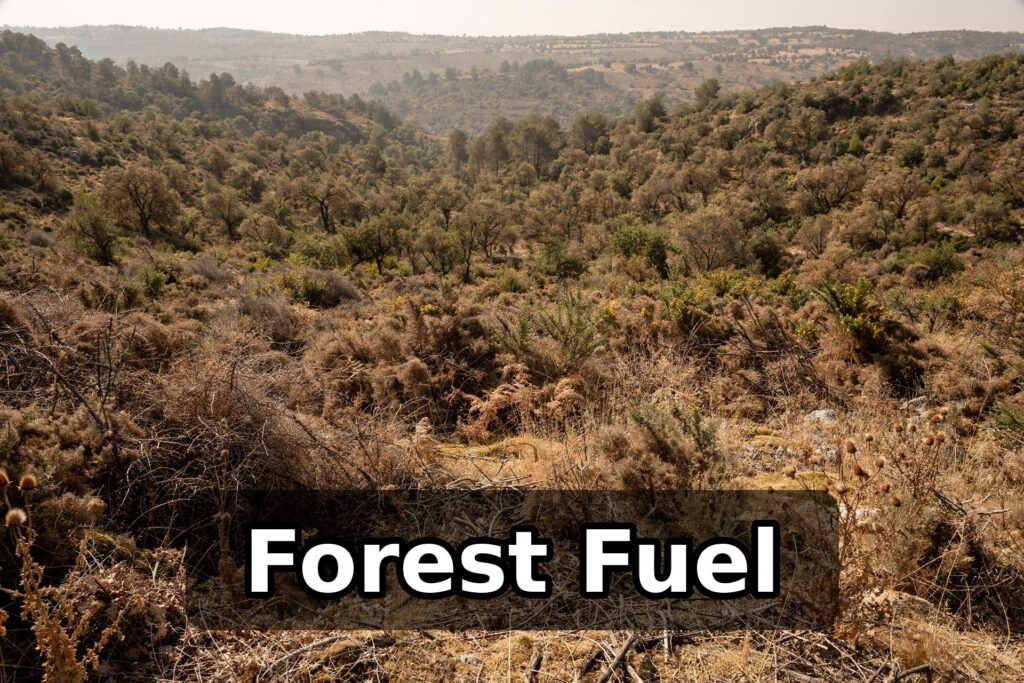
The third factor — unmanaged forests and shrubs — is the physical mechanism through which rural abandonment translates into fire severity. Fuel is the material that burns, and its amount, type, arrangement, and moisture determine how a fire behaves.
In a managed forest, fuel is often controlled, even if that is not the primary purpose of management. Thinning removes small trees and reduces the density of the canopy. Grazing or clearing removes undergrowth. Harvesting removes timber and, if done carefully, also removes some of the dead wood that would otherwise accumulate. The result is a forest with less ladder fuel — the shrubs and small trees that allow a fire to climb from the ground into the canopy — and with more space between trees, which can slow a crown fire that spreads through the treetops.
In an unmanaged forest, fuel accumulates. Dead branches, fallen trees, leaf litter, and dense undergrowth build up over years. Shrubs grow thick and tall, creating a continuous layer of flammable material from the ground up into the lower canopy. When a fire starts in such a forest, it can move quickly through the shrub layer, climb into the canopy via ladder fuels, and become a crown fire that is far harder to suppress than a ground fire. Crown fires generate intense heat, produce large amounts of embers, and can spread rapidly with wind.
How the three factors reinforce each other
The three factors — climate, rural abandonment, and forest fuel — do not act independently. They reinforce each other in ways that make severe fires more likely than any single factor would suggest.
Hotter, drier conditions dry out the fuel that has accumulated in unmanaged forests and shrublands. A shrubland that might burn only patchily in a moist year can burn intensely in a dry year, because the same fuel is now drier and more flammable. A forest with a heavy fuel load becomes more dangerous when that load is dry, because the fire can release more energy more quickly.
Why suppression alone cannot solve the problem
Fire suppression — firefighters, aircraft, firebreaks, and emergency response — is essential for protecting lives and property, and the bravery and skill of firefighters in Europe’s fire seasons should not be underestimated. But suppression has limits, especially under the conditions described above.
When a fire is small and conditions are moderate, direct suppression can succeed: firefighters can attack the fire edge, aircraft can drop water or retardant, and the fire can be contained. When a fire becomes large, fast-moving, and intense, especially in continuous fuel under hot, dry, windy conditions, direct attack can become too dangerous. Firefighters must then shift to indirect strategies: building fire lines ahead of the fire, protecting communities, and letting the fire burn through fuel in a controlled way where possible, while focusing on life safety.
What can be done: managing fuel, supporting rural communities, and adapting to climate
Addressing Europe’s wildfire severity requires action on all three factors, not just one. For forest fuel, the core task is fuel management at landscape scale. That includes thinning dense forests, clearing shrubs in strategic locations, maintaining firebreaks along ridges, roads, and around villages, and restoring a mosaic of land uses that breaks up fuel continuity. Fuel management does not mean clearing all vegetation or turning forests into parks; it means managing vegetation in a way that reduces fire intensity and spread while preserving ecological values, biodiversity, and the other benefits forests provide.
Grazing can be part of that management, where it is appropriate. Traditional grazing by sheep, goats, or cattle can keep shrubs in check and maintain open pastures that act as fuel breaks. In some areas, targeted grazing is being revived as a fire prevention tool, sometimes with support from fire services or land management agencies. Similarly, prescribed burning — carefully controlled fires lit under safe conditions to reduce fuel load — is used in some regions, though it requires expertise, suitable weather windows, and public acceptance.
For rural abandonment, the task is harder, because it involves economics and demographics, not just forestry. Supporting rural livelihoods — through agriculture, forestry, tourism, renewable energy, or remote work — can help retain population and the labour force needed for land management. Subsidies or payments for ecosystem services, including fire prevention, can make fuel management economically viable where it otherwise would not be. Land consolidation, cooperative management, or community forestry models can help manage land that is fragmented among many small owners, some of whom may no longer live locally.
The Mediterranean context and beyond
While much of the discussion focuses on southern Europe, particularly the Mediterranean region, wildfire severity is not confined to one area. Different parts of Europe face different fire regimes, shaped by climate, vegetation, and land use. Northern and central Europe, historically less fire-prone, have also experienced notable fires in recent years during hot, dry summers, raising questions about preparedness in areas where fire management capacity is less developed.
Reading fire news with all three factors in mind
When the next major European fire season arrives, and headlines focus on heat and drought, readers can ask a fuller set of questions, informed by the Reuters reporting on all three factors.
Was it hot and dry? Almost certainly, if fires were severe, the weather will have played a role. But what was the fuel like? Was the fire burning through unmanaged shrubs and dense forest, or through a managed mosaic? Had the area experienced depopulation and a decline in farming or grazing? Were there fuel breaks, and did they hold or were they jumped by spotting? How quickly was the fire spotted, and how accessible was the terrain for firefighters?
Those questions do not diminish the role of climate. They complete the picture. A fire is a meeting point between weather, vegetation, and people — people who manage land, people who live in fire-prone areas, and people who fight fires. Understanding all three is necessary to understand why a fire became severe, and what might prevent the next one from doing the same.
Europe’s wildfires grew severe, according to Reuters, not just because conditions were hotter and drier, but because unmanaged forests and shrubs in depopulated rural areas fed fire spread. That sentence, held in full, is a compact summary of a complex problem — and a guide to its solutions. Addressing climate alone, or fuel alone, or rural abandonment alone, will not be enough. Addressing all three together, over years, offers the best chance of living more safely with fire in a changing Europe.
Raina





댓글 0
첫 댓글을 남겨보세요.