
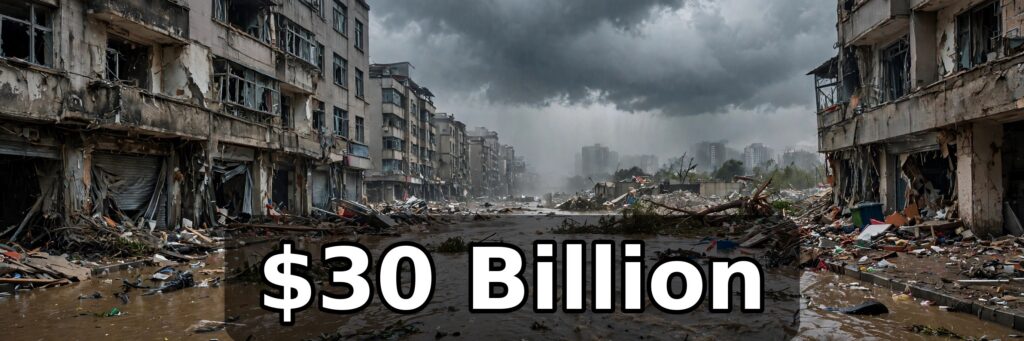
China’s $30 Billion Disaster Bill: How Much Came From Typhoons, Floods, and Landslides?
Reuters, citing Chinese government figures, put direct economic losses from natural disasters in China in the first nine months of 2026 at about $30 billion, a total in which typhoons, floods, and landslides — often striking together — are among the principal drivers, though the headline figure captures direct losses only and not the full human and indirect costs.
Key points
- Direct economic losses from natural disasters in China in the first nine months of 2026 reached about $30 billion, according to Reuters, citing Chinese government figures.
- Direct losses cover physical damage and immediate disruption — not the full societal cost, which would likely be higher if indirect and longer-term losses were included.
- Typhoons, floods, and landslides are often intertwined: one storm can cause wind, surge, flood, and landslide damage in the same event, so a clean breakdown by hazard depends on how events are counted.
- No detailed breakdown was provided in the briefing, so this article explains what the figure means and how the three hazards contribute, rather than inventing one.
When a country tallies the cost of natural disasters, the final figure is more than a number. It is a summary of homes damaged, crops lost, roads washed away, factories disrupted, and communities forced to rebuild. It also reflects how the disasters were counted, what kinds of loss were included, and what kinds were left out.
According to Reuters, citing Chinese government figures, direct economic losses from natural disasters in China in the first nine months of 2026 reached about $30 billion. That figure, attributed to the government announcement, provides a starting point for understanding the scale of the damage — and for asking a more detailed question: how much of that bill came from typhoons, floods, and landslides, the hazards that so often dominate China’s disaster seasons?
This article does not invent a breakdown that the briefing does not provide. Instead, it explains what the headline figure means, how typhoons, floods, and landslides each contribute to disaster losses in China, why those three hazards are so often intertwined, and why the total should be read with an understanding of what “direct economic losses” includes and excludes. Where the government announcement is the source, that attribution is preserved.
What the $30 billion figure represents
| Included in direct economic losses | Usually not included | |
|---|---|---|
| Physical damage | Homes, buildings, and infrastructure damaged or destroyed; crops ruined; livestock lost; machinery and inventory damaged | — |
| Response | Cost of emergency response and immediate repair | — |
| Longer-term costs | — | Lost wages and business income over months of disruption; cost of relocating communities; long-term health effects |
| Intangible losses | — | Psychological impacts; environmental damage that is hard to price; broader effects on supply chains and regional economies |
| Unrecorded losses | — | Damage to informal housing, uninsured property, or subsistence crops that never enter market statistics |
Reuters reported the figure as direct economic losses, citing Chinese government figures for the first nine months of 2026. The phrase “direct economic losses” has a specific meaning in disaster accounting, and it is narrower than the full cost of a disaster to society.
Direct losses typically refer to the monetary value of physical damage and immediate economic disruption that can be measured relatively directly: homes, buildings, and infrastructure damaged or destroyed; crops ruined; livestock lost; machinery and inventory damaged; and the cost of emergency response and immediate repair. They are, in principle, observable and quantifiable after an event, through surveys, insurance claims, government assessments, and reports from affected areas.
That distinction matters for interpreting the $30 billion figure. It is a large sum by any measure, and it signals a very costly nine months. But it is not a complete accounting of everything disasters cost China in that period. The true societal cost, if indirect and intangible losses were fully included, would likely be higher, though by how much is difficult to say without a different kind of assessment.
Why typhoons, floods, and landslides dominate the conversation
China’s geography and climate make it especially exposed to typhoons, floods, and landslides, and those three hazards often occur together, compounding each other’s damage.
Typhoons form over warm western Pacific waters and can make landfall along China’s long southeastern coastline, bringing powerful winds, heavy rain, and storm surge. Even after a typhoon weakens inland, it can continue to bring torrential rain far from the coast, sometimes for days. That rain can cause rivers to overflow, urban drainage systems to be overwhelmed, and slopes to fail.
Floods in China take many forms. River floods occur when prolonged or intense rain swells major rivers and their tributaries. Flash floods occur in smaller catchments, where steep terrain and intense rain can turn a normally small stream into a torrent in hours. Urban floods occur when drainage cannot cope with extreme rainfall, inundating streets, subways, basements, and ground floors. Coastal floods can result from storm surge pushing seawater ashore, especially when surge coincides with high tide or heavy rain.
Typhoons: wind, rain, and surge in one package
Typhoons contribute to disaster losses through at least three distinct mechanisms, each of which damages different kinds of property and infrastructure.
Wind damage is the most visible. Strong gusts can tear roofs from buildings, topple trees and power lines, damage signage and light structures, and disrupt transport. In coastal cities with dense construction, even a typhoon that does not cause catastrophic structural failure can cause widespread damage to windows, cladding, and rooftop equipment, and can leave large areas without power for days.
Rain damage is often more costly than wind damage, especially inland. A typhoon’s rain bands can drop enormous amounts of water over a wide area, and if the storm moves slowly or stalls, that rain can accumulate to dangerous levels. Rivers rise, reservoirs fill, and low-lying areas flood. Agricultural land can be inundated, destroying crops at a critical stage of growth. Industrial areas, warehouses, and transport hubs can be flooded, damaging inventory and equipment.
Storm surge is the third mechanism, and it can be the most dangerous for life, even if its economic footprint is more localised. Surge is the rise in sea level driven by a typhoon’s winds and low pressure, pushing seawater ashore and inundating coastal lowlands. When surge coincides with heavy rain, the water has nowhere to drain, because rivers are already high and the sea is pushing back. Coastal defences, ports, and aquaculture facilities can be severely damaged, and saltwater intrusion can harm farmland and freshwater supplies.
Floods: the most widespread hazard
Floods are, in many years, the largest single contributor to disaster losses in China, because they affect such a wide area and such a diverse range of assets. Unlike a typhoon, which is tied to a specific storm track, floods can result from many different weather patterns: typhoon rain, monsoon rain, convective storms, snowmelt, or a combination of these.
River floods affect agriculture on a vast scale. When major rivers overflow, they can inundate farmland for days or weeks, destroying crops, drowning livestock, and depositing silt or debris that makes fields difficult to restore. They can also damage irrigation infrastructure, rural roads, and village housing, much of which may be less resilient than urban construction.
Landslides: smaller in area, severe in impact
Landslides typically affect a smaller geographic area than floods or typhoons, but their local impact can be devastating, and their economic losses can be disproportionate to the area involved.
A landslide can destroy homes, bury roads, sever rail lines, and damage pipelines or power lines in a single event. In mountainous areas, a road buried by a landslide may be the only connection between a village and the outside world, and reopening it may require extensive clearing, slope stabilisation, and engineering work. The cost of that work, plus the cost of the disruption while the road is closed, can far exceed the value of the land that actually slid.
How the three hazards combine in a disaster season
A typical costly disaster season in China does not consist of isolated typhoons, isolated floods, and isolated landslides. It consists of a sequence of weather systems that produce all three, often in overlapping areas and overlapping time periods.
A typhoon may make landfall, cause wind and surge damage on the coast, and then move inland, bringing heavy rain that causes river flooding and triggers landslides in mountainous areas. A few weeks later, a separate monsoon rain system may cause flooding in a different basin, also triggering landslides. Over a nine-month period, the cumulative effect is a series of events that, taken together, produce a large total, even if no single event accounts for the majority of the losses.
What the figure does not tell us
As useful as the $30 billion total is as a headline, it leaves many questions unanswered, and those gaps should be acknowledged. It does not tell us, on its own, how the losses were distributed geographically. Some provinces may have borne a disproportionate share, while others were relatively spared. That distribution matters for recovery planning, because resources need to go where damage is greatest, not spread evenly.
It does not tell us how losses were distributed by sector. Housing, agriculture, transport, energy, and manufacturing may have been affected very differently, and each sector requires a different recovery strategy. Agricultural losses may require seed, credit, and irrigation repair; housing losses may require temporary shelter and reconstruction; transport losses may require engineering and rerouting.
It does not tell us how many people were affected, displaced, injured, or killed. Economic losses and human impacts are related, but they are not the same. A disaster that causes high economic losses in an industrial area may affect relatively few people directly, while a disaster that causes lower economic losses in a rural area may displace many families and disrupt livelihoods for a long time. Both dimensions matter, and neither should be read as a substitute for the other.
Why disaster costs are rising in many countries, not just China
While this article focuses on China, the pattern of rising disaster losses is not unique to China. In many countries, disaster costs have risen over recent decades, for reasons that go beyond the weather itself.
One reason is exposure: more people, buildings, and economic activity are located in hazard-prone areas than before, because of urbanisation, coastal development, and agricultural expansion. When a hazard strikes a more developed area, the economic losses are higher, even if the hazard itself is no more severe than a similar hazard decades ago.
What happens after the losses are counted
Counting losses is only the first step. The more important question is what happens next: how recovery is funded, how rebuilding is done, and whether rebuilding reduces future risk or reproduces it.
China’s $30 billion disaster bill for the first nine months of 2026, as reported by Reuters citing Chinese government figures, is a stark reminder of the scale of natural disaster risk in a large, geographically diverse country. Typhoons, floods, and landslides are central to that story, because they are the hazards that most often strike together, affect the widest areas, and cause the most widespread damage.
But the headline total should not be read as a precise breakdown, and it should not be read as a complete measure of human suffering or societal cost. It is a government figure for direct economic losses over a specific period, compiled under specific methods, and it captures one dimension of a much larger picture. The question in the title — how much came from typhoons, floods, and landslides? — is the right question to ask, and it deserves a detailed answer based on the government’s breakdown, when that breakdown is published in full. Until then, the responsible answer is qualitative: those three hazards, often intertwined, are among the principal drivers of China’s disaster losses, and any serious effort to reduce future losses must address them together, along with the exposure and vulnerability that turn a hazard into a disaster.
Raina





댓글 0
첫 댓글을 남겨보세요.