
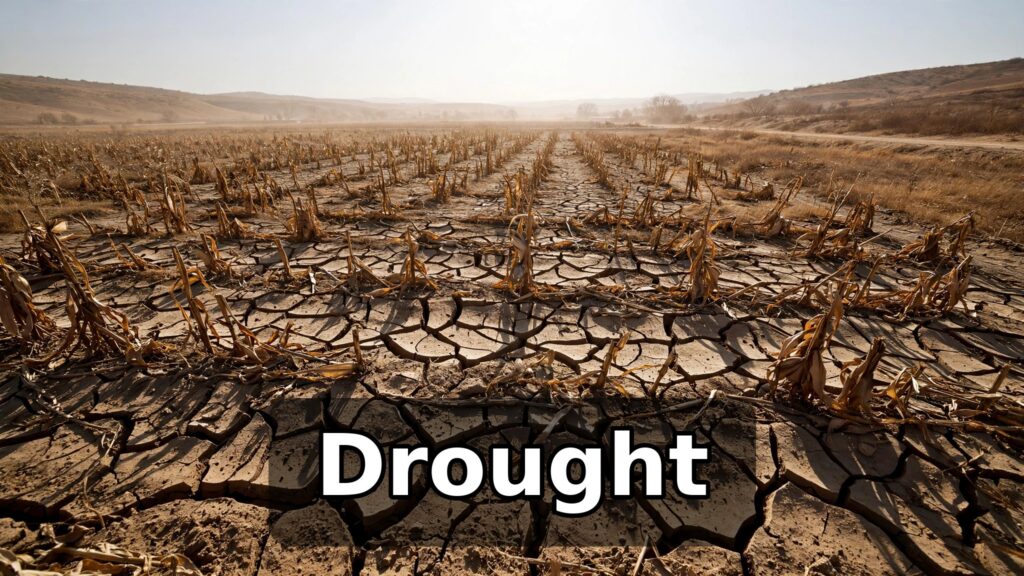
When Drought Destroys Crops: How El Niño Is Deepening Honduras’ Food Crisis
AP reporting from Honduras shows how drought has damaged crops and deepened food shortages, with cloud seeding among the responses — a crisis driven by the natural El Niño phenomenon, which global warming did not cause, meeting subsistence farming communities with little margin for a failed harvest, and one that only water storage, drought-tolerant crops, early warning, safety nets, and insurance can break.
Key points
- El Niño is a natural climate phenomenon, not a product of global warming — but it can still be devastating when it meets a farming system with very little margin.
- Many Honduran small farmers depend on rain to grow the beans and maize that feed their families, with no irrigation system to fall back on.
- When a harvest fails, families may be forced to sell livestock, tools or land, take children out of school, or migrate — losses that echo for years.
- Cloud seeding can only work when suitable clouds are already present; it is a limited, uncertain supplement, not a drought solution.
In the dry hills of Honduras, a failed harvest is not an abstract statistic. It is an empty field, a family with less to eat, and a debt that cannot be repaid. The Associated Press has reported on how drought has damaged crops across Honduran farming communities, deepening a food crisis that was already severe. At the centre of the story is El Niño, the natural climate phenomenon that periodically warms the Pacific and rearranges rainfall around the world.
The crisis in Honduras is not a story about a single bad season. It is a story about how a natural climate event meets a farming system with very little margin, and how the consequences of one failed harvest ripple through households, communities and markets for years afterward. To understand it, follow the chain from rain to plate — from a field that does not receive water to a family that cannot eat, and from a family’s coping choices to a community’s long-term vulnerability.
What El Niño is — and what it is not
El Niño is a natural part of the climate system. Every few years, the surface waters of the central and eastern Pacific Ocean warm more than usual, and that warming shifts wind and rainfall patterns across the globe. Some regions get more rain than normal. Others, including parts of Central America, often get less.
It is important to be precise here: El Niño is a natural climate phenomenon. Global warming did not create El Niño, and it should not be described as its cause. That distinction does not make El Niño harmless. A natural event can still be devastating, especially when it arrives in a place where people have little margin for a bad season.
The naturalness of El Niño matters for how to think about responsibility and response. El Niño cannot be prevented, and blaming it on a single cause obscures the real question: why does the same natural event produce a food emergency in one place and a dry spell in another? The answer lies not in the Pacific alone, but in the conditions on the ground where the rain does or does not fall. A natural phenomenon becomes a human crisis when it meets vulnerability, and vulnerability is shaped by poverty, infrastructure, institutions and history.
El Niño is also not a single, uniform event. Its strength varies, its timing varies, and its effects vary by region and by season. A strong El Niño may bring severe drought to parts of Central America, while a weaker one may bring only a modest rainfall deficit. The timing matters enormously for farming: rain that fails during planting or during a critical growth stage does far more damage than rain that fails after the harvest.
The subsistence-farming squeeze
For a subsistence farming family, the sequence from drought to hunger is brutally short. Seeds are planted in expectation of seasonal rain. If the rain does not come, the plants wither before they can produce. A family that expected to feed itself from its own field must instead buy food at market prices — prices that rise precisely because so many other families are in the same position. Income falls at the same moment that food becomes more expensive.
If the rain is late, the seed may germinate and then die, or may not germinate at all. If the rain arrives but then stops during a critical growth period, the plants may survive but produce little. If the rain is too little overall, the harvest is meagre even if the plants survive to maturity. Each failure has a different consequence, but all share the same core problem: the investment is lost, and there is no second planting season to recover it within the same year for many crops and regions.
When the rain fails, the harvest fails
The AP’s reporting from Honduras captures this squeeze: damaged crops, deepening food shortages and communities under strain. The damage is not only to one season’s harvest. Farmers who lose a crop may be forced to sell livestock, tools or land to survive, leaving them less able to plant the next season. Children may be taken out of school to work or to help at home. A single drought can therefore echo for years, even if the following season’s rain returns to normal.
The echo works through assets. A farming family owns a small set of productive assets: land, tools, livestock, seed stocks and perhaps a small store of grain. These assets are both a source of income and a buffer against shocks. When a harvest fails, the family may sell an asset to buy food. Selling a chicken or a goat provides cash for a few weeks, but it removes a source of future income, milk, eggs or meat. Selling tools reduces the ability to farm effectively next season. Selling land is the most drastic step, because it removes the family’s means of production itself. Each sale helps the family survive the present crisis, but makes the next crisis harder to survive.
Coping costs: school, health and leaving home
The coping costs of drought extend beyond assets and debt into the fabric of family and community life. When a harvest fails, families make difficult choices, and those choices often fall hardest on children and on the future.
Children leaving school is one of the most consequential coping costs. A family that cannot feed itself may take a child out of school to work — in the fields, in informal labour or in domestic work — to earn income or to help at home while adults seek work elsewhere. Even a temporary withdrawal from school can have lasting effects: a child who misses a season of schooling may fall behind, may not return, or may return to a grade where they are older than their classmates and more likely to drop out. Education is one of the few pathways out of subsistence vulnerability, and drought can interrupt it at exactly the moment when the family needs it most.
Health costs are another dimension. Families may reduce spending on healthcare, delay treatment or forgo medicines to save money for food. Malnutrition weakens resistance to disease, so illness may rise at the same time that healthcare becomes less affordable. Water scarcity, which often accompanies drought, can also affect hygiene and sanitation, increasing the risk of diarrhoeal disease and other water-related illness.
Cloud seeding and the search for relief
Faced with failing rains, Honduran authorities have turned to cloud seeding — a technique that attempts to encourage rainfall from existing clouds by dispersing particles into them. The AP has reported on these efforts as part of the country’s response to the crisis. Cloud seeding is a measure of how serious the situation has become: when the sky will not deliver rain on its own, governments look for ways to coax it down.
It is worth being honest about what such measures can and cannot do. Cloud seeding can only work when suitable clouds are already present, and its effects are local and uncertain. It is not a substitute for rainfall, and it cannot fix a drought on its own. For the families waiting on rain, it is at best a supplement to the deeper work of building resilience: water storage, drought-resistant crops, irrigation and social safety nets that keep people fed when a harvest fails.
Why some countries suffer more
Drought does not strike all countries equally, even when the climate pattern is the same. Honduras is vulnerable for reasons that go beyond weather. Poverty limits what families can do to prepare. Infrastructure for storing and moving water is limited. Many farmers work small plots with little access to credit, insurance or technical support. When a shock arrives, there is very little buffer between a bad harvest and hunger.
This is why the same El Niño event can mean a dry summer in one country and a food emergency in another. The climate provides the trigger, but poverty, infrastructure and institutions determine how far the damage spreads. Addressing a food crisis therefore means addressing more than the weather. It means asking why some communities are left so exposed in the first place.
What recovery really requires
Short-term food aid can keep people alive through the worst months, and it matters enormously. But aid alone does not break the cycle. Breaking it requires investment in the things that make the next drought survivable: reliable water supplies, crops that tolerate dry conditions, early warning systems that give farmers time to adjust planting, and financial tools that let a family survive one bad season without losing everything.
Water storage is foundational. That includes large-scale storage such as reservoirs, but also small-scale, community-level storage: rainwater harvesting tanks, small ponds, and soil management practices that help soil retain moisture. Water storage allows a community to capture water when it is available and use it when it is not, smoothing the variability of rainfall.
Drought-tolerant crops are another key measure. Crop varieties bred or selected for tolerance to dry conditions, shorter growing seasons or heat can produce a harvest where traditional varieties fail. But drought tolerance is not a magic trait. A drought-tolerant variety may yield less in a good year than a traditional variety, creating a trade-off that farmers must weigh. Successful introduction therefore requires not just seed, but advice, demonstration and market access.
Early warning is a third measure, and one that is often undervalued. A forecast that reaches farmers in time, in a form they can use, allows them to adjust: to plant earlier or later, to choose a different crop or variety, to reduce the area planted to conserve seed, or to stagger planting to spread risk. Early warning is only useful if it is trusted, timely and actionable.
Safety nets are a fourth measure. These include cash transfers, food assistance, school feeding programs and public works programs that provide income during a crisis. Safety nets prevent families from selling productive assets or taking children out of school to survive a bad season. They preserve the family’s capacity to recover.
A crisis that is also a warning
The food crisis in Honduras is, at its heart, a story about a natural climate event meeting human vulnerability. El Niño did not have to cause hunger. It caused hunger because the people in its path had so little to fall back on. That is the part of the story that can change.
As the world watches drought deepen food crises in vulnerable regions, Honduras offers a clear lesson. Preparing for the next dry season cannot wait until the rain has already failed. The time to build resilience is during the good years, when there is still something to build with. El Niño will return. It always has. The question is whether the next time it does, Honduran farming families will face it with more protection than they have now.
The lesson extends beyond Honduras. The countries and communities that fare best will not be those that were lucky enough to escape El Niño’s effects. They will be those that treated El Niño as a recurring reality, invested in water, crops, warning and safety nets during the good years, and protected their most vulnerable people from having to choose between eating today and farming tomorrow.
Raina





댓글 0
첫 댓글을 남겨보세요.