
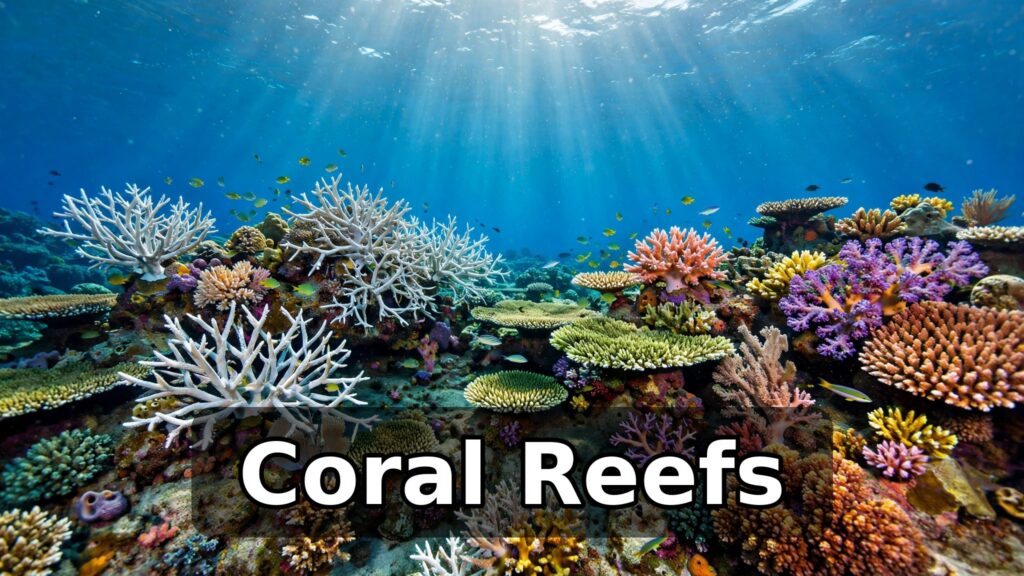
Could 96% of the World’s Shallow-Water Coral Reefs Face Collapse by 2075?
Citing an IUCN assessment, The Guardian reports that 96% of shallow-water coral reef ecoregions fall into a severe-risk category once warming impacts are factored in — a risk classification, not a prediction that 96% of coral will be gone by a date, with 2075 as the risk horizon — and whether that risk becomes functional collapse depends on slowing warming, reducing local stressors, and giving reefs time to recover between bleaching events.
Key points
- An IUCN assessment cited by The Guardian finds that, once warming impacts are factored in, 96% of shallow-water coral reef ecoregions fall into a severe-risk category.
- The year 2075 frames the horizon of that risk, not a scheduled day of collapse.
- Repeated bleaching is the central mechanism: corals can survive one event, but shrinking recovery windows leave them weaker each time.
- Local protection can buy time, but restoration works at a small scale compared with the size of the problem and cannot substitute for slowing warming.
Coral reefs occupy a tiny fraction of the ocean floor, yet they support an extraordinary share of marine life and protect the livelihoods of coastal communities around the world. Now a stark assessment, cited by The Guardian, has put the scale of the threat in plain terms: factoring in the impacts of warming, 96% of the world’s shallow-water coral reef ecoregions fall into a severe-risk category.
The question that follows is sobering. If nearly all of these reef regions are at severe risk, could most of the world’s shallow-water coral reefs face collapse by 2075? The question deserves careful handling, because it is easy to hear it as a prophecy and harder to hear it as what it actually is: a warning about risk, measured across regions, over a horizon that still leaves room for action.
What the assessment actually says
Precision matters here, because the headline number is easy to misread. The Guardian cited an assessment by the International Union for Conservation of Nature (IUCN). Its finding is that, once warming impacts are factored in, 96% of shallow-water coral reef ecoregions fall into a severe-risk category. That is a statement about risk across reef regions, not a prediction that 96% of all coral will be gone by a particular date.
Ecoregions are broad areas defined by their distinctive marine life and conditions. Saying that nearly all of them are at severe risk means the danger is not confined to a few unlucky reefs. It is widespread, touching the tropical and subtropical coasts where reefs have built their structures over thousands of years.
Why warming hits reefs so hard
Corals are animals that live in a delicate partnership with tiny algae inside their tissues. The algae photosynthesise and share energy with the coral, and in return the coral provides shelter and nutrients. This partnership works within a narrow range of conditions, and temperature is the critical one. When ocean water stays too warm for too long, corals expel the algae. The coral turns white — a process called bleaching — and, if the stress lasts, it starves.
A single bleaching event does not have to be fatal. Corals can recover if temperatures fall and conditions improve. The problem is repetition. When bleaching returns again and again, with too little time to recover in between, reefs weaken, growth slows, and the living structure that other species depend on begins to break down.
Recovery windows are therefore the hidden variable in reef survival. It is not only the peak temperature of a heat event that matters, but the interval between events. As warming makes marine heat waves more frequent, longer and more widespread, those intervals shrink. The result is a ratchet effect: each event leaves the reef slightly weaker, and the next event pushes it slightly further down, until the structure that took centuries or millennia to build can no longer maintain itself.
Warming does not only bring hotter water. It also brings stronger storms that can smash reef structures, and it changes ocean chemistry in ways that make it harder for corals to build their skeletons.
Ocean acidification: the slower pressure
Warming is the most visible threat to reefs, but it is not the only one that comes from the same source. As the ocean absorbs carbon dioxide from the atmosphere, its chemistry changes. The water becomes more acidic, which makes it harder for corals and other calcifying organisms to build and maintain their calcium carbonate skeletons.
For corals, acidification means growth slows and skeletons become weaker and more fragile. A reef that is growing slowly is less able to keep pace with erosion, storm damage and sea-level change. It is also less able to recover from bleaching, because rebuilding requires energy and materials that are harder to obtain in more acidic water. Warming delivers the acute shocks. Acidification erodes the capacity to recover from them.
What reefs do for the rest of us
It is easy to think of coral reefs as beautiful but remote, something that matters mainly to divers. Their real value is far more practical. Reefs act as natural breakwaters, absorbing wave energy and protecting coastlines from erosion and storm damage. They are nurseries and feeding grounds for a vast number of fish species, including many that coastal fishing communities depend on for food and income. They also support tourism that sustains entire local economies.
When a reef degrades, those services degrade with it. Fish move away or decline. Coastlines become more exposed. A community that once relied on the reef for protection, food and income finds all three under pressure at the same time.
Biodiversity is the foundation beneath all of these services. Reefs support an extraordinary diversity of species, many found nowhere else. That diversity is what makes the reef system resilient: different species perform different roles, and when one species declines, others may compensate. As diversity falls, that resilience falls with it.
Local stressors: pollution, overfishing and physical damage
Global warming is the central driver of reef risk, but it is not the only pressure reefs face. Local stressors — pollution, overfishing and physical damage — matter enormously, because they determine how well a reef can withstand warming and recover from bleaching.
Pollution comes in many forms. Sediment washed from land after deforestation or construction smothers corals, blocking light and clogging their feeding structures. Nutrients from sewage and agricultural runoff fuel algal growth that can overgrow corals and deplete oxygen. Chemical pollutants, including some sunscreens and industrial discharges, can stress or poison corals directly. Each of these pressures weakens corals, making them more susceptible to bleaching and less able to recover.
Overfishing disrupts the reef’s ecological balance. Many reef fish graze on algae, keeping it from overgrowing corals. When those grazers are removed, algae can take over, especially after a bleaching event when corals are already weakened. Destructive fishing practices — using explosives, poisons or heavy gear that breaks coral — cause direct physical damage that can take decades to repair.
The hopeful implication is that local stressors are, in principle, more controllable than global warming. A community, a government or a tourism operator can reduce pollution, enforce fishing limits and prevent physical damage in ways that directly improve a reef’s chances. Local action cannot substitute for slowing warming, but it can buy time and preserve the reefs most likely to survive and seed future recovery.
Restoration efforts and their limits
Scientists, conservationists and coastal communities have developed a range of restoration efforts. These include growing corals in nurseries and transplanting them onto degraded reefs, breeding or selecting heat-tolerant corals, creating artificial structures that provide habitat while natural reefs recover, and establishing marine protected areas where fishing and other pressures are limited.
These efforts are promising, and they have produced real successes at local scales. Coral gardening can restore patches of reef, reintroduce species and maintain genetic diversity. Heat-tolerant coral breeding may help reefs cope with warmer water, at least for a time. Protected areas can allow fish populations to recover and algal overgrowth to be controlled.
But their limits must be stated plainly. Restoration works at a small scale compared with the size of the problem. Reefs cover vast areas across tropical and subtropical coasts, and restoration projects typically cover fractions of that area. Growing and transplanting corals is labour-intensive and expensive, and transplanted corals face the same warming, acidification and storm pressures as natural corals. If a marine heat wave bleaches a restored reef as it bleaches a natural one, the restoration effort is set back along with everything else.
What collapse means, functionally
“Collapse” in this context does not mean every coral suddenly dying overnight. It means the reef system losing its structure and function: the coral cover that builds the habitat thins out, the diversity of species it supports falls away, and the reef stops providing the protection and productivity that people and wildlife rely on. A collapsed reef may still have some life on it, but it no longer works as a reef.
That distinction matters because it leaves room for action. A reef at severe risk is not yet a lost reef. Recovery is possible where local pressures are reduced, and where global warming is slowed enough to give corals time to adapt and regrow. But recovery takes years, and it cannot happen if bleaching keeps returning faster than reefs can heal.
Functional collapse is gradual: first the most sensitive corals die, then the structure begins to erode, then the fish that depend on complex structure leave, then algae take over, and finally the reef becomes a flat, algae-dominated surface that provides little shelter, little fisheries productivity and little coastal protection. Early in decline, reducing local pressures may restore function. Late in decline, when structure has eroded and key species are gone, restoration becomes far more difficult. Prevention is far more effective than cure, and early action matters more than heroic restoration after collapse.
Can the 2075 outlook change?
The 2075 horizon in the assessment is a warning, not a verdict. Reducing greenhouse gas emissions is the only measure that addresses the root cause, since warming water is the central driver of the risk. Local protection matters too: marine protected areas, limits on destructive fishing and cleaner coastal water all give reefs a better chance of surviving heat stress and recovering afterward.
Changing the outlook requires action on two timescales at once. In the short term, local protection and restoration can preserve the healthiest reefs and maintain the conditions for recovery. In the longer term, only slowing warming can change the trajectory that puts almost all reef ecoregions at severe risk. A reef protected locally but subjected to ever-hotter water will still bleach. A world that slows warming but continues to pollute and overfish its reefs will still lose them to local pressures. Both tracks are necessary, and neither alone is sufficient.
There is also a question of equity. The communities most dependent on reefs are often those least responsible for the emissions driving warming, and least equipped to fund large-scale protection or restoration. International support for marine protection, sustainable fisheries, water quality and adaptation is therefore a recognition that reef decline is a shared problem with unevenly distributed costs.
A risk that covers almost everywhere
The most striking part of the IUCN assessment is not any single reef’s fate. It is the breadth. When 96% of shallow-water reef ecoregions fall into a severe-risk category, the message is that there is almost nowhere left that is safe by default. The reefs that survive will be the ones that are actively protected and given the conditions to recover.
Could most of the world’s shallow-water coral reefs face collapse by 2075? On the current trajectory, the assessment suggests the risk is real and widespread. Whether that risk becomes reality depends on choices made now — about emissions, about ocean protection, and about how much value societies place on ecosystems that, quietly and without fanfare, feed and protect hundreds of millions of people.
Protecting reefs is not a niche conservation concern. Reefs are an early indicator of ocean health, because they are so sensitive to temperature. Their decline signals changes that will affect fisheries, coastlines and marine ecosystems far beyond the reefs themselves. The decision is not only about reefs. It is about what kind of oceans, coastlines and food systems societies want to live with.
Raina





댓글 0
첫 댓글을 남겨보세요.