
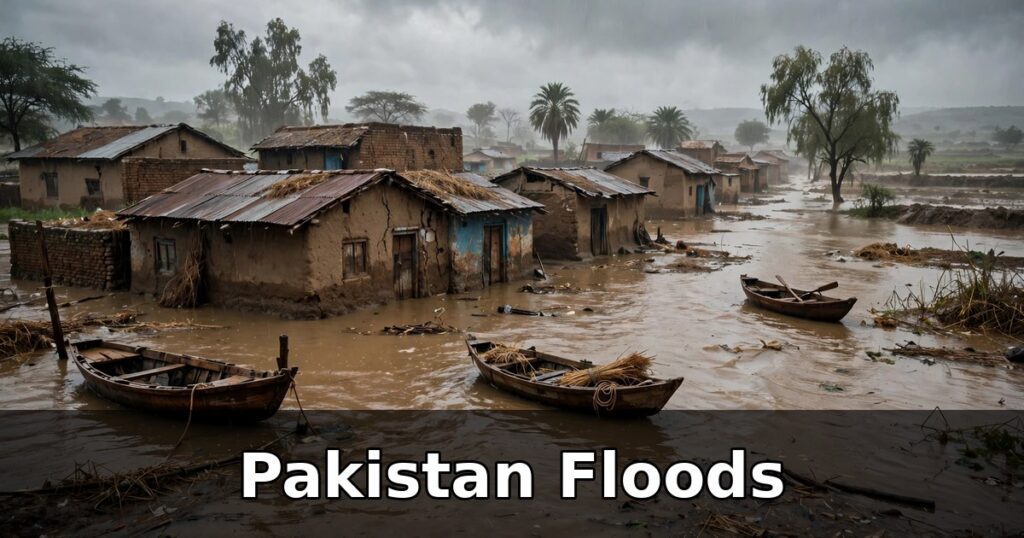
Pakistan Floods Struck Again Within Three Years—Why Do Poorer Communities Face Longer Recoveries?
Pakistan was flooded catastrophically in 2022, and it was flooded catastrophically again in 2025, and the interval between those two disasters, just three years, is the key to understanding why recovery has been so uneven and why the poorest communities have fallen furthest behind.
Key points
- Pakistan was flooded catastrophically in 2022 and again in 2025, just three years apart, before recovery from the first flood was complete.
- The 2022 floods affected 33 million people, killed 1,739, and damaged or destroyed around 1.7 million homes.
- The 2025 monsoon killed 1,006 people, including 275 children, displaced around three million people, and affected more than 6.9 million people.
- About 12.4 percent of the grid cells studied — 10,637 cells — were flooded in both 2022 and 2025, concentrated in the lower Indus basin in Sindh.
Pakistan was flooded catastrophically in 2022, and it was flooded catastrophically again in 2025, and the interval between those two disasters, just three years, is the key to understanding why recovery has been so uneven and why the poorest communities have fallen furthest behind.
According to UNICEF’s Pakistan floods update of 26 September 2025, monsoon flooding that began on 26 June 2025 caused 1,006 deaths, including 275 children, and displaced around three million people, with Khyber Pakhtunkhwa and Punjab the hardest-hit provinces. A later UNICEF situation report covering January to September 2025 put the wider toll even higher, with more than 1,000 lives lost, over 6.9 million people affected, and more than 229,700 homes damaged.
A new study by Sughra, Siriporn Darnkachatarn, and Yoshio Kajitani, published in 2026 in Environmental and Sustainability Indicators as article 101544 under the title Flood recovery inequality in Pakistan, provides the explanation, using satellite data and a relative wealth index to show that the poorest communities not only suffered more severe damage but also recovered more slowly, and that a second flood struck before the first recovery was anywhere near complete.
The 2022 flood
The 2022 monsoon floods, described by the researchers as the most severe in Pakistan’s recorded history, affected 33 million people, killed 1,739, and damaged or destroyed around 1.7 million homes. A Post-Disaster Needs Assessment led by Pakistan’s Ministry of Planning, with the Asian Development Bank, the European Union, United Nations agencies, and the World Bank, estimated total damages exceeding 14.9 billion dollars and total economic losses of about 15.2 billion dollars, with rehabilitation and reconstruction needs of at least 16.3 billion dollars.
Housing, agriculture and livestock, and transport and communications suffered the most significant damage, at 5.6 billion, 3.7 billion, and 3.3 billion dollars respectively, and Sindh was the worst-affected province, with close to 70 percent of total damages and losses. The World Bank also warned that the floods would push an additional 8.4 to 9.1 million people into poverty, raising the national poverty rate by 3.7 to 4.0 percentage points.
That prediction captures a central mechanism: a flood does not merely destroy things that can be rebuilt, it destroys the income, savings, and assets that would have paid for rebuilding, most completely for people who had the least to begin with. A wealthy household that loses a house may have insurance, savings, or relatives who can lend money; a poor household that loses a mud-brick house, a season’s crop, and a few head of livestock may lose, in a single week, everything it had accumulated over a decade.
The 2025 flood on unfinished recovery
The 2025 flood arrived on top of that unfinished recovery, and its geography was different enough to matter. While the 2022 floods centred on Sindh and Balochistan, the 2025 monsoon shifted northward into Punjab and Khyber Pakhtunkhwa, with riverine flooding in Punjab described by UNICEF as the province’s worst flooding in 40 years, and with glacial lake outburst floods and landslides adding to the toll in Gilgit-Baltistan and Khyber Pakhtunkhwa.
Khyber Pakhtunkhwa reported 504 deaths and Punjab 304 deaths by late September. A rapid needs assessment in Punjab identified 4.2 million people affected and 2.8 million displaced in 18 targeted districts, while one in Khyber Pakhtunkhwa identified over 1.57 million people affected, with critical gaps in nutrition, education, and water, sanitation, and hygiene services.
The study puts the 2025 totals at about 6.9 million people affected and around three million displaced, with about 1.12 million hectares of crops submerged in Punjab and about 230,000 homes and 4,700 villages inundated. About 12.4 percent of the grid cells examined, 10,637 cells, were affected by both floods, concentrated largely in the lower Indus basin in Sindh. For those places, the second flood was not a new disaster starting from a recovered baseline; it was a second blow landing on communities still in the middle of a slow and incomplete recovery.
How the study was done
The researchers analysed 85,533 grid cells covering roughly 379,000 square kilometres, each cell averaging about 4.4 square kilometres, or about 2.1 kilometres on a side — fine enough to distinguish one floodplain village from a wealthier neighbour a few kilometres away. They combined satellite measurements of nighttime lights, a proxy for economic activity, vegetation, which captures agricultural health, and population exposure, alongside a Relative Wealth Index derived from machine learning, and they used radar-derived flood maps to identify which cells were actually inundated.
Critically, they did not simply compare flooded areas with unflooded areas, because floods do not strike random locations: floodplains are low-lying, often poorer, and often more agriculturally dependent than higher ground. Instead, they used propensity score matching, matching each flooded cell to statistically comparable unflooded cells based on pre-flood population density, cropland fraction, built-up fraction, elevation, and three years of nighttime light baselines.
That matching allows the study to speak with more confidence about the causal contribution of flooding to losses and slower recovery, although the authors cautioned that affected and comparison areas were already following different trends before 2022, and that figures such as population exposure should not be read as simple causal effects without that context.
What the study found
Flooded areas experienced about 29 percentage points more vegetation loss than comparable non-flooded areas after the 2022 floods, with especially severe impacts in agricultural parts of Sindh and Balochistan, and about 37.3 percent of the population in flooded grid cells was directly exposed to inundation in 2022. Balochistan recorded the largest vegetation loss of any province in 2022, at 66 percentage points, reflecting both the severity of flooding there and the fragility of vegetation in an arid province where a single season’s growth is hard to replace.
Provincial recovery patterns diverged sharply afterwards: Punjab showed steadily improving economic activity by 2024, as measured by nighttime lights, while Sindh, hit hardest in 2022, had effectively no economic recovery by 2023 and stayed negative through 2025. The province that lost the most also recovered the least, and the gap widened rather than narrowed. The wealth gradient ran through all of these patterns: poorer areas suffered bigger losses and recovered more slowly, and that pattern held in every year checked.
How the two floods compare
| Measure | 2022 floods | 2025 floods |
|---|---|---|
| People affected | 33 million | More than 6.9 million |
| Deaths | 1,739 | 1,006 (including 275 children) |
| Homes damaged or destroyed | About 1.7 million | More than 229,700 damaged; about 230,000 inundated |
| People displaced | — | Around 3 million |
| Total damages | More than 14.9 billion dollars | — |
| Economic losses | About 15.2 billion dollars | — |
| Reconstruction needs | At least 16.3 billion dollars | — |
| Worst-affected provinces | Sindh and Balochistan | Punjab and Khyber Pakhtunkhwa |
Why poorer households recover more slowly
First, housing quality and location. Poor families are more likely to live in low-lying areas close to rivers and canals, because land there is cheaper, and in houses built of mud brick or other materials that dissolve or collapse when inundated, whereas wealthier families are more likely to live on higher ground in brick or concrete houses that can be dried out and repaired. When the water recedes, the wealthier house needs repair; the poorer house needs complete reconstruction, which costs more relative to the household’s resources even if it costs less in absolute terms.
Second, livelihood. Poor rural households depend disproportionately on agriculture and daily wage labour, both destroyed by flooding in ways that office or salaried work is not: a submerged crop cannot be harvested later, a drowned animal cannot be milked next week, and a labour market that depends on fields being workable collapses until the fields drain and dry.
Third, finance. Poor households have less savings, less access to formal credit, and less insurance, so they borrow informally at high interest, sell productive assets such as livestock or tools to survive, and thereby reduce their capacity to earn in the following season, a downward spiral economists call asset depletion.
Fourth, public services. Floods damage schools, health facilities, roads, and water systems, and poorer districts, which already had thinner services, lose a larger share of what they had and wait longer for it to be restored, because reconstruction funding tends to flow first to places with stronger administrative capacity to apply for it and oversee contracts. UNICEF’s 2025 reporting illustrates this concretely: the floods disrupted essential health services for millions, damaged health facilities, disrupted nutrition centres, and put thousands of children at risk of malnutrition.
Where investment should go first
The researchers identified six persistently flood-affected, low-wealth districts in the lower Indus basin — Kambar Shahdadkot, Jacobabad, Kashmore, Larkana, Dadu, and Shikarpur — as priority targets for recovery and resilience investment, arguing that disaster risk management must explicitly plan for sequential floods, with pre-positioned financing and adaptive infrastructure designed to shorten recovery windows between events.
Pre-positioned financing means money already allocated and ready to move before the next flood. Adaptive infrastructure means houses, roads, and embankments designed to be repaired quickly and cheaply after the next flood.
What is still uncertain
The comparisons are not simple cause and effect. Affected and comparison areas were already following different trends before 2022, and population exposure should not be read as a simple causal effect without that context.
Nighttime lights are a proxy, not a direct measure of income. They track economic activity visible from space across 85,533 cells, but they do not capture informal work, remittances, or household savings directly.
Pakistan contributes less than one percent of global greenhouse gas emissions, yet ranks among the most climate-vulnerable nations. The monsoon that flooded Pakistan in 2022 and again in 2025 was intensified by a warmer atmosphere capable of holding more moisture and by warmer seas that supplied that moisture, and the communities that paid the highest price had contributed least to it and had the fewest resources to adapt. That does not absolve domestic institutions of responsibility for land-use planning, embankment maintenance, early warning, and reconstruction, but recovery cannot be treated as purely local rebuilding in the same places in the same way.
The bottom line
Why do the poorest communities recover the slowest? Because they start from less, lose proportionally more, live in weaker houses on lower ground, depend on livelihoods that floods erase completely, borrow at higher cost to survive, sell the assets they would need to earn again, and wait longest for public services to return, and because, in Pakistan’s lower Indus basin, the second flood arrived before the first recovery had finished, turning a slow recovery into a cumulative one.
The satellite record assembled by Sughra and colleagues makes that story visible at a scale household surveys alone could not, by showing, cell by cell, how vegetation and nighttime lights diverged between flooded and comparable unflooded places, how Sindh’s economic activity stayed negative through 2025 while Punjab’s improved, and how the same low-wealth districts appear, flood after flood, at the bottom of the recovery distribution. Recovery is not a single event that happens after a flood, but a race against the next flood, and the poorest communities are losing that race not because they work less hard to rebuild, but because the race is run on unequal ground, with unequal starting points, and with an ever-shorter interval between starting guns.
Raina





댓글 0
첫 댓글을 남겨보세요.