
Greenland’s Ice Slabs Are Trapping Meltwater—Where Does That Water Go?
It sounds like a contradiction, and in a sense it is the kind of contradiction that makes Greenland so difficult to model.
Key points
- Ice slabs underlie around 150,000 square kilometres of the Greenland ice sheet, with a wide range of about 60,000 to 220,000 square kilometres.
- Between 2017 and 2022, slabs made it possible for 56 gigatons of meltwater to refreeze — more than the 43 gigatons of glacier ice in the entire Swiss Alps.
- Across the ice sheet, 40 to 50 percent of melt has refrozen in firn in recent decades.
- The visible runoff area has expanded by 29 percent in the past four decades, mainly along the western and northern flanks.
It sounds like a contradiction, and in a sense it is the kind of contradiction that makes Greenland so difficult to model. The ice sheet is losing mass, the Arctic is warming fast, and summer meltwater is visibly carving rivers across white terrain that once seemed permanent. Yet beneath the surface, in a band where snow has not yet become solid glacier ice, meltwater is meeting a barrier it helped to create, slowing down, and in many cases freezing again before it ever reaches the ocean.
A study published in Nature Communications in 2025 by Andrew Tedstone, Horst Machguth, Nicole Clerx and colleagues asks what that barrier really does, and its answer complicates a story that had begun to look straightforward. The barrier is a slab of ice, metres thick and almost impermeable, and it is both a runoff surface and a refreezing surface at the same time.
A sponge of snow and firn
To understand why that matters, picture Greenland not as a single block of ice but as a layered system with a history written in snow. Each winter adds a layer of snow. Over years, that snow compacts into firn, a porous, granular material that still contains air spaces, and eventually into dense glacier ice. In the higher, colder interior, firn acts like a sponge. When summer meltwater forms at the surface, it can percolate downward into the pore space, refreeze there, and remain part of the ice sheet rather than running off to the sea.
According to surface mass balance modelling cited in the paper, 40 to 50 percent of ice-sheet-wide melt has refrozen in firn in recent decades. That refreezing is one of the quiet buffers in the sea-level equation, a process that delays or prevents some melt from becoming ocean water.
When the sponge seals
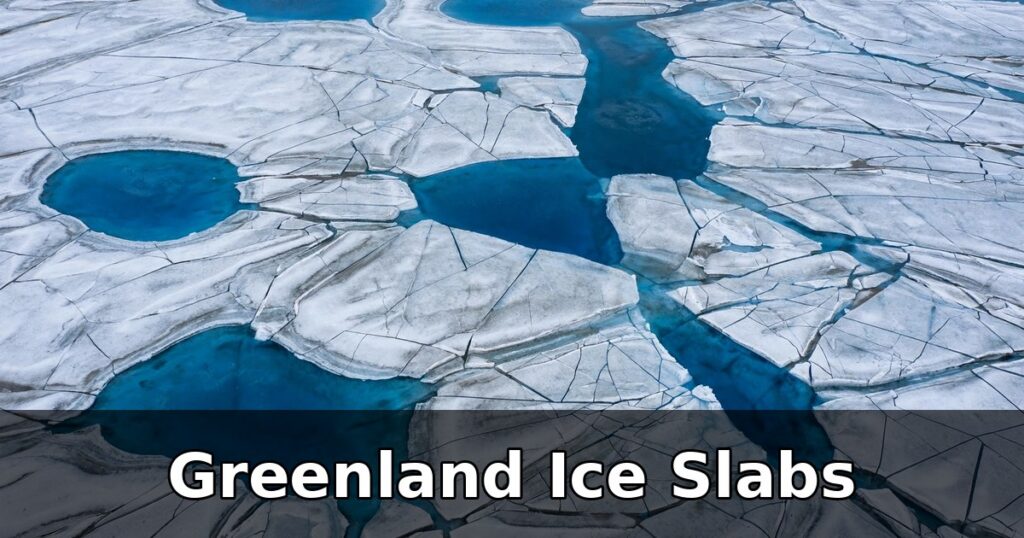
The problem begins when melt becomes too intense, too frequent, or too deep for the sponge to keep working in the same way. In the lower accumulation area, where melting is stronger, repeated percolation and refreezing can fill the pore space near the surface. The result is a slab: a layer of ice metres thick, just below the surface, with very low permeability. Once such a slab forms, water can no longer sink easily through it. Instead, meltwater moves sideways, through snow and firn above the slab, and eventually finds a surface stream or river. That is why earlier work treated ice slabs largely as an accelerator of runoff.
The new study does not overturn that picture entirely, but it adds a second, competing process on top of the slab itself. Field observations show that meltwater percolating through the overlying snowpack and firn does not simply race across a hard surface. It flows laterally through a slush matrix on top of the ice slab, a layer up to several decimetres thick, at speeds ranging from 1.3 to 15.1 metres per hour. That is roughly three orders of magnitude slower than the open river flow that follows, at 1 to 3 metres per second. Slowness matters because time is what allows cold to do its work. A slush matrix sitting on a cold slab can refreeze from the bottom up, building new ice directly onto the slab surface. The authors call this superimposed ice formation, and it is concurrent with runoff rather than separate from it.
Runoff and refreezing together
That dual behaviour is the central finding. According to the University of Lausanne summary, most of the surface meltwater in areas where ice slabs have formed can in fact refreeze before reaching the sea, and the analysis estimates that the slabs made it possible for 56 gigatons of meltwater to refreeze between 2017 and 2022. To give that number scale, the same summary notes that the Swiss Alps in their entirety contain around 43 gigatons of glacier ice. The comparison is not meant to suggest Greenland has somehow gained a Swiss Alps’ worth of ice in a benign way. It shows the refreezing term is not a rounding error, and sea-level accounting that ignores it, or treats every slab-covered area as a pure runoff zone, will misstate how much melt actually leaves the ice sheet.
At the same time, the authors are explicit that this is not good news in any simple sense. Horst Machguth, a co-author based at the University of Fribourg, is quoted as warning that there should be no mistake about the overall direction: the Greenland ice sheet continues to melt and that melting is contributing to rising sea levels in a highly problematic way, and in the future, with the warm temperatures that are expected, the existing slabs will no longer be able to refreeze the meltwater. Refreezing depends on cold. As warming continues, more meltwater arrives, the cold content available to refreeze it is used up earlier, and the balance shifts from trapping to release.
Where the slabs are
According to synthetic aperture radar observations, ice slabs are estimated to underlie around 150,000 square kilometres of the ice sheet, although the estimate carries a wide range, from as little as around 60,000 square kilometres to as much as around 220,000 square kilometres. The visible runoff area, the area drained by surface river networks, has expanded by 29 percent in the past four decades, mainly along the western and northern flanks in areas now underlain by ice slabs.
Slabs are not a curiosity confined to one valley. They occupy a substantial fringe of the accumulation zone, precisely the transition region where the ice sheet changes from a place that mostly stores melt to a place that mostly exports it. A study led by Michael MacFerrin and colleagues, using firn cores, radar observations and regional climate models, showed that recent melt increases had formed metres-thick, low-permeability slabs that expanded Greenland’s total runoff area by 26 percent since 2001, with runoff from ice slabs projected to contribute substantially more to sea level by 2100 under higher emissions. The Tedstone study does not erase that mechanism. It shows that expansion of the runoff area and refreezing on slab surfaces can happen together, and that net runoff depends on how much slow-moving slush actually freezes before it reaches a channel. A map of slabs alone is not a map of runoff.
How the numbers compare
| Measure | Value |
|---|---|
| Ice-slab area (estimate) | Around 150,000 sq km (range about 60,000–220,000 sq km) |
| Melt refrozen in firn, ice-sheet-wide | 40–50% of melt in recent decades |
| Meltwater refrozen on slabs, 2017–2022 | 56 gigatons |
| Glacier ice in the entire Swiss Alps, for comparison | Around 43 gigatons |
| Slush flow speed on slabs | 1.3–15.1 metres per hour |
| Open river flow speed | 1–3 metres per second |
| Visible runoff area expansion, past four decades | 29% |
| Runoff area expansion since 2001 (MacFerrin et al.) | 26% |
Flow versus freezing
That competition is governed by physics easy to state and hard to measure at ice-sheet scale. Meltwater arriving at the slab surface carries heat. The slab and the overlying snow carry cold. If water moves slowly through slush, conduction can remove heat and freeze water onto the slab, thickening it from above. If water moves quickly, or if the volume overwhelms the available cold, it escapes into a stream network and heads for the margin. Temperature, melt rate, snow depth, slab temperature and the geometry of the slush layer all enter the balance.
The 2025 paper combines satellite imagery, physical models of thermal conduction, and on-site measurements to represent that balance, rather than assuming impermeability alone decides the outcome. When slush refreezes onto a slab, the slab grows thicker. A thicker slab can, in a later season, provide an even more effective platform for lateral flow, but it can also provide a cold surface for further superimposed ice formation if conditions remain cold enough. In a strongly warming world, the storage term is expected to shrink, the runoff term to grow, and the slab zone to migrate inland to higher elevations where firn has not yet been sealed.
What is still uncertain
The slab area is a wide estimate. Around 150,000 square kilometres is the central estimate, but the range runs from about 60,000 to 220,000 square kilometres.
Refreezing has a temperature limit. As Machguth warned, with the warm temperatures expected, the existing slabs will no longer be able to refreeze the meltwater. The paper does not give a single year when that threshold is crossed.
A buffer that works until it does not is hard to time. If refreezing on slabs is omitted, a model may overestimate runoff in the near term and then underestimate how abrupt the later increase could be when refreezing capacity is exhausted.
What this means for sea-level accounting
For sea-level accounting, the practical lesson is about timing rather than whether Greenland is melting. It is melting. The question for any given year or decade is how much of the melt that forms at the surface actually leaves the ice sheet, how much refreezes in firn or on slabs, and how much is lost through other routes such as iceberg calving. The 56 gigatons refrozen between 2017 and 2022 should be read as evidence of a process currently active, not as evidence that it will protect coastlines indefinitely.
Greenland is warming around twice as rapidly as the rest of the world, according to the University of Lausanne, a feature of Arctic amplification that brings more frequent and more intense melt events to elevations that once melted rarely. Each intense event can push meltwater deeper into firn, create or thicken slabs, and set up conditions for the next season. The ice sheet carries a memory of past melt seasons in its near-surface structure, literally frozen into the top metres of the ice sheet.
Water delayed, not trapped
In the end, the image to keep is not of water trapped forever, but of water delayed. Meltwater on an ice slab is moving slowly, in a cold, wet layer, with two possible fates. Some of it will freeze and become part of the slab, at least for a time. Some of it will find a stream and begin the long journey to the ocean. The balance between those fates, measured in gigatons over a handful of years, is one of the quiet numbers inside the larger sea-level story. It does not reverse Greenland’s melting, but it does explain why melting and sea-level rise are not linked by a simple, immediate arithmetic, and why a warming ice sheet can, for a while, hold back some of the very water it is producing.
Raina





댓글 0
첫 댓글을 남겨보세요.