
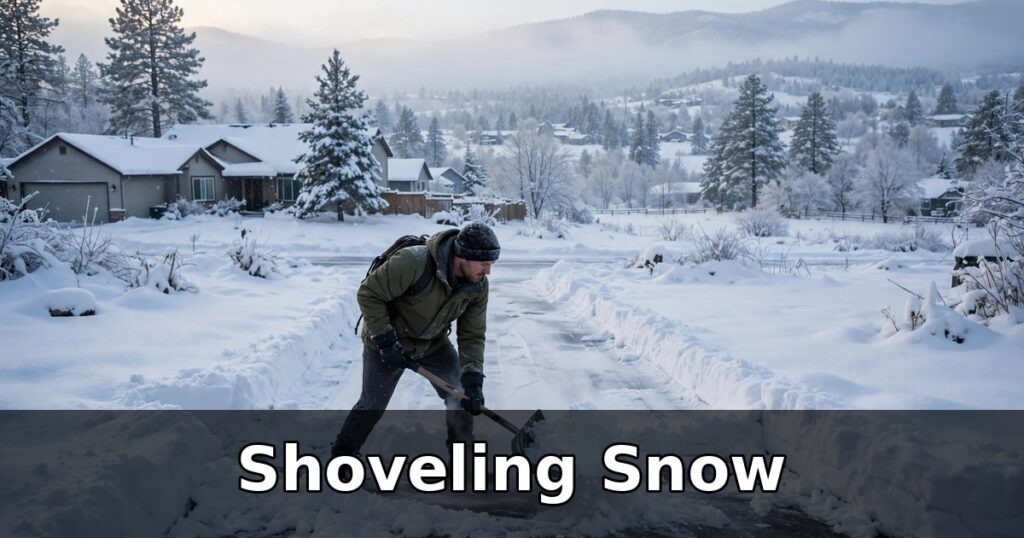
How to Shovel Snow Without Hurting Your Back — or Your Heart
Key points
- Snow shoveling sent about 11,500 people a year to United States emergency departments between 1990 and 2006, and heart problems caused all 1,647 deaths recorded in that period.
- In a classic study, healthy men shoveling heavy snow reached 97% of their maximum heart rate within 10 minutes, with blood pressure higher than during a maximal treadmill test.
- Soft-tissue injuries were the most common diagnosis at 54.7%, and the lower back was involved in 34.3% of cases.
- The safest method is simple: push the snow, take small loads, lift with the legs, never twist while throwing, and take a break every 10 to 15 minutes.
- People who have had a heart attack, stroke, bypass surgery, or angioplasty should not shovel snow, according to the American Heart Association.
Snow shoveling looks like a chore. Physiologically, it is a workout that most people start cold, untrained, and in a hurry. That combination — sudden effort, cold air, heavy loads, and a bent, twisting back — is exactly what makes an ordinary winter task one of the most injury-prone activities of the season.
The back usually gives the first warning. The heart often gives very little warning at all. Both risks can be reduced by changing how the work is done, and by knowing when to hand it to someone else. The advice below is general information, not medical advice. Anyone with heart disease, high blood pressure, diabetes, or a history of back problems should talk with a doctor before the first storm.
The scale of the problem
The most detailed national picture comes from a study of United States emergency department visits from 1990 to 2006 (Watson et al., 2011, American Journal of Emergency Medicine). The researchers estimated about 195,100 visits over 17 years, an average of 11,500 a year — counting only people who went to an emergency department.
Most of those visits were not life-threatening. Soft-tissue injuries — strains, sprains, and pulled muscles — accounted for 54.7% of diagnoses. The lower back was the single most commonly injured body part, involved in 34.3% of cases. Overexertion was the leading cause, at 53.9%, followed by slips and falls at 20.0%.
Heart problems told a different story. They made up only 6.7% of visits, yet they accounted for more than half of all hospital admissions — and for all 1,647 deaths. The National Safety Council gives a similar picture: thousands of injuries and about 100 deaths a year in the United States.
| Finding, 1990–2006 (Watson et al., 2011) | Figure |
|---|---|
| Emergency department visits, total | About 195,100 |
| Visits per year, on average | About 11,500 |
| Soft-tissue injuries | 54.7% of visits |
| Lower back involved | 34.3% of visits |
| Caused by overexertion | 53.9% of visits |
| Heart problems | 6.7% of visits, but all 1,647 deaths |
The pattern is consistent: the back is the most likely thing to hurt, and the heart is the most dangerous thing to strain. The habits that spare the back — smaller loads, slower pace, pushing instead of lifting — also spare the heart.
Why shoveling strains the heart
The danger is not the snow itself. It is the way the body meets it. Cardiovascular researcher Barry Franklin, who has studied shoveling for decades, describes four stressors arriving at once: static exertion, arm-dominated work, breath-holding while lifting, and cold air. The American Heart Association calls the combination a perfect storm. Each stressor raises heart rate or blood pressure on its own. Together, they raise both sharply, in a person who may have been sitting indoors for months.
Static exertion means the muscles contract hard without much movement, as they do when a heavy shovel is held and lifted. Arm work asks more of the heart than leg work carrying the same weight, because the arms are smaller muscles working closer to the chest. Holding the breath and straining spikes blood pressure further. Cold air constricts blood vessels, raising blood pressure again and narrowing the coronary arteries that feed the heart muscle itself. None of this requires a marathon effort. The effort arrives in the first minutes, before the body has warmed up and before the person shoveling has any sense of how hard they are working.
What the research says
The clearest measurements come from a 1995 study in the Journal of the American Medical Association (Franklin et al.). Ten healthy young men who did not exercise regularly cleared heavy, wet snow while researchers measured heart rate and blood pressure, then compared the results with maximal treadmill tests.
After just 2 minutes, heart rates averaged 86% of maximum. After 10 minutes, the average reached 97% of maximum. Peak systolic blood pressure hit 198 mm Hg, higher than the 181 mm Hg on the maximal treadmill test. The work was rated at 6 metabolic equivalents (METs), a vigorous level. In 10 minutes of clearing snow about 5 inches deep, the men moved about 2,000 pounds of snow. A snow blower cut the average heart rate from about 170 beats per minute to about 120.
A larger Quebec study examined 128,073 hospital admissions for heart attack from 1981 to 2014 (Canadian Medical Association Journal, 2017). In men, a day with about 20 centimetres (8 inches) of snow was linked with 16% higher odds of hospital admission for a heart attack the next day, and 34% higher odds of dying from one. The study tracked snowfall, not who shoveled, so it cannot prove cause — but the effect fits a strenuous chore done the morning after a storm.
Why the back fails first
A shovelful of snow is heavier than it looks, and wet snow is the worst of all. The Canadian Centre for Occupational Health and Safety gives a useful example: a shovel weighing just over 1 kilogram, carrying about 5 kilograms of snow every 5 seconds, moves more than 70 kilograms a minute — about 1,000 kilograms in 15 minutes. That is a metric ton of weight lifted, carried, and thrown in a quarter of an hour, mostly by the muscles of the lower back and shoulders.
The back is most vulnerable in exactly the posture shoveling encourages: bent forward at the waist, arms extended, twisting to throw the load aside. Bending loads the discs of the lower spine; twisting while loaded adds shear force. Cold muscles, stiff from sleep and sitting indoors, tear more easily than warm ones.
How to shovel without hurting your back
Warm up first. Five minutes of walking or gentle stretching raises blood flow to cold muscles before they lift. Dress in layers, and wear boots with good traction: falls on ice account for one in five shoveling injuries.
Shovel early and often. Fresh snow is lighter than snow that has been walked on, driven on, or left to absorb rain. Clearing a few inches at a time during a long storm is far easier on the back than waiting for a foot of snow to accumulate and then moving it all at once. If the forecast calls for a foot or more, plan on two or three short sessions instead of one long one.
Push the snow instead of lifting it. When lifting is unavoidable, keep the load small — a half-full shovel is the correct dose. Bend at the hips and knees, not at the waist. Keep the back straight, the chest up, and the shovel close to the body. Lift with the legs, exhaling as the load rises, and never hold the breath and strain.
Never twist and throw. Turn the whole body by stepping the feet toward where the snow is going. Twisting at the waist while loaded is the most common mechanism of shoveling back injuries. Take a short break every 10 to 15 minutes, stand upright, and drink water. Stop for the day if the back starts to ache sharply.
Who should not shovel at all
For some people, the right answer is not better technique. It is not shoveling. The American Heart Association states that people who have had a heart attack or stroke, or who have had bypass surgery or angioplasty, simply should not shovel snow. The same caution applies to anyone over 45 with known or suspected heart disease, high blood pressure, high cholesterol, diabetes, obesity, a history of smoking, or a sedentary lifestyle.
The 1995 study found heart rates near maximum in healthy young men. In an older person with narrowed coronary arteries, the same workload leaves far less margin. The alternatives are straightforward: a snow blower, which roughly halves the energy cost, a paid service, or a neighbourly swap.
Warning signs: when to stop
Chest discomfort is the sign that matters most. Pressure, tightness, squeezing, or pain in the chest, pain spreading to the arm, jaw, or back, shortness of breath, light-headedness, nausea, or an irregular heartbeat during or after shoveling are reasons to stop immediately, sit or lie down, and call emergency services. Do not drive to the hospital. Do not wait to see if the feeling passes.
Back pain has a different threshold. Mild muscle soreness that fades within a day is common after unaccustomed effort. Sudden, sharp pain, pain that shoots down a leg, numbness or tingling, weakness in a leg, or pain that persists for more than a day after shoveling deserves medical attention. Stop shoveling at the first sharp pain, not after finishing the section. Continuing to lift with an injured back turns a strain that might have healed in days into one that lasts weeks.
What is still uncertain
The death count is an estimate, not a census. Deaths at home, hours later, may not be recorded as shoveling-related.
The Quebec study cannot prove cause. It shows that heavy snowfall days are followed by more heart attacks in men. It does not show who shoveled, for how long, or how hard. Cold air alone, stress, and delayed medical care during storms could each contribute to the same pattern.
The classic heart-rate study was small and narrow. Ten healthy young men is a strong design for measuring effort, and a weak basis for generalising to women, older adults, or people with heart disease.
There is no agreed safe time limit. No study has established a duration below which shoveling is safe for a person with heart disease — which is why the guidance for high-risk people is to avoid the task entirely.
What this means
Shoveling is exercise, and it should be treated as exercise. It burns roughly 400 to 500 calories an hour at moderate effort, and it demands a vigorous level of exertion from the first minutes. Nobody would run at near-maximum heart rate, in the cold, without warming up.
The back and the heart are protected by the same habits. Small loads, pushing instead of lifting, legs instead of back, no twisting, and regular breaks reduce the strain on the spine and the demand on the heart at the same time. There is no separate technique for each; there is one careful way of working, and it protects both.
Knowing who should not shovel matters more than perfect technique. Technique reduces risk. It does not remove it. For people with heart disease or multiple risk factors, the safest shovel is the one someone else is holding.
A short routine for the next storm
Check the forecast the night before, and decide who will clear the snow. Warm up for five minutes. Dress in layers and wear grippy boots. Clear a few inches at a time, pushing more than lifting, taking half-full scoops, lifting with the legs, breathing out on the lift, and stepping around instead of twisting. Rest every 10 to 15 minutes. Stop at the first sign of chest discomfort or sharp back pain. The driveway will still be there in an hour. The point of shoveling safely is to be sure the person doing it is, too.
Raina





댓글 0
첫 댓글을 남겨보세요.