
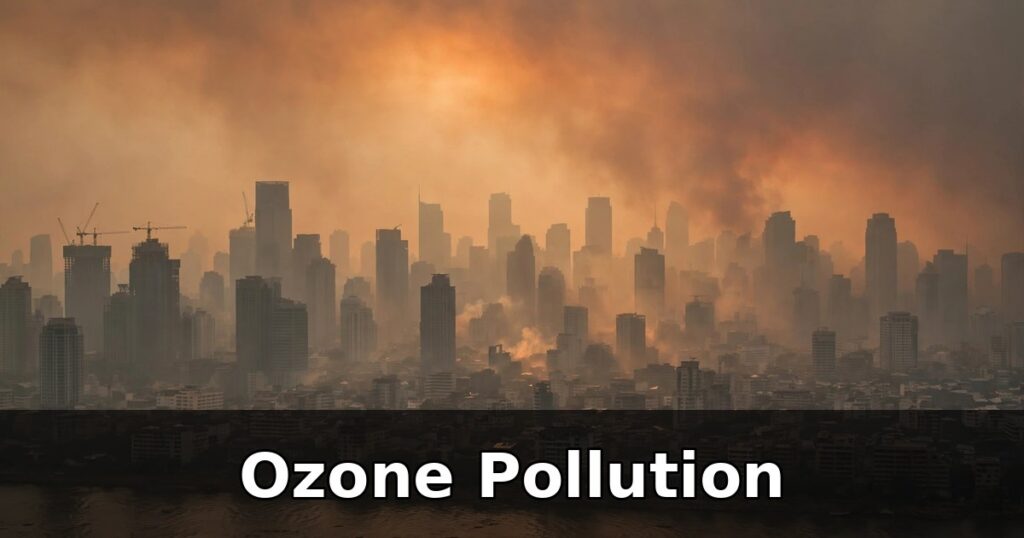
Heat and Smoke Worsened Ozone Pollution for a Third of the World’s Population—How Was the Impact Estimated?
In the autumn of 2026, a European monitoring service published a finding that should have stopped anyone who thinks of air pollution as a local problem in its tracks.
In the autumn of 2026, a European monitoring service published a finding that should have stopped anyone who thinks of air pollution as a local problem in its tracks. According to the Copernicus Atmosphere Monitoring Service, in its inaugural Atmosphere Watch report released on 30 September 2026, about 34 percent of the global population had been exposed to ground-level ozone air quality classified as extremely poor between 1 January and 15 September 2026, with a further 17 percent exposed to very poor conditions and only about 5 percent living with ozone levels classified as good. In Asia, the worst-affected region, 53 percent of the population faced extremely poor ozone and a further 22 percent faced very poor conditions. In North America, about two-thirds of the population were exposed to poor or very poor air quality, and in Europe the corresponding figure was about 45 percent. Only Oceania stood out as a bright spot, with about 66 percent of its population enjoying good ozone levels. The report’s central explanation was not a single new source of pollution but a collision: record-breaking heatwaves and wildfires in Europe and North America, combined with continuing human-caused emissions from vehicles and industry, in a year when a strong El Nino pattern that began in June was expected to peak later in the year and could drive further fires in Southeast Asia. The question the report poses is therefore not only why ozone reached such levels in 2026, but why a pollutant that regulators in Europe have spent decades reducing through emissions controls has proved so stubbornly resistant to those controls, and why heat and smoke can so quickly undo progress made elsewhere.
A Pollutant Made in the Air
The first step toward an answer is to understand what ground-level ozone actually is, because it is unlike most pollutants in a way that makes it harder to control. Ozone is a molecule made of three oxygen atoms, and high in the stratosphere it plays a protective role, absorbing ultraviolet radiation from the Sun and shielding life below. Near the ground, in the troposphere, the same molecule is a pollutant and a primary component of smog. Crucially, ground-level ozone is almost never emitted directly from a chimney or an exhaust pipe. It is a secondary pollutant, formed in the atmosphere itself when sunlight, particularly ultraviolet light, acts on precursor gases, principally nitrogen oxides and volatile organic compounds, in the presence of heat. The main anthropogenic sources of those precursors are transportation and industry, and they are largely associated with urban areas, although carbon monoxide and methane from residential and agricultural sources also play a role, and natural sources contribute as well, including biogenic emissions of volatile organic compounds from vegetation, soil emissions of nitrogen oxides, and wildfire emissions of carbon monoxide. The chemistry takes several hours, which means that ozone concentrations often peak not at the tailpipe but dozens of kilometres downwind of the city that produced the precursors, after the wind has carried the reacting plume across suburbs, farmland and neighbouring regions. A hot, sunny, still day is, as air quality agencies have long explained, the perfect environment for ozone production, and concentrations typically reach their peak in mid to late afternoon, after morning rush-hour emissions have had time to react in sunlight. That delay and that displacement are why ozone is a regional pollutant rather than a street-level one, and why a city can do everything right about its own traffic and still breathe ozone formed from emissions that originated elsewhere, or from fires burning hundreds of kilometres away.
How Heat and Smoke Accelerate It
Heat accelerates this chemistry in several reinforcing ways. Higher temperatures speed up the chemical reactions that form ozone, increase the evaporation of volatile organic compounds from vegetation, fuels and solvents, and often coincide with the stagnant, high-pressure weather that traps air near the surface and prevents pollutants from dispersing. The European Climate and Health Observatory, summarising the meteorological sensitivity of surface ozone, lists faster chemistry at higher temperatures, increased biogenic emissions of volatile organic compounds and nitrogen oxides, and faster photochemistry under stronger solar radiation as factors that push ozone upward, with the effect depending on whether the local atmosphere is rich or poor in nitrogen oxides. Wildfire smoke adds a further, potent ingredient, because fires emit large quantities of nitrogen oxides, volatile organic compounds and carbon monoxide at once, together with particles, and they do so over wide areas and for days or weeks at a time, creating a moving source of precursors that can generate ozone far downwind of the flames. The Copernicus report, as relayed by Agence France-Presse, described exactly this combination in 2026: heatwaves and wildfires combined with human-caused emissions to expose a third of the world’s population to extremely high levels of ozone pollution, with record-breaking heatwaves and wildfires that seared Europe and North America sending smoke well beyond their borders, and major wildfires also reported in Indonesia. When the director of the Copernicus Atmosphere Monitoring Service, Laurence Rouil, said in the report that air pollution does not stop at borders and can travel thousands of kilometres, crossing continents and oceans and affecting air quality far from its source, he was describing not a metaphor but the physical reality of ozone formation: the precursors travel, the chemistry continues en route, and the resulting ozone arrives in places that never produced it.
What Extremely Poor Means for Health
The scale of exposure in 2026 becomes clearer when it is set against the health benchmark that the Copernicus analysis uses. The World Health Organization’s guideline sets 100 micrograms of ozone per cubic metre, averaged over eight hours, as the maximum recommended level of exposure. The extremely poor band in the Copernicus analysis represents concentrations well above that guideline, and a detailed reading of the report’s chart data, published by analysts who examined the underlying figures, places the extremely poor threshold at a peak-season level above 110 micrograms per cubic metre, with the very poor band between 100 and 110, and the good band below 60, using the average of daily highs over the six worst months. Those thresholds matter because they show that the 34 percent figure is not a marginal exceedance of a strict guideline by a few micrograms. It describes a large share of humanity living, for a sustained part of the year, with ozone levels that are not merely above the guideline but well above it, in the band the monitoring service reserves for its worst category. The health consequences of that exposure are well established and are not abstract. Ground-level ozone damages lung tissue, causes breathing problems, triggers asthma attacks and contributes to other health problems, and it does so through a direct irritant effect on the airways, inflaming the lining of the lungs and reducing lung function, with children, older people, outdoor workers and people with existing respiratory conditions among the most vulnerable. Ozone is also a greenhouse gas in the troposphere, and it damages crops and vegetation, reducing yields and weakening plants, so that its burden falls on food systems as well as on lungs.
Why Regulation Has Not Solved Ozone
That health burden is given a stark European dimension by a figure cited alongside the Copernicus release. Ian Marnane, an official at the European Environment Agency, told a media briefing that ozone pollution is linked to about 60,000 premature deaths per year in Europe. The figure should be read as an estimate of the mortality burden associated with ozone exposure, derived from epidemiological relationships and population exposure modelling, not as a count of death certificates naming ozone, and it is best understood as a measure of scale: even in a region with extensive air quality regulation, ozone remains a major cause of premature mortality. The same briefing context carried a paradox that explains much of the 2026 story. European Union regulation has been effective in reducing emissions of many air pollutants, but ozone has remained an exception. That exception is not a mystery once the chemistry is understood. Cutting nitrogen oxides alone does not necessarily cut ozone in a simple linear way, because in nitrogen-oxide-rich urban air, nitrogen oxides can actually suppress ozone locally through a titration effect, so that reducing them can, in some circumstances and in some places, temporarily increase ozone until volatile organic compounds are also reduced and the chemical regime shifts. Cutting emissions in one country does not protect it from ozone formed from precursors emitted in a neighbouring country or from wildfire smoke drifting across a continent. And none of the emissions controls designed for average conditions are calibrated for a summer in which heatwaves push temperatures into the range where ozone chemistry accelerates sharply and fires inject a sudden, massive pulse of precursors into an already warm atmosphere. The result is a pollutant that can improve slowly in average years and deteriorate dramatically in hot, smoky ones, which is precisely what the 2026 analysis appears to capture.
A Geography of Exposure
The geography of the 2026 exposure adds further texture. Asia’s position as the worst-affected region, with more than half its population in the extremely poor band, reflects a combination of large urban and industrial precursor emissions, intense summer heat, and the sheer population density of the region, which means that a given area of poor air quality affects more people than the same area would elsewhere. Cities named in coverage of the report as falling in the extremely poor band include New Delhi, Dhaka, Chongqing and Lahore, a list that spans South and East Asia and underlines that the problem is not confined to a single country or a single source. The North American picture, with two-thirds of the population exposed to poor or very poor conditions, reflects a year in which wildfires and heatwaves interacted with the continent’s own precursor emissions, and the European figure of 45 percent poor or very poor shows that even a region with strong regulation is not insulated when heat and smoke coincide. Oceania’s contrasting result, with two-thirds of its population in the good band, is a reminder that ozone is not uniformly bad everywhere and that lower precursor emissions, different meteorology and lower population density can still produce relatively clean air, but it is the exception that highlights the scale of the problem elsewhere rather than a reassurance about the global trend.
El Nino and the Months Ahead
The forward-looking warning in the report concerns El Nino, and it is worth explaining why a Pacific Ocean warming pattern should matter for air quality in Asia and beyond. El Nino, which the Copernicus analysis says began in June 2026 and was expected to peak later in the year, alters rainfall patterns across the tropics, typically drying parts of Southeast Asia and increasing the risk of drought and fire in Indonesia and neighbouring regions. More fires mean more precursors, and more precursors in a warm atmosphere mean more ozone, not only near the fires but downwind, as the chemistry continues during transport. The report’s warning that the ongoing strong El Nino could prolong episodes is therefore not a vague gesture toward climate variability but a specific mechanism: a climate pattern that dries one region can, through fire and chemistry, degrade air quality in a much larger one, and it can do so for months, extending the ozone season beyond the usual summer peak. That interaction between climate variability and air quality is also why the Copernicus service frames its Atmosphere Watch report as a demonstration that climate change, air quality and public health require coordinated international action. Heatwaves are becoming more frequent and more intense in a warming climate, wildfire seasons are lengthening in many regions, and both trends push ozone formation in the same direction, so that a pollutant that was once treated mainly as a summer urban problem is increasingly a climate-driven, cross-border health problem.
What Counts as Progress
There is a final, less comfortable implication to draw from the 2026 figures, and it concerns what counts as progress. If only about 5 percent of the global population lived with ozone levels classified as good in the first eight and a half months of 2026, then good ozone air is not the norm but the exception, and the goal of bringing the rest of humanity into that band cannot be achieved by any single country’s emissions programme alone. It requires simultaneous reductions in nitrogen oxides and volatile organic compounds, because cutting one without the other can shift the chemistry in unhelpful ways; it requires wildfire prevention and management, because fires are now a major precursor source in their own right; it requires heat adaptation, because the same heatwaves that threaten health directly also manufacture ozone; and it requires international cooperation, because ozone and its precursors cross borders as a matter of physics. The Copernicus Atmosphere Monitoring Service, which tracks air pollution and wildfires using satellite data and computer models, is well placed to document this problem, because satellites can see the fires, the smoke and the ozone across borders in a way that ground monitors alone cannot, but monitoring is not mitigation. The 2026 report is best read as a measurement of a system under stress: a warmer atmosphere, loaded with precursors from vehicles, industry and fires, converting sunlight and heat into a pollutant that reached its worst category for a third of humanity. The chemistry that produced that result is not mysterious, and the measures that would reduce it are not unknown. What the report shows, above all, is how quickly heat and smoke can overwhelm those measures when they arrive together, and how much of humanity now lives in the path of that collision.
Raina





댓글 0
첫 댓글을 남겨보세요.