
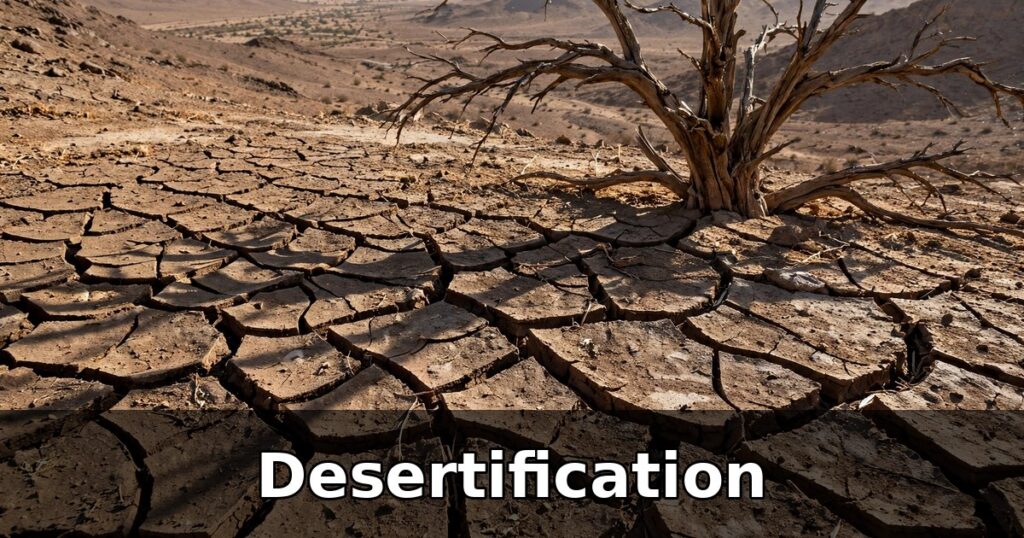
Desertification: When Fertile Land Turns to Dust
There is a particular kind of loss that does not make dramatic headlines. It is not a flood sweeping away a town in a night, or a fire racing through a forest in an afternoon. It is slower, quieter,…
Key points
- 77.6 percent of Earth’s land experienced drier conditions over the last three decades, according to a UNCCD report launched at COP16 in December 2024.
- Drylands expanded by about 4.3 million square kilometres between 1990 and 2020 — nearly a third larger than India — and now cover 40.6 percent of Earth’s land, excluding Antarctica.
- Up to 40 percent of the world’s land is degraded, affecting more than 3.2 billion people.
- At least 2.6 trillion US dollars is needed by 2030 to restore over 1 billion hectares, but only about 77 billion dollars a year is projected against 355 billion needed annually.
There is a particular kind of loss that does not make dramatic headlines. It is not a flood sweeping away a town in a night, or a fire racing through a forest in an afternoon. It is slower and quieter: soil that grows thinner each year, grass that returns more sparsely after each dry season, a field that once fed a family and now barely feeds a goat.
Scientists call the process in drylands desertification, and the related, broader process land degradation. It is not the natural expansion of an existing desert, though it can look like that. It is the degradation of land in arid, semi-arid, and dry sub-humid areas, driven by climate variation, human activity, and increasingly by long-term aridification.
What desertification actually means
The word desertification is misleading, and that misunderstanding has hampered policy for decades. It does not primarily mean that the Sahara or another existing desert is marching outward like an army, swallowing villages in its path, though sand encroachment can occur locally. It means that land that was once productive, in dry regions that were never desert, loses its productivity, its soil, its vegetation, and its ability to retain water, until it functions like desert even if it is not formally classified as one.
The UNCCD defines desertification specifically as land degradation in arid, semi-arid, and dry sub-humid areas, resulting from various factors including climatic variations and human activities. Land degradation more broadly refers to the reduction or loss of the biological or economic productivity of land, through soil erosion, loss of soil organic matter, salinisation, nutrient depletion, and vegetation loss. The common thread is not sand. It is the loss of the living soil system that holds water, cycles nutrients, and supports vegetation.
Aridity is a long-term climatic condition, a measure of how dry a climate is on average, based on the balance between precipitation and evaporation. Drought is different: it is a temporary period of below-average precipitation. As UNCCD Executive Secretary Ibrahim Thiaw has emphasised, droughts end, but when an area’s climate becomes drier, the ability to return to previous conditions is lost.
The scale of drying
| Measure | Figure | Period or scope |
|---|---|---|
| Land experiencing drier conditions | 77.6% | Last three decades |
| Dryland expansion | ~4.3 million sq km | 1990–2020 |
| Drylands’ share of Earth’s land | 40.6% | Excluding Antarctica |
| Land crossing critical aridity thresholds | 7.6% | Humid landscapes becoming drylands |
| World’s land degraded | Up to 40% | Affecting 3.2 billion people |
| Annual finance needed vs projected | $355 billion vs ~$77 billion | 2025–2030 |
The headline figures come from the UNCCD report The Global Threat of Drying Land: Regional and Global Aridity Trends and Future Projections, launched at the 16th Conference of the Parties (COP16) in Riyadh, Saudi Arabia, in December 2024. Its central findings are that 77.6 percent of Earth’s land experienced drier conditions over the last three decades, that drylands expanded by approximately 4.3 million square kilometres between 1990 and 2020, and that drylands now cover 40.6 percent of Earth’s land, excluding Antarctica. The report further indicated that 7.6 percent of global lands crossed critical aridity thresholds, transforming from humid landscapes to drylands.
A separate UNCCD financial needs assessment, also released at COP16, estimated that at least 2.6 trillion US dollars are required by 2030 to restore over 1 billion hectares of degraded land, with 355 billion dollars per year needed between 2025 and 2030, against projected investments of only about 77 billion dollars per year — a gap of about 278 billion dollars per year. Those figures are estimates, not precise audits. But their direction is consistent: a large share of the world’s land is becoming drier, the people affected number in the billions, and the investment needed dwarfs current spending.
Why land degrades
No single cause explains desertification, and attributing it to climate change alone or to human activity alone would be misleading. In most places, both interact. Climate variation and long-term warming can increase evaporation, reduce soil moisture, shift rainfall patterns, and make dry periods longer and more intense. Human activities amplify those effects by removing vegetation that protects soil, compacting soil with machinery or livestock, and depleting groundwater for irrigation.
Overgrazing is a classic example, but it is often misunderstood. Grazing itself is not inherently destructive; many dryland ecosystems evolved with grazing animals, and well-managed grazing can maintain grassland health. Problems arise when stocking rates exceed what the land can support for prolonged periods, especially during drought, when grasses are already stressed and recovery is slow. Deforestation for fuelwood, charcoal, or farming removes the trees and shrubs that shade soil and add organic matter, leaving soil exposed to erosion.
Agricultural practices matter enormously. Repeated ploughing without cover crops or fallow periods breaks down soil structure and depletes organic matter. Irrigation without drainage, especially in arid regions with high evaporation, draws salts to the surface, salinising soil until crops can no longer grow. Poverty, insecure tenure, and market pressures compound these causes: a farmer without secure tenure has little incentive to invest in soil conservation that pays off over years.
Who bears the cost
According to the UNCCD, up to 40 percent of the world’s land is degraded, impacting over 3.2 billion people. The 2025 observance of Desertification and Drought Day, on 17 June 2025 under the theme “Restore the Land, Unlock the Opportunities”, reiterated that desertification and drought already affect 3.2 billion people worldwide, with tens of millions losing their livelihoods each year due to loss of fertile land. The burden falls disproportionately on those with the fewest resources to adapt.
Africa is among the hardest-hit continents in the UNCCD aridity report, which noted a 12 percent decline in gross domestic product between 1990 and 2015 due to rising aridity in Africa, with countries such as South Sudan and Tanzania seeing some of the largest percentage transitions of land to drylands. That GDP figure is a modelled estimate, not a precise accounting. Its message, however, is clear: aridification affects national economies through reduced crop yields, livestock losses, water scarcity, health costs, and the fiscal strain of responding to droughts and food crises.
The UNCCD financial needs assessment warns that by 2050, crop yields in some regions could drop by as much as 50 percent, driving food prices up by 30 percent and exacerbating food insecurity, particularly in vulnerable areas, if current trends continue. Those are projections under particular scenarios, not predictions for every region. But they illustrate why land degradation is a food security issue, not just an environmental one: when fertile land turns to dust, food must be imported, grown elsewhere on marginal land, or foregone, and the poorest households, who spend the largest share of income on food, feel price rises first and hardest.
Restoration: more than planting trees
If desertification were simply about a lack of trees, the solution would be simple: plant trees everywhere. Reality is more complicated, and the history of large-scale tree planting in drylands includes both successes and cautionary tales. Trees can help restore land by shading soil, reducing wind erosion, and improving soil organic matter. But planting the wrong species, in the wrong place, at the wrong density, can deplete groundwater, displace native grassland, or fail entirely when seedlings die in the first dry season. A plantation is not an ecosystem, and counting seedlings planted is not the same as counting land restored.
Successful restoration in drylands typically starts with understanding why land degraded and what the land can support. In many cases, the first steps are not planting at all, but protecting what remains: reducing grazing pressure during recovery, preventing further clearing, managing fire, and restoring water flows. Farmer-managed natural regeneration, in which farmers protect and prune trees that regenerate naturally from stumps and seeds, has restored large areas in parts of Africa at low cost, because the trees are already adapted to local conditions and have established root systems. Stone bunds, terraces, and half-moon pits slow runoff and let rain infiltrate soil, while cover crops, rotations, compost, and agroforestry rebuild soil organic matter over years.
The UNCCD’s financial needs assessment argues that investing in land restoration offers significant returns, generating up to 8 dollars in social, environmental, and economic benefits for every dollar spent, and that restoring over 1 billion hectares could generate up to 1.8 trillion dollars annually in benefits. Those return figures are modelled estimates, not guaranteed returns for every project, and they include benefits, such as ecosystem services and avoided damage, that are not captured in market prices. As Ibrahim Thiaw has said, every dollar invested in healthy land is a dollar invested in biodiversity, climate, and food security.
What is still uncertain
The headline figures are estimates, not audits. The 77.6 percent, the 4.3 million square kilometres, and the 3.2 billion people affected all depend on definitions, models, and assumptions that researchers continue to debate.
The economic projections are scenario-dependent. The 12 percent GDP decline for Africa, the 50 percent crop yield drop by 2050, and the 30 percent food price rise are modelled outcomes under particular assumptions about emissions, adaptation, technology, and policy.
What this means
Prevention is cheaper than repair. Once the soil system is damaged enough, recovery is slow, expensive, or effectively irreversible on human timescales, even if rainfall returns.
Land is a food security issue, not only an environmental one. With crop yields in some regions projected to fall by up to 50 percent by 2050 and food prices to rise by 30 percent, degradation reaches households through the price of food, and the poorest feel it first.
Restoration is an investment case, not only a cost. Up to 8 dollars of benefit per dollar spent, and up to 1.8 trillion dollars a year from restoring over 1 billion hectares, reframe land restoration as economic policy — provided the finance reaches smallholders and pastoralists, not only large projects.
What should change
Close the finance gap. The UNCCD framework includes a goal of land degradation neutrality by 2030, meaning that the amount of healthy, productive land remains stable or increases, with new degradation balanced by restoration elsewhere. Current investment falls far short of the 355 billion dollars per year estimated as needed between 2025 and 2030. The private sector contributes only about 6 percent of global funding for land restoration and drought resilience. Closing that gap will require public finance, private investment, and finance that reaches smallholder farmers, pastoralists, and local communities.
Fix tenure and governance, not just techniques. Restoration that excludes local users, or prioritises carbon storage over food production, may fail or create new conflicts. Restoration that prioritises local livelihoods, food security, and water availability alongside carbon and biodiversity is more likely to endure, because the people who live on the land have a stake in maintaining it.
A slow crisis becoming visible
Desertification is a slow crisis, and slow crises are easy to ignore until they become fast ones: a failed harvest, a dust storm, a water shortage. The UNCCD’s recent reports are an attempt to make the slow visible — to show, in numbers and maps, that drylands are expanding and that the window for cost-effective restoration is narrowing. Whether that warning translates into finance, tenure reform, and local action will determine whether the dust becomes the new normal.
Raina





댓글 0
첫 댓글을 남겨보세요.