
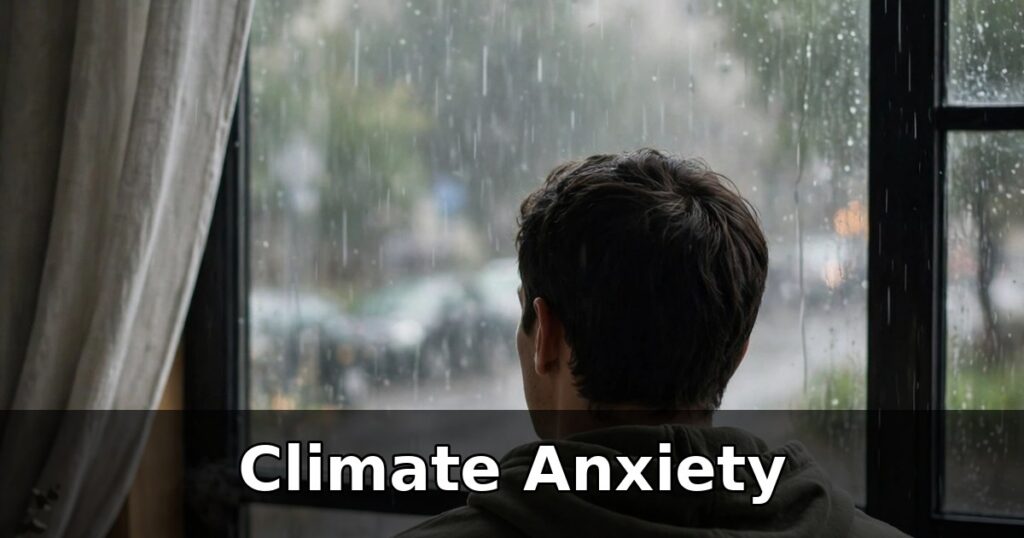
Climate Anxiety: The Mental Health Cost Nobody Counts
When economists tally the costs of climate change, they usually count damaged homes, lost crops, flooded roads, and higher insurance bills. Those costs are real and large. But there is another cost…
Key points
- A 2025 UK study of 461 university students and 400 young adults aged 18 to 25 found climate anxiety was linked to poorer mental health and worse insomnia — but that link became nonsignificant or greatly diminished once other stressors were considered.
- Loneliness was the most important predictor of mental health, and financial anxiety the most important predictor of insomnia severity.
- In Pakistan, 71 percent of 300 urban youth aged 15 to 24 reported moderate to high climate anxiety, with higher scores among females and those from lower socio-economic backgrounds.
- Climate anxiety is not a formal diagnosis. For many people it is an understandable emotional response to real risks — but when worry becomes persistent or paralysing, it can affect sleep, concentration, and relationships.
When economists tally the costs of climate change, they usually count damaged homes, lost crops, flooded roads, and higher insurance bills. Those costs are real and large. But there is another cost that rarely appears in a balance sheet, because it is harder to measure and harder to price: the worry, grief, anger, and sleeplessness that many people, especially young people, feel when they think about a changing climate and an uncertain future.
Researchers call it climate anxiety, or eco-anxiety. It is not a formal diagnosis in the way depression or generalised anxiety disorder are, and it is not the same as a mental illness. For many people, it is an understandable emotional response to real information about real risks. That does not make it harmless. When worry becomes persistent, intrusive, or paralysing, it can affect sleep, concentration, relationships, and the ability to plan for the future, and it deserves attention in its own right.
A 2025 study published in the Annals of the New York Academy of Sciences offers a useful corrective to both alarm and dismissal. The study, by Ogunbode and colleagues, surveyed university students and a general population sample of young adults in the United Kingdom, with 461 university students and 400 people aged 18 to 25 in the general population sample.
It found that while climate anxiety was significantly associated with poorer mental health and worse insomnia when examined alone, that association became nonsignificant or greatly diminished when other stressors were considered. Loneliness was found to be the most important predictor of mental health, and financial anxiety the most important predictor of insomnia severity. The authors concluded that climate anxiety, while concerning, may not be an especially dominant factor in young people’s mental health, and that the broader context of young people’s lives, and the complex interplay of psychological stressors, needs to be considered in efforts to map pathways between climate change and mental health.
What climate anxiety feels like
Climate anxiety is an umbrella term, and people use it to describe a range of experiences. For some, it is a background worry, a sadness when reading news about extreme weather, disappearing species, or hotter summers, that fades as daily life resumes. For others, it is more persistent: difficulty sleeping after a storm or a heatwave, guilt about personal consumption, anger at governments or companies perceived as failing to act, grief for places or species already lost, and a sense of helplessness about the future.
Psychologists distinguish between different dimensions of eco-anxiety. Affective symptoms include worry, sadness, and fear. Behavioural symptoms include changes in daily habits, such as avoiding news, or, conversely, compulsively checking it. Functional impacts occur when worry interferes with work, study, sleep, or relationships. A person can have high emotional worry but low functional disruption, meaning worry is common but daily life continues normally, a pattern reported in several studies.
Who experiences it, and why young people are often the focus
Climate anxiety has been reported across ages, cultures, and countries, but research and media attention have focused particularly on young people, for understandable reasons. Young people will live longest with the consequences of current emissions, they are often taught about climate change in school at the same time as they are forming their identities and plans for adulthood, and they are heavy users of social media, where climate news, images of disasters, and activist messaging circulate constantly.
They are also at a life stage when mental health challenges in general are common, and when transitions in education, work, housing, and relationships create vulnerability.
Studies in different countries have found varying levels of climate anxiety, and those variations are instructive. A 2025 mixed-methods study of urban youth in Pakistan, surveying 300 participants aged 15 to 24 in Lahore, Karachi, and Islamabad using the Climate Anxiety Scale, reported that 71 percent reported moderate to high levels of climate anxiety, with significantly higher scores among females and individuals from lower socio-economic backgrounds.
| Study | Sample | Key finding |
|---|---|---|
| Ogunbode et al., UK, 2025 | 461 students + 400 young adults aged 18–25 | Climate anxiety link to poor mental health and insomnia faded once other stressors were counted; loneliness mattered most for mental health, financial anxiety most for insomnia |
| Pakistan urban youth, 2025 | 300 participants aged 15–24 in Lahore, Karachi, Islamabad | 71% moderate to high climate anxiety; higher among females and lower socio-economic backgrounds |
| Global South adolescents and young adults, 2025 | 760 respondents, average age 18.56 | Affective eco-anxiety varied by age, income, and education; highest mean affective symptoms among graduate students |
| Canadian university students, 2025 | University students | Nature connectedness predicted more climate worry, linked to depression and anxiety; meaning-focused coping was protective |
What the 2025 UK study adds: context matters
The UK study by Ogunbode and colleagues is valuable precisely because it did not study climate anxiety in isolation. Many earlier studies asked whether climate anxiety correlates with poorer mental health, and found that it does. That is a useful first step, but it leaves open whether climate anxiety is a distinct cause, a symptom of broader anxiety, or a marker for other stressors that happen to coincide with it.
A young person who is lonely, financially insecure, and worried about the future may score highly on climate anxiety, general anxiety, and sleep problems, not because climate worry alone causes the other problems, but because all of them reflect a difficult life context.
By measuring climate anxiety alongside other common stressors, the UK study found that loneliness mattered most for mental health and financial anxiety mattered most for insomnia, once all stressors were considered together. That does not erase the earlier finding that climate anxiety alone was associated with poorer outcomes. It refines it: climate anxiety may be one thread in a web of stressors, not the single dominant thread.
When worry becomes helpful, and when it harms
Not all climate anxiety is harmful, and pathologising every instance of worry would be a mistake. Worry can be adaptive. It can motivate learning, voting, volunteering, changing consumption, joining a community group, or pursuing a career in environmental work. Many activists and researchers describe their own climate concern as a source of purpose rather than paralysis, even when it is painful. The distinction is not between feeling worry and not feeling it, but between worry that leads to action, connection, and a sense of agency, and worry that leads to rumination, avoidance, hopelessness, and withdrawal.
Research on coping offers clues about that distinction. Meaning-focused coping, which involves finding purpose, values, and connection in the face of a problem that cannot be solved individually, has been associated with greater resilience in several studies, including the Canadian study mentioned above and the Pakistan study, which found meaning-focused coping, such as community engagement and environmental education, to be associated with greater resilience.
Problem-focused coping, such as reducing personal emissions or preparing for a disaster, can help when the problem is tractable at individual scale, but it can increase frustration when the problem is systemic and individual action feels insufficient. Emotion-focused coping, such as seeking social support, expressing feelings, or spending time in nature, can help regulate distress, though avoidance, such as refusing to think about climate change at all, may provide short-term relief at the cost of longer-term unpreparedness.
A more helpful response acknowledges the reality of the risks, distinguishes between what is already changing and what can still be influenced, and offers concrete, collective avenues for action that are proportionate to a young person’s age and capacity. For a child, that might mean a school garden or a local clean-up. For a teenager, it might mean a youth council, a community project, or learning skills in repair, energy, or nature restoration. For a young adult, it might mean work, study, voting, or organising. The action does not need to solve climate change to be meaningful. It needs to restore a sense of agency and connection.
What helps: individuals, schools, and health systems
There is no single treatment for climate anxiety, because it is not a single disorder, and most people experiencing it do not need clinical treatment. For many, the most helpful supports are social and practical rather than medical: talking with peers who share concerns, spending time in nature, limiting doom-laden news consumption without avoiding information entirely, maintaining sleep, exercise, and routines, and participating in community action.
For people whose worry interferes significantly with daily functioning, or who have co-occurring depression, anxiety, or trauma, professional mental health support can help, and clinicians are increasingly developing approaches that validate climate concerns while treating underlying symptoms, rather than treating climate concern itself as irrational.
A balanced approach teaches the science honestly, including uncertainties and regional differences, discusses both mitigation and adaptation, and gives students opportunities to participate in real projects, from energy audits to habitat restoration, where they can see the effects of their work.
What is still uncertain
Much remains uncertain. The UK study was a snapshot in time, so it cannot show whether climate anxiety causes poor sleep, or whether poor sleep makes worry worse, or whether both reflect the same difficult circumstances. The studies from Pakistan and the Global South show strong associations, but they too are cross-sectional. Longitudinal studies that follow the same people over time, and studies that test interventions, are still needed to untangle cause from correlation and to identify what actually helps.
Levels of climate anxiety also vary widely by country, age, income, and education, so findings from one population cannot be assumed to apply everywhere. And while meaning-focused coping looks protective in several studies, the evidence base is still young, and what helps one person may not help another.
Counting a cost that cannot be priced
Climate anxiety will never fit neatly into a cost-benefit analysis, and that is part of why it has been overlooked. It cannot be counted in tonnes of carbon or dollars of damage, and it varies by person, culture, and context. But the fact that it is difficult to price does not mean it is unimportant.
The 2025 UK study’s message is ultimately a humane one: young people’s mental health cannot be understood through a single issue, however important. Climate anxiety matters, but so do loneliness, money, housing, and belonging. Addressing climate anxiety well means addressing the broader conditions in which young people live, while also taking their climate concerns seriously on their own terms. It means listening without dismissing, acting without promising what cannot be promised, and building communities where worry can become connection and action rather than isolation and despair. That is a cost worth counting, even if it never appears on a balance sheet.
Raina





댓글 0
첫 댓글을 남겨보세요.