
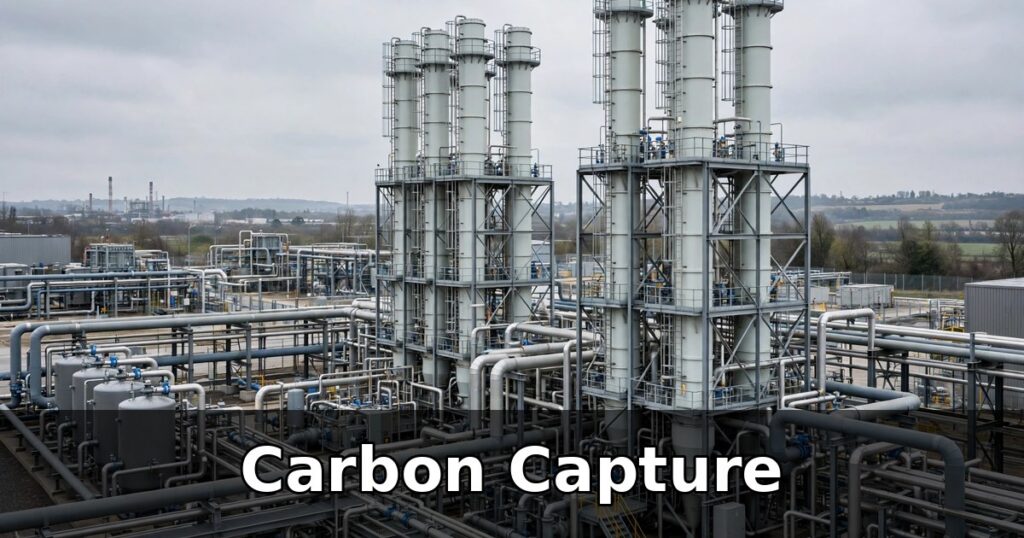
Carbon Capture: Promise, Hype, or Necessary Tool?
Few climate technologies divide opinion as sharply as carbon capture. To its supporters, it is an essential tool for industries that cannot easily stop producing carbon dioxide, a way to clean up…
Key points
- Operational carbon capture capacity was just over 50 million tonnes per year in the first quarter of 2025 — tiny against global energy and industry emissions of tens of billions of tonnes per year.
- The project pipeline could reach about 430 million tonnes per year of capture capacity by 2030, with storage capacity of about 670 million tonnes.
- More than 60 percent of operational capacity sits in natural gas processing, not in the hard-to-abate industries where the case for capture is strongest.
- In the IEA’s World Energy Outlook 2025, CCUS is projected to contribute less than 5 percent — a maximum of 4.9 percent — to offsetting emissions by 2050, while renewables, electrification, fuel switching, and efficiency deliver more than 82 percent.
- Full CCUS systems in Europe cost between 105 and 280 euros per tonne of CO₂ captured, once transport and storage are included.
Few climate technologies divide opinion as sharply as carbon capture. To its supporters, it is an essential tool for industries that cannot easily stop producing carbon dioxide, a way to clean up cement, steel, and chemicals, and a bridge to a net-zero economy. To its critics, it is an expensive distraction, a licence for fossil fuel companies to keep polluting, and a technology that has repeatedly promised more than it delivered. Both views contain elements of truth, which is why the debate is so persistent.
Carbon capture is neither a magic solution that can offset unlimited emissions, nor a fraud with no legitimate use. Its value depends, almost entirely, on where it is applied, how well it performs, what happens to the captured carbon, and whether it displaces emission cuts that could have been made more cheaply another way. Understanding carbon capture therefore requires precision about terms. Carbon capture, utilisation, and storage, often abbreviated CCUS, covers a family of technologies that capture carbon dioxide from a large source, such as a power station, cement plant, or gas processing facility, or directly from the air, then either use it in a product or store it permanently underground.
Carbon capture and storage, or CCS, refers to the storage variant. Direct air capture is a separate, more energy-intensive approach that removes carbon dioxide directly from ambient air. These are not interchangeable, and their costs, energy needs, and climate benefits differ greatly. Lumping them together as simply carbon capture obscures the most important distinctions.
What the IEA reported in 2025
According to the International Energy Agency, the global carbon capture, utilisation, and storage sector reached key development milestones over the past year but remained short of the trajectory needed to meet net-zero targets. The IEA said this in its update to its CCUS Projects Database, reported on 30 April 2025, incorporating developments between the first quarter of 2024 and the first quarter of 2025.
As of the first quarter of 2025, operational carbon dioxide capture and storage capacity was just over 50 million tonnes per year, slightly higher than one year earlier. Eight new CCUS projects began operation in the previous year, although these were modest in scale, with capacities as low as 5,000 tonnes per year. The majority of operational capacity remained concentrated in natural gas processing, which accounts for more than 60 percent, boosted by a major investment in Indonesia’s liquefied natural gas sector. The pipeline of projects indicated that capture capacity could surge to about 430 million tonnes annually by 2030, with storage capacity reaching about 670 million tonnes, a 10 percent increase from the previous year’s forecast. Projects at advanced stages, including those under construction or undergoing detailed engineering, now made up 60 percent of the pipeline, and if completed, they would nearly double global capacity — a first since the IEA began tracking deployment.
Where carbon capture makes most sense
The strongest case for carbon capture is in sectors where emissions are hard to eliminate by other means. Cement is the classic example. Making cement involves heating limestone, which releases carbon dioxide as a chemical by-product, not only from burning fuel. Even if the kiln were powered entirely by clean electricity, a large share of cement emissions would remain unless the chemistry changes or the carbon dioxide is captured. That process emission cannot be avoided by switching fuels alone, which is why cement is often listed first among hard-to-abate sectors.
Steel presents a related but different challenge. Much steel is made by reducing iron ore with carbon, which produces carbon dioxide. Alternative routes, such as using hydrogen instead of carbon, or recycling scrap steel in electric arc furnaces, can cut emissions substantially, but they face their own constraints around hydrogen supply, scrap availability, and ore quality. Carbon capture can, in principle, reduce emissions from existing blast furnaces, though it does not eliminate the need for broader transformation. Chemicals, refining, and some other industrial processes also produce concentrated streams of carbon dioxide that are, in principle, capturable, though costs and energy needs vary.
Where the case is weakest
The weakest case for carbon capture is where it is used to prolong fossil fuel power generation that could be replaced more cheaply and cleanly by renewable electricity, storage, and efficiency. Capturing carbon dioxide from a coal or gas power station adds cost, consumes energy, and does not capture all emissions. It also leaves upstream emissions — from fuel extraction, processing, and transport, including methane leaks — largely untouched. If a power station with capture still emits a significant share of its carbon dioxide, and if its fuel supply chain leaks methane, its overall climate benefit may be far smaller than the capture rate at the stack suggests.
That concern is reflected in recent IEA analysis. According to the Institute for Energy Economics and Financial Analysis, reporting on the IEA’s World Energy Outlook 2025, CCUS is projected to contribute less than 5 percent to offsetting emissions by 2050 in that outlook, with a maximum of 4.9 percent, comprising 1.2 percent attributed to power generation and 3.7 percent to industry. IEEFA described this as a multi-year downgrading of the technology compared with earlier expectations, and noted that renewable energy, electrification, fuel switching, and energy efficiency are likely to deliver more than 82 percent of required emission reductions in the same pathway. Those figures are scenario projections, not observed facts, and different scenarios will give different shares. They do, however, suggest that even the IEA, which has long supported CCUS, now sees it as a supporting technology rather than a central pillar of decarbonisation.
Direct air capture deserves separate scepticism. Removing carbon dioxide that is diluted to about 0.04 percent of the atmosphere requires far more energy per tonne than capturing it from a concentrated industrial stream. That energy must itself be low-carbon, or the net benefit shrinks or disappears. Direct air capture may have a role for removing residual emissions that cannot be eliminated otherwise, or for drawing down past emissions, but at current costs and scales it cannot plausibly offset ongoing large-scale fossil fuel use. Presenting it as a general solution, rather than a niche and expensive option, risks misleading the public about how much emission cutting can be postponed.
Costs, energy, and the storage question
Cost is a recurring barrier. According to reporting on IEA analysis, full CCUS systems in Europe cost between 105 and 280 euros per tonne of carbon dioxide captured once transport and storage are included, levels that carbon markets rarely sustain without permanent subsidies. Costs vary by application, location, scale, and whether infrastructure already exists, so a single range should not be applied to every project. A gas processing plant with a pure carbon dioxide stream and nearby storage will be far cheaper than a dispersed industrial site that needs a new pipeline and a new storage site. But the general point stands: carbon capture is not cheap, and it usually needs policy support — through carbon pricing, subsidies, contracts, or regulation — to be commercially viable.
Energy use is the other hidden cost. Capture equipment, compression, transport, and injection all consume energy. If that energy comes from fossil fuels without capture, the net emission reduction is reduced. If it comes from low-carbon sources, those sources could often have been used to displace fossil generation directly, raising a question of opportunity cost. That trade-off does not automatically invalidate carbon capture, especially where the alternative is continued process emissions with no other solution, but it does mean that projects should be assessed on net emissions, including energy use and upstream effects, not only on gross tonnes captured at the stack.
Enhanced oil recovery and the credibility problem
That credibility problem is not solved by technology alone. It is solved by clear rules: that capture projects report net emissions transparently, that storage is monitored and verified, that projects in hard-to-abate sectors are distinguished from projects that merely prolong unabated fossil fuel use, and that public money is directed where the climate benefit is greatest and alternatives are weakest. Without such rules, carbon capture risks becoming a label that obscures continued emissions, rather than a tool that reduces them.
What is still uncertain
The pipeline is a projection, not a guarantee. Capture capacity of about 430 million tonnes by 2030 depends on announced projects being built on time. Projects in this sector have repeatedly been delayed, cancelled, or scaled down.
Shares are scenario figures. The 4.9 percent maximum CCUS contribution and the more than 82 percent from renewables, electrification, fuel switching, and efficiency come from one outlook’s pathway. Different scenarios will give different shares.
A narrower, more honest role
The IEA’s 2025 update, read carefully, points toward a narrower role for carbon capture than its early hype suggested. It is not the backbone of net zero. It is a supporting technology for specific, hard-to-abate applications, where it can complement — not replace — efficiency, electrification, fuel switching, and material innovation. In cement, in some chemicals, and in parts of steel and refining, it may be necessary to reach near-zero emissions. In power generation, its role is likely to be limited, because cleaner and often cheaper alternatives exist. In direct air capture, its role is likely to be small and expensive, reserved for residual emissions.
That narrower role is still important. A few hundred million tonnes of captured carbon dioxide per year, if delivered reliably and stored permanently, could make the difference in sectors where no other solution yet exists at scale. But it will not, on its own, solve climate change, and it should not be used to justify delaying emission cuts that are available today. The test for any carbon capture project should be simple, even if the engineering is complex: does it reduce net emissions, compared with a credible alternative, at a reasonable cost, with permanent storage and transparent monitoring, without locking in fossil fuel dependence that could have been avoided? Projects that pass that test deserve support. Projects that fail it should not be dressed up as climate solutions.
Carbon capture, in the end, is a tool, and tools are judged by how they are used. Used narrowly, honestly, and alongside deep emission cuts, it can help clean up the hardest industries. Used broadly, vaguely, and as a substitute for cutting emissions, it becomes hype — and hype, in climate policy, has a cost measured not in press releases, but in years of delay that cannot be recovered.
Raina





댓글 0
첫 댓글을 남겨보세요.