
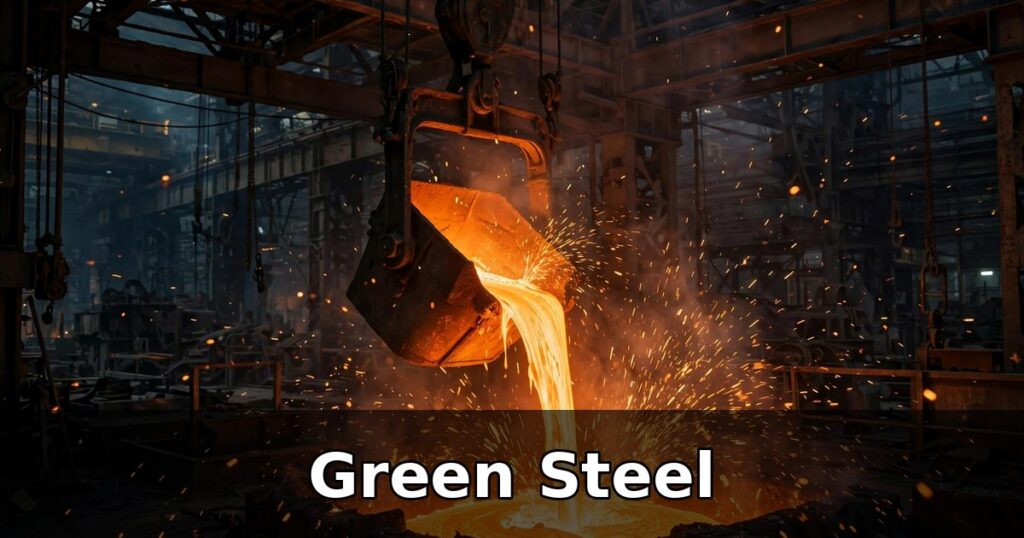
Green Steel and Cement: Cleaning Up the Hardest Industries
Steel and cement are the quiet foundations of modern life. They hold up buildings, bridges, roads, and wind turbines. They are also among the hardest materials to decarbonise, because their emissions…
Key points
- Steel and cement are hard to decarbonise because their emissions come from chemistry, not just fuel: heating limestone releases carbon dioxide, and traditional steelmaking uses carbon to strip oxygen from iron ore.
- On 12 November 2025, Adani Cement and Coolbrook announced the world’s first commercial deployment of the RotoDynamic Heater at the Boyareddypalli cement plant in Andhra Pradesh, India, expected to cut about 60,000 tonnes of carbon dioxide a year, with potential to increase tenfold.
- In 2025, Heidelberg Materials launched the Brevik carbon capture facility in Norway, the first industrial-scale CCS plant in cement, designed to capture 400,000 tonnes of carbon dioxide a year.
- Adani aims to raise alternative fuels to 30 percent, up from an earlier target of 28 percent, and to reach a 60 percent green power share by the 2028 financial year.
- Steel has more clean routes — hydrogen-based direct reduction, scrap recycling in electric arc furnaces — but faces a green premium that policy must bridge.
Steel and cement are the quiet foundations of modern life. They hold up buildings, bridges, roads, and wind turbines. They are also among the hardest materials to decarbonise, because their emissions come not only from burning fuel for heat, but from chemistry itself.
Making cement releases carbon dioxide when limestone is heated and breaks down. Making steel traditionally releases carbon dioxide when carbon is used to strip oxygen from iron ore. Those process emissions cannot be eliminated simply by switching to clean electricity, though clean electricity helps with the fuel part. That is why steel and cement are routinely called hard-to-abate, and why progress in these sectors is watched so closely: if they cannot be cleaned up, a large share of global emissions will remain, no matter how clean electricity and cars become.
The challenge is also one of scale and longevity. Steel plants and cement kilns are large, capital-intensive facilities designed to operate for decades. Decisions made today about a new plant or a major retrofit will shape emissions for a generation. At the same time, demand for both materials remains high, driven by construction, infrastructure, and urbanisation, particularly in growing economies. The task is therefore not to stop using steel and cement, which would be neither feasible nor desirable, but to change how they are made, how much is needed, and how long products last and are reused.
A first for cement in India
A concrete sign of change came on 12 November 2025, when Adani Cement and Coolbrook announced a delivery agreement for the world’s first commercial deployment of Coolbrook’s RotoDynamic Heater technology to advance cement decarbonisation at the Boyareddypalli Integrated Cement Plant in Andhra Pradesh, India. According to the companies’ announcement, this marks the first industrial-scale deployment of the technology, advancing Adani Cement’s net-zero goals for 2050, validated by the Science Based Targets initiative, and Coolbrook’s goal of cutting emissions across heavy industry.
The technology targets calcination, described by the companies as the most fossil fuel-intensive stage of cement production. By providing clean heat to dry and enhance the heating value of alternative fuels, the system enables a significantly higher substitution of fossil fuels with sustainable alternatives. The deployment is expected to directly reduce approximately 60,000 tonnes of carbon dioxide emissions annually, with potential to increase tenfold in due course, according to the announcement.
Critically, the system will be powered entirely by Adani Cement’s large-scale renewable energy portfolio, ensuring that the industrial heat generated is completely emission-free, according to the companies. The announcement also notes that Adani Cement aims to increase alternative fuels to 30 percent, up from an earlier target of 28 percent, while achieving a 60 percent green power share by the 2028 financial year.
Those figures should be read as company expectations for a first commercial deployment, not as measured, long-term operating results. A first deployment is, by definition, a test at scale: it will reveal practical issues around integration, maintenance, fuel handling, and cost that laboratory and pilot work cannot fully predict. Its significance lies less in 60,000 tonnes alone — a small fraction of global cement emissions — than in what it demonstrates: that high-temperature electrified heat, powered by renewables, can be applied to a real cement plant, in a major producing country, as a commercial project rather than a research experiment. If it works reliably and economically, it can be replicated. If it struggles, the lessons will still be valuable, though the timeline for wider adoption will lengthen.
A parallel milestone in Norway
The Indian announcement did not occur in isolation. In 2025, Heidelberg Materials launched the Brevik carbon capture and storage facility in Norway, described as the first industrial-scale CCS plant in the cement sector globally, designed to capture 400,000 tonnes of carbon dioxide annually. That project tackles cement emissions from a different angle: rather than only changing the heat source, it captures carbon dioxide from the production process itself, including process emissions that electrified heat alone cannot eliminate.
| Project | Approach | Scale | First of its kind |
|---|---|---|---|
| Boyareddypalli, India (Adani Cement and Coolbrook, 2025) | Electrified clean heat for calcination, plus alternative fuels | About 60,000 tonnes of CO2 a year, potential tenfold increase | First commercial deployment of RotoDynamic Heater technology |
| Brevik, Norway (Heidelberg Materials, 2025) | Carbon capture and storage on cement production | 400,000 tonnes of CO2 a year | First industrial-scale CCS plant in the cement sector |
Why cement is so difficult
Cement’s difficulty starts with chemistry. Portland cement, the most common type, is made by heating limestone and other materials in a kiln to very high temperatures to produce clinker. Heating limestone releases carbon dioxide from the stone itself, a process emission that accounts for a large share of total cement emissions. Burning fuel to reach those temperatures adds more. Even a kiln powered entirely by renewable electricity would still release process emissions unless the chemistry changes or carbon is captured.
Reducing clinker content is therefore one of the most powerful levers available today. Blended cements that replace part of the clinker with other materials can cut emissions significantly, often with existing technology and at modest cost, provided standards, supply chains, and performance requirements allow it. Not all substitutes are available everywhere in sufficient quantity, and some, such as fly ash from coal plants, may decline as coal power phases out. Calcined clay is attracting attention because clay is widely available, but scaling it requires investment in new production capacity and confidence among builders and regulators that performance will meet specifications.
Why steel is different, and equally hard
Steel’s challenge is also chemical, but the routes to clean steel are more varied. Traditional blast furnace steelmaking uses coke, made from coal, both as fuel and as a chemical reducing agent to remove oxygen from iron ore, producing carbon dioxide. An alternative route uses direct reduced iron, where iron ore is reduced with natural gas or hydrogen, then melted in an electric arc furnace powered by electricity. If the hydrogen is made from renewable electricity and the furnace is powered by low-carbon electricity, emissions can fall dramatically. If the hydrogen is made from fossil gas without capture, or the electricity is carbon-intensive, the benefit shrinks.
Recycling offers another route. Scrap steel melted in an electric arc furnace avoids the need to reduce iron ore altogether, and can be far less carbon-intensive, provided electricity is clean. The constraint is scrap availability and quality. There is only so much scrap in circulation, and some high-quality steel products require virgin iron to meet specifications or to dilute impurities that accumulate through repeated recycling. As the global stock of steel grows and older products reach end of life, scrap availability should increase, but it will not, on its own, meet all demand for new steel in growing economies.
Other approaches include carbon capture on blast furnaces, biomass as a partial substitute for coke, and novel processes such as electrolysis of iron ore, which are at earlier stages of development. Each faces trade-offs around cost, energy, material quality, and scale. The steel industry also faces a green premium: low-carbon steel often costs more to produce than conventional steel, at least initially, and buyers — from carmakers to construction firms — must be willing to pay it, or policy must bridge the gap through standards, procurement, carbon pricing, or contracts that share risk.
The cost gap and the policy bridge
Both steel and cement face a version of the same economic problem. Conventional production benefits from decades of optimisation, established supply chains, and, in many places, fossil fuel prices that do not fully reflect climate damage. Low-carbon production often requires new equipment, new energy supplies, and new materials, with higher upfront costs and uncertain returns. Without policy that rewards low-carbon production or penalises high-carbon production, early movers can be undercut by cheaper, dirtier competitors, including imports from regions with weaker climate rules.
Demand, design, and circularity
Cleaning up production is only half the story. Using less material, using it more efficiently, and keeping it in use longer can cut emissions without waiting for every plant to be rebuilt. In construction, that means designing buildings that use steel and concrete efficiently, avoiding over-specification, reusing structural elements where safe, and planning for disassembly and recycling at end of life. In manufacturing, it means lightweighting, product longevity, and design for repair and recycling.
What is still uncertain
The headline figures are company expectations, not operating results. The 60,000-tonne reduction at Boyareddypalli and the 400,000-tonne capture capacity at Brevik describe what the projects are designed to deliver. How they perform over years of continuous operation, and at what cost, is not yet known.
The green premium has no single size. How much more low-carbon steel and cement cost depends on energy prices, hydrogen availability, capture costs, and policy in each market. Without that support, early movers remain exposed to cheaper, dirtier competition.
Substitute materials are not unlimited. Fly ash supply may fall as coal power phases out, and calcined clay needs new production capacity and builder confidence before it can scale. The availability of each substitute varies by region.
What success would look like
Success in steel and cement will not look like a single breakthrough moment. It will look like a series of first commercial deployments — like Boyareddypalli for electrified heat, like Brevik for capture — that prove technologies in real plants, followed by replication, cost reduction, and policy that makes the cleaner option the normal option. It will look like blended cements becoming standard where suitable, scrap use rising where quality allows, hydrogen-based steel moving from pilot to commercial scale where renewable electricity and hydrogen are available, and public and private buyers consistently choosing lower-carbon products.
Steel and cement are hard because they are fundamental, chemical, and long-lived. That hardness is precisely why they deserve attention disproportionate to their headline visibility. Electricity and transport often dominate climate discussions because their technologies are familiar and their progress is visible. Steel and cement progress is slower, more industrial, and less photogenic, but without it, the built world we live in will continue to carry a heavy carbon cost. The first commercial deployments of 2025 do not solve that problem, but they show that solutions are moving from laboratory and pilot to real plants, in real markets, with real customers. The next test is whether those firsts become seconds, thirds, and, eventually, the standard way these essential materials are made.
Raina





댓글 0
첫 댓글을 남겨보세요.