
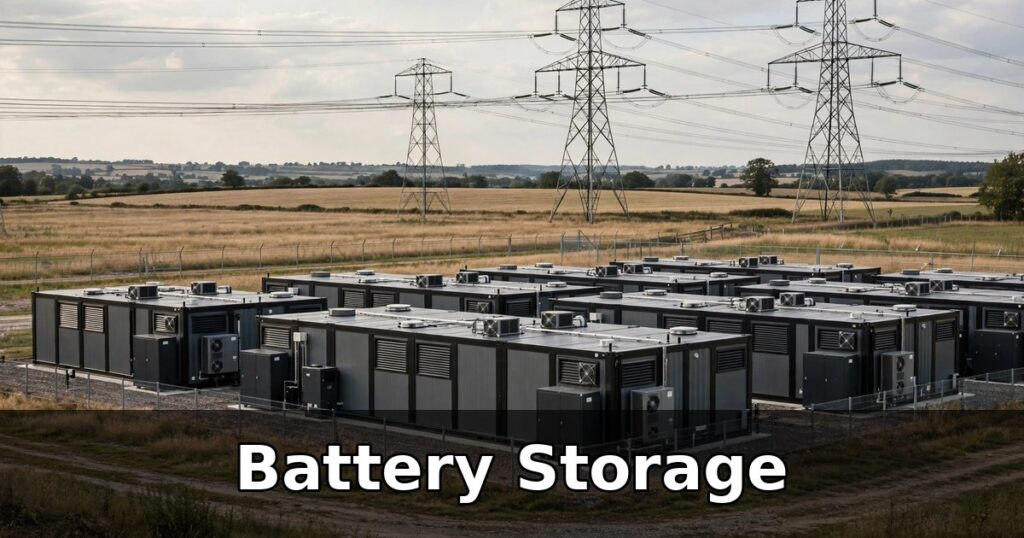
The Battery Boom: Storing Sunshine for the Night
Solar power has a timing problem. It produces most when the sun is high, but people use most electricity in the morning and evening, when the sun is low or gone. Wind power has a related problem: it…
Key points
- Global battery storage additions reached 108 gigawatts in 2025, up around 40 percent from 2024 — more than the historical peak year for gas-fired power additions, about 107 gigawatts in 2002.
- Installed battery storage capacity is now eleven times higher than in 2021, and the IEA calls battery storage the fastest-growing power technology today.
- Utility-scale projects accounted for around 87 gigawatts, about four-fifths of the total, while behind-the-meter storage also accelerated.
- China added just over 63 gigawatts; the United States added 19 gigawatts; Australia surged to nearly 8 gigawatts, almost nine times its previous year.
- Lithium iron phosphate batteries now account for around 90 percent of storage deployments, up from well below 50 percent five years ago.
Solar power has a timing problem. It produces most when the sun is high, but people use most electricity in the morning and evening, when the sun is low or gone. Wind power has a related problem: it produces when the wind blows, not necessarily when demand peaks. For years, that mismatch was cited as a fundamental limit on renewable energy. Grids could handle some variable output, the argument went, but beyond a certain share, they would need vast amounts of backup from fossil fuels.
Batteries are changing that argument, not by eliminating variability, but by shifting energy in time — storing sunshine at midday and releasing it in the evening, storing wind at night and releasing it in the morning, and responding to grid disturbances in milliseconds. The scale of that shift accelerated sharply in 2025. Batteries moved from a promising supporting technology to one of the fastest-growing parts of the power system, deployed at utility scale, behind the meter in homes and businesses, and in new markets far beyond the early leaders.
A record year, according to the IEA
According to the International Energy Agency, global battery storage deployment expanded strongly in 2025. Total capacity additions reached 108 gigawatts, up around 40 percent from 2024. The IEA reported this in its Global Energy Review 2026, published on 20 April 2026. Annual growth of this scale exceeds the historical peak for gas-fired power capacity additions, which was around 107 gigawatts in 2002, according to the IEA. In other words, in a single year, the world added more battery power capacity than it had ever added of gas power in a single year at the peak of gas expansion.
Utility-scale battery storage accounted for around 87 gigawatts of global battery capacity additions in 2025, around four-fifths of the total, according to the IEA. Behind-the-meter battery storage deployment also accelerated, particularly in markets with high retail electricity prices and supportive regulatory and policy frameworks. Around 24 gigawatts of utility-scale battery storage additions in 2025 were co-located directly with renewables, on par with the previous year. That meant the share of capacity co-located with renewables fell just below 30 percent, as market reforms in China in early 2025 removed broad co-location mandates.
The IEA also reported that installed battery storage capacity is now eleven times higher than in 2021, and described battery storage as the fastest-growing power technology today. The comparison is striking: a technology that was marginal five years ago now sets the pace for the entire power sector.
Where the growth happened
| Market | Additions in 2025 | Notable detail |
|---|---|---|
| China | Just over 63 GW | One-third more than 2024; 55 GW utility-scale, about 8 GW behind the meter |
| United States | 19 GW | More than 16 GW utility-scale, nearly 3 GW behind the meter |
| Australia | Nearly 8 GW | Almost nine times the previous year; utility-scale rose from under 1 GW to about 4.2 GW |
| Middle East | More than 3 GW | More than three times the 2024 level, driven almost entirely by Saudi Arabia |
| Chile | Approaching 1 GW | Utility-scale batteries absorbing surplus solar and meeting peak demand |
The geography of growth was broadening, even as China continued to lead. Just over 63 gigawatts of new battery capacity was added in China in 2025, one-third more than in 2024, according to IEA data reported by trade press. Utility-scale installations accounted for 55 gigawatts of that total, with about 8 gigawatts of behind-the-meter additions. In the United States, 19 gigawatts of battery storage was split across more than 16 gigawatts of utility-scale capacity and nearly 3 gigawatts behind the meter.
Australia stood out, with additions surging to nearly 8 gigawatts, almost nine times higher than the previous year. Utility-scale installations in Australia rose from under 1 gigawatt in 2024 to around 4.2 gigawatts in 2025, while behind-the-meter additions increased from roughly 0.2 gigawatts to about 3.4 gigawatts, supported by state- and federal-level incentives. The IEA noted that battery storage now accounts for around 18 percent of installed dispatchable capacity in Australia, ahead of China at 7 percent, the United States at 5 percent, and Europe at 4 percent. In the Middle East, additions topped 3 gigawatts in 2025, more than three times their 2024 level, driven almost entirely by Saudi Arabia. In Chile, additions approached 1 gigawatt, as utility-scale batteries are deployed to absorb surplus solar generation and meet peak demand.
Those figures measure power capacity, in gigawatts, which is the maximum rate at which batteries can charge or discharge. They do not, on their own, tell us how much energy, in gigawatt-hours, those batteries can store, which depends on duration. That distinction is essential, and it is where much of the nuance in the battery boom lies.
Power versus energy, and why duration matters
A battery rated at 100 megawatts with two hours of storage can deliver 100 megawatts for two hours, storing 200 megawatt-hours of energy. The same power rating with four hours of storage stores twice as much energy. Most battery projects still cluster around two hours, according to the IEA, but an increasing number can be deployed for four hours or more, reflecting the growing value of flexibility in systems with rising shares of solar power. That lengthening matters because different grid needs require different durations.
Short-duration batteries, measured in minutes to an hour or two, are excellent for frequency control, smoothing rapid changes in solar and wind output, and providing instant backup when a generator trips. They can respond in milliseconds, far faster than a gas turbine that must ramp up. Two-hour batteries are well suited to shifting solar energy from midday to the evening peak, which is often the most valuable daily shift in a solar-rich system. Four-hour and longer batteries can cover longer evening peaks, cloudy periods, or overnight wind lulls, but they cost more per unit of power, because they need more cells.
Why lithium iron phosphate dominates
According to the IEA, lithium iron phosphate, or LFP, batteries now account for around 90 percent of battery storage deployments, while less energy-dense than rival chemistries commonly used in electric vehicles, LFP batteries are typically cheaper and better suited to more frequent cycling. Just five years ago, the market share of LFP batteries in deployments was well below 50 percent, according to the IEA. That shift reflects the different priorities of stationary storage compared with electric vehicles.
An electric vehicle battery must be light and compact, because it has to be carried around, and energy density matters greatly for range. A stationary battery, sited in a container or building, can afford to be heavier and larger, because weight and volume are less constrained. What matters more for stationary storage is cost per cycle, safety, lifespan under frequent charging and discharging, and tolerance for being charged to full and discharged deeply on a daily basis. LFP chemistry performs well on those criteria, with a longer cycle life and a lower risk of thermal runaway than some higher-energy chemistries, though safety still depends on system design, thermal management, fire protection, and installation standards.
Co-location, standalone, and behind the meter
Battery projects take three broad forms, and each serves a slightly different purpose. Co-located batteries sit alongside a solar or wind farm, sharing a grid connection and often charging directly from that farm. They can smooth output, store surplus generation that would otherwise be curtailed, and deliver power when the farm itself is not producing. Standalone batteries connect directly to the grid, charging from the grid when electricity is cheap or plentiful and discharging when it is expensive or scarce, regardless of which generator produced it. Behind-the-meter batteries sit in homes, businesses, or industrial sites, behind the customer’s electricity meter, storing solar power from rooftop panels or cheap grid electricity for later use, providing backup during outages, and reducing peak demand charges.
The IEA data show a shift in the balance between co-located and standalone projects. In China, the removal of broad co-location mandates in early 2025 meant that fewer new batteries were automatically paired with renewables, and more were built as standalone grid assets. That shift may reflect a maturing market, in which batteries are valued for grid services in their own right, not only as an add-on to a renewable project. In Australia, behind-the-meter growth was particularly strong, driven by high retail prices and incentives, suggesting that households and businesses see direct value in storing their own solar power and reducing grid imports during expensive evening hours.
What batteries cannot do alone
It is tempting, amid record numbers, to present batteries as the solution to renewable variability. That would overstate their role. Batteries shift energy over hours, not over seasons. A solar-rich system in summer will still produce far less in winter in high-latitude regions, and a wind system can experience multi-day lulls that no plausible fleet of two- or four-hour batteries can bridge alone. Those longer gaps require other solutions: interconnection between regions with different weather, demand flexibility, dispatchable low-carbon generation such as hydro, nuclear, or geothermal where available, and, potentially, long-duration storage or clean fuels.
Batteries also depend on the grid they serve. A battery can store clean electricity, but if it charges from a coal-heavy grid at night and discharges during a gas-heavy peak, its net climate benefit may be smaller than expected, or even negative in some accounting, depending on marginal generation. As grids become cleaner, that concern diminishes, because the electricity being shifted is increasingly low-carbon. But it is a reminder that storage is an enabler of clean electricity, not a substitute for generating it cleanly in the first place.
What this means
The most useful way to think about the battery boom is as a system change, not a gadget story. Batteries make variable renewable energy more valuable by allowing it to be used when it is needed, not only when it is produced. They make grids more resilient by providing fast frequency response and backup. They give consumers more control over when they use grid electricity. And they create new markets for flexibility, in which the ability to shift demand or supply by hours becomes a valuable service, alongside the traditional service of generating electricity itself.
The IEA’s 2025 record — 108 gigawatts added, 40 percent growth, eleven times the capacity of 2021 — shows that this system change is happening faster than many expected, and in more places than the early leaders alone. It does not show that the transition is complete, or that batteries alone can carry a renewable-heavy grid through every weather pattern and season. It shows that one of the key objections to large-scale solar and wind — that their output cannot be stored at scale — is weakening year by year, as storage is built, costs fall, durations lengthen, and markets learn to value flexibility.
Raina





댓글 0
첫 댓글을 남겨보세요.