
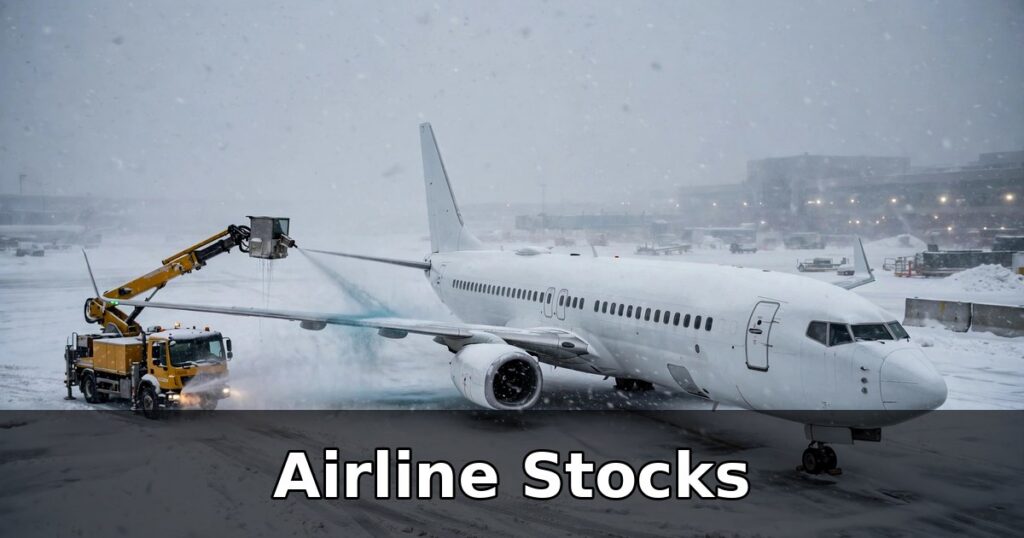
Winter Storm Warning? Why Airline Stocks Fall Before the First Flake
Key points
- Southwest Airlines cancelled more than 16,700 flights between 21 and 31 December 2022, stranding more than 2 million passengers.
- The meltdown cost Southwest a pretax hit of $725 million to $825 million, plus a record $140 million penalty from the U.S. Department of Transportation.
- Airline stocks fall before the storm because airlines cancel flights in advance — the revenue loss is booked the moment the forecast is published, not when the snow falls.
- Most airlines recover in a day or two. The stocks that keep falling are the ones whose recovery systems fail.
Contents
- Why the fall comes first in winter storm airline stocks
- What the Southwest meltdown cost — winter storm airline stocks
- Why some airlines fall further than others in winter storm airline stocks
- What the filings show — winter storm airline stocks
- What is still uncertain about winter storm airline stocks
- A winter storm checklist for winter storm airline stocks
- The recovery trade — winter storm airline stocks
- What this means for winter storm airline stocks
- The forecast is the event — winter storm airline stocks
When a winter storm is forecast for a major hub, airline stocks often fall before the first flake lands. The reason is simple: the airlines cancel the flights before the storm arrives. The revenue disappears on the day of the forecast, not on the day of the snow.
A cancelled flight is a particular kind of loss. The seat cannot be sold twice, and the passenger cannot be flown later on the same ticket without cost. The airline refunds the fare, pays for hotels and meals, and still has to move its aircraft and crews back into position. A storm that lasts three days can disrupt a network for a week.
Most of the time, the damage is limited and the stocks recover quickly. But every few years a storm exposes a weakness that the market had not priced in, and the fall becomes a collapse. The winter of 2022 gave the industry its clearest example.
Why the fall comes first in winter storm airline stocks
Airlines do not wait for the snow. When a forecast shows a major storm hitting a hub, they cancel flights hours or days in advance, rebook passengers, and try to keep aircraft out of the storm’s path. The cancellations are the right operational decision, and they are also an immediate revenue loss. The market sees the cancellation notices in real time and reprices the stock the same day.
The loss compounds through the network. An aircraft that does not fly from Chicago to Denver cannot fly the next leg from Denver to Phoenix. A crew that times out in the wrong city cannot operate the next morning’s departures. Airlines call this the problem of getting aircraft and crews back into position, and after a big storm it can take days. Every day of recovery is another day of cancelled flights and lost revenue.
Winter Storm Elliott, which hit the United States just before Christmas 2022, showed the scale. The storm itself was severe, but most airlines recovered within a day or two. Southwest did not. Its crew scheduling system, built for a smaller and simpler airline, could not reassign crews fast enough once the disruption passed a certain size. The airline kept cancelling flights long after the weather had cleared, and the market punished it accordingly.
What the Southwest meltdown cost — winter storm airline stocks
| Item | Figure | Source |
|---|---|---|
| Flights cancelled, 21–31 Dec 2022 | More than 16,700 | SEC filing |
| Passengers stranded | More than 2 million | U.S. DOT |
| Lost revenue | $400–425 million | SEC filing |
| Total pretax hit | $725–825 million | SEC filing |
| Refunds and reimbursements paid | More than $600 million | U.S. DOT |
| DOT civil penalty, Dec 2023 | $140 million | U.S. DOT consent order |
The numbers grew after the storm. Southwest’s own filing put the pretax hit at $725 million to $825 million, including lost revenue and the costs of reimbursing passengers and paying premium wages. The company’s accounts later showed about $390 million of disruption costs in December 2022 and a further $55 million in the first quarter of 2023. The Department of Transportation put the airline’s total cost from the debacle at more than $1 billion.
The stock reacted immediately. Southwest shares fell by almost 6 percent on 27 December 2022, the first trading day after the scale of the disruption became clear, and the decline continued over the following months. A year later, the DOT imposed a $140 million civil penalty — the largest ever for consumer protection violations — including a $35 million cash fine and a requirement to provide $90 million in travel vouchers to future passengers delayed by the airline’s own faults.
Why some airlines fall further than others in winter storm airline stocks
The difference between a bad storm and a disaster is the recovery system. Airlines that operate hub-and-spoke networks can reroute passengers through other hubs when one closes. Airlines that operate point-to-point networks, flying directly between cities without a central hub, have less flexibility when crews and aircraft end up in the wrong places.
Southwest’s problem was its crew scheduling technology. The system was designed decades earlier and relied heavily on manual workarounds. When thousands of flights were cancelled at once, schedulers could not reassign crews fast enough by phone, and the airline had to cancel more flights simply because it did not know where its crews were. The technology failure turned a three-day storm into a ten-day meltdown.
The market’s judgment was not about the weather. It was about the system. Other airlines faced the same storm and recovered. Southwest faced the same storm and lost a quarter’s profit, its reputation for reliability, and more than a billion dollars. Investors learned to ask a new question: not whether an airline can fly through a storm, but whether it can recover from one.
What the filings show — winter storm airline stocks
The official record is unusually complete because the disruption produced both an SEC filing and a DOT investigation. The SEC filing, made within days of the event, disclosed the cancellation count and the estimated financial hit while the recovery was still under way. The DOT consent order, a year later, documented the passenger impact: roughly 16,900 cancellations and more than 2 million stranded travellers.
The DOT order also changed the rules. Southwest must now provide a transferable voucher worth at least $75 to any passenger who arrives at their destination three or more hours late because of a cancellation or delay the airline caused. The requirement runs through April 2027. It is a direct cost of the meltdown, and it applies to future disruptions as well.
The episode also shows how quickly a reputation built over decades can be spent. Southwest had led all U.S. airlines in profit during the first nine months of 2022. The storm turned a money-losing fourth quarter into a case study that regulators, competitors and investors still cite.
What is still uncertain about winter storm airline stocks
Storm tracks change. A forecast that points at Chicago on Monday can point at Detroit by Wednesday. The market prices the forecast, and the forecast moves.
Recovery speed is hard to predict. It depends on the airline’s network, its crew scheduling system and the weather at every airport in the chain. Two airlines hit by the same storm can recover days apart.
Compensation rules are tightening. The DOT has moved toward requiring automatic refunds and stronger passenger protections. Each new rule raises the cost of the next meltdown.
Climate is shifting the calendar. Winter storms are not becoming less frequent, and the industry’s busiest travel days — the Christmas holidays — fall squarely in storm season. The exposure is structural.
A winter storm checklist for winter storm airline stocks
Hub exposure. Check which airports an airline depends on. A carrier concentrated in one storm-prone hub is more vulnerable than one spread across several.
Cancellation policy. Airlines publish their cancellation counts in real time. A carrier cancelling 5 percent of flights is managing a storm. One cancelling 60 percent is in trouble.
Crew scheduling. This is the question Southwest’s meltdown made unavoidable. An airline’s ability to reassign crews after a disruption is now part of how investors judge it.
Cash buffer. A storm costs money even when it is handled well. The airlines that recover fastest are the ones that can absorb refunds and rebooking costs without cutting the rest of the operation.
The recovery trade — winter storm airline stocks
The same speed that punishes airline stocks in a storm rewards them in the recovery. When cancellations fall back to normal levels and the operation stabilises, the revenue loss stops growing. The stock often recovers before the refunds are even paid, because the market prices the end of the disruption rather than the cost of it.
The recovery is fastest for the airlines that kept their networks intact. An airline that cancelled 10 percent of its flights for two days loses a small slice of a quarter. An airline that cancelled 60 percent for ten days loses the quarter and part of the next one. The difference shows up in the first earnings report after the storm, and the market reads it closely.
There is also a secondary effect. A storm that grounds one airline’s passengers often fills its competitors’ planes. Travellers rebook on whichever carrier is still flying, and the carriers that recover first pick up the stranded demand. The storm redistributes revenue as well as destroying it, and the winners are usually the airlines whose hubs were spared.
What this means for winter storm airline stocks
Airline stocks price the forecast, not the snowfall. The cancellations happen before the storm, and the revenue loss is booked at the same time. Waiting for the snow is waiting too long.
The storm is a test of systems, not of weather. Every airline faces the same sky. The ones that fall furthest are the ones whose recovery breaks down.
The bill keeps growing after the storm. Refunds, penalties and new rules arrive months later. The true cost of a meltdown is measured in quarters, not days.
The forecast is the event — winter storm airline stocks
Airline stocks fall before the first flake because the airline industry cancels before the first flake. The forecast is the event, the cancellation is the cost, and the recovery is the test. Most airlines pass it in a day. The ones that do not pay for it for a year.
Sources
- U.S. Securities and Exchange Commission
- U.S. Department of Transportation
- Federal Aviation Administration
Raina





댓글 0
첫 댓글을 남겨보세요.