
Wildfire Season: The One Number That Decides a Utility Stock’s Fate
Key points
- PG&E filed for Chapter 11 bankruptcy on 29 January 2019, facing potential wildfire liabilities of $30 billion or more.
- The Camp Fire of November 2018 killed 85 people and destroyed 18,793 structures, the deadliest and most destructive wildfire in California history.
- PG&E ultimately settled wildfire claims for $25.5 billion, including a $13.5 billion trust for victims.
- The one number that decides a utility’s fate in wildfire country is its estimated liability — and that number is set by the law, not by the fire.
Contents
- How one fire broke a utility in wildfire utility stock
- The number that decides everything — wildfire utility stock
- Why the law makes the number so large in wildfire utility stock
- What the record shows — wildfire utility stock
- What is still uncertain about wildfire utility stock
- A wildfire checklist for wildfire utility stock
- The next test — wildfire utility stock
- What this means for wildfire utility stock
- One number, one fate — wildfire utility stock
For a utility in wildfire country, the fire season is not a weather event. It is a balance sheet event. A single fire can create a liability larger than the company’s entire market value, and the stock price follows the liability estimate the way a shadow follows its object.
The number that matters is the estimated cost of the damage the utility’s equipment caused. It is not the acres burned or the homes destroyed, though those are the human tragedy. It is the dollar figure that lawyers, insurers and regulators attach to the event, and it moves in steps: an investigation, a finding of cause, a court ruling, a settlement. At each step, the number gets bigger, and the stock gets smaller.
No case illustrates this more clearly than PG&E, the largest utility in California. Its story is the reason investors in any fire-prone state now ask one question first: how big is the liability?
How one fire broke a utility in wildfire utility stock
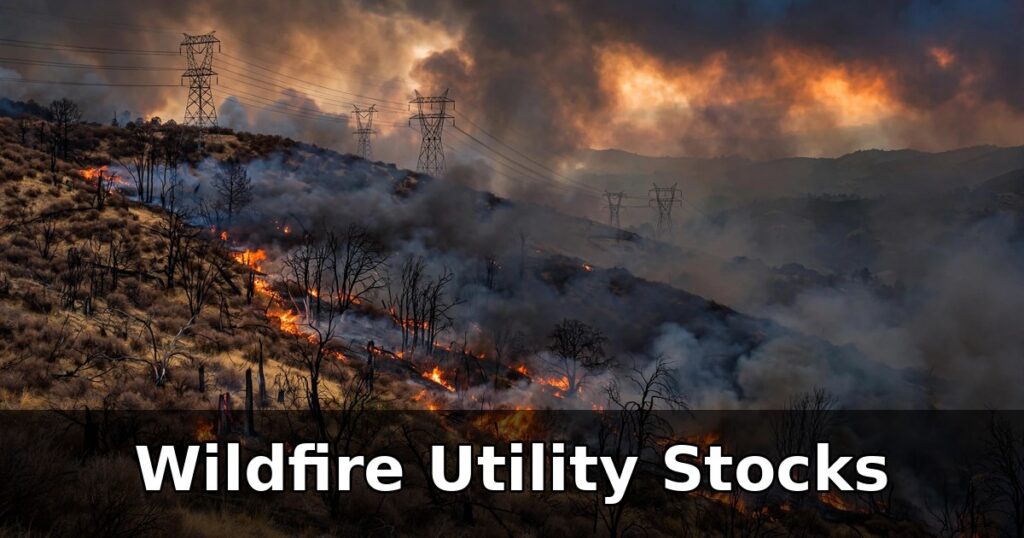
The Camp Fire began on 8 November 2018, when a failed hook on a 97-year-old transmission line in Butte County ignited dry vegetation. The fire killed 85 people, destroyed 18,793 structures including much of the town of Paradise, and burned 153,336 acres. It was the deadliest and most destructive wildfire in California’s history. Munich Re called it the world’s most expensive natural disaster of 2018, with overall losses of $16.5 billion.
Less than three months later, on 29 January 2019, PG&E filed for Chapter 11 bankruptcy protection, citing wildfire liabilities estimated at $30 billion or more. The company had only $1.5 billion in cash on hand, and its insurance covered only a fraction of the exposure. Its market value, about $35 billion as recently as August 2017, had lost roughly 90 percent by the time of the filing. On the day the company announced its intention to file, the stock fell by more than 50 percent.
The Camp Fire was not PG&E’s first. State investigators found the company’s equipment responsible for 17 of the 21 major fires in Northern California in 2017, which caused about $10 billion in damages and 44 deaths. The 2017 and 2018 fires together created the liability that broke the company.
The number that decides everything — wildfire utility stock
| Item | Figure |
|---|---|
| Potential wildfire liabilities at filing | $30 billion or more |
| Total wildfire claims settled | $25.5 billion |
| Victim trust (Fire Victim Trust) | $13.5 billion |
| Insurance subrogation claims | $11 billion |
| Cities and counties | $1 billion |
| Camp Fire insured losses (RMS estimate) | $7.5–10 billion |
| PG&E cash on hand at filing | $1.5 billion |
The table shows why the liability estimate is the whole story. PG&E’s cash was $1.5 billion. Its liability was more than twenty times that. No operating result could close the gap. The company had to restructure, and the settlement that emerged from bankruptcy totalled $25.5 billion: $13.5 billion for individual victims, $11 billion for insurance subrogation claims, and $1 billion for cities and counties.
PG&E also pleaded guilty to 84 counts of involuntary manslaughter for the deaths in the Camp Fire. The criminal case and the civil liability arrived together, and both pushed the number in the same direction: up.
Why the law makes the number so large in wildfire utility stock
The reason a utility’s liability can exceed its market value is a California legal doctrine called inverse condemnation. Under it, a utility is liable for wildfire damage caused by its equipment even if it was not negligent. The standard is strict liability: if the equipment caused the fire, the company pays, regardless of how carefully it maintained the lines.
The doctrine was designed for a different era, when the main risk was a power line starting a small fire in a field. Applied to a modern wildfire season, it turns every ignition into a potentially company-ending event. The utility cannot defend itself by showing it did everything reasonable. It can only argue about the size of the damage.
That is why the liability estimate is the one number that matters. It is set by the law, not by the fire, and it grows with every acre burned and every home destroyed. An investor trying to value a California utility is, in effect, trying to value the next fire season.
Most other states apply a different rule. Outside California, a utility is generally liable only if it was negligent — if it failed to maintain its equipment to a reasonable standard. That difference is worth billions. A utility in Texas or Oregon can argue that it did everything reasonable and still face a fire; a utility in California cannot use that defence at all. The legal regime, not the climate alone, is what makes California utilities the most exposed in the country.
What the record shows — wildfire utility stock
The PG&E case followed a clear sequence. First came the fires of 2017 and the finding that the company’s equipment had caused most of them. Then came the Camp Fire and the $30 billion liability estimate. Then came the bankruptcy filing, the chief executive’s resignation, and the guilty plea. The company emerged from bankruptcy in July 2020 under a reorganisation plan built around the $25.5 billion settlement.
California responded by creating a state wildfire fund in 2019, designed to share the cost of future fires between utilities, their shareholders and ratepayers. The fund was meant to stop the next PG&E. Whether it is large enough for the fires now burning is an open question, and every fire season tests it again.
Other utilities watched and learned. The standard response is now a programme of mitigation: cutting back vegetation near lines, replacing bare wire with insulated cable, burying lines underground in the highest-risk areas, and shutting off power pre-emptively during dangerous wind events. A judge’s proposal on wildfire mitigation for PG&E at one point carried a price tag as high as $150 billion. The cost of prevention is enormous. The cost of another Camp Fire is larger.
What is still uncertain about wildfire utility stock
Investigations take time. The cause of a fire is not known on the day it starts. Months can pass before investigators attribute it to utility equipment, and the stock hangs on the outcome.
Fire seasons are getting worse. Hotter, drier conditions are lengthening the season and increasing the intensity of fires. The liability of the past may understate the liability of the future.
Insurance is harder to buy. After several years of large wildfire losses, insurers have raised prices and reduced coverage for utilities. A utility that cannot buy enough insurance keeps more of the risk itself.
Mitigation is expensive and slow. Undergrounding a power line costs far more than maintaining one, and the work takes years. The risk remains while the work is under way.
A wildfire checklist for wildfire utility stock
Service territory. Map where the utility’s lines run. A utility whose network crosses dry, windy, forested terrain carries more wildfire risk than one serving a city.
The liability number. Read the company’s disclosures for its wildfire liability estimate and its insurance coverage. The gap between the two is the risk.
Mitigation spending. Check how much the utility is spending on vegetation management, insulated wire and undergrounding — and how fast the work is progressing.
Shutoff history. Pre-emptive power shutoffs, known as public safety power shutoffs, show that a utility is managing risk. They also show that the risk is real enough to darken whole counties.
The next test — wildfire utility stock
The risk is not limited to PG&E. In January 2025, wildfires in Los Angeles put Southern California Edison under the same scrutiny, with investigators examining whether its equipment played a role in the Eaton Fire. The pattern is the same: a fire in a populated area, a utility’s equipment under investigation, and a liability estimate that will take months to settle.
That is the point for investors. The PG&E story is not a single company’s tragedy. It is the shape of the risk for every utility whose lines run through dry, windy country. The next test is always the next fire season, and the question is always the same: how big is the number?
What this means for wildfire utility stock
For a utility in fire country, liability is the business. The power it sells is the smaller part of the story. The fires its equipment might start are the larger one.
The law sets the number. Strict liability means the estimate grows with the fire, not with the company’s fault. Investors must price the law as well as the weather.
Prevention is the only defence. Once a fire starts, the liability is already set. The companies that survive are the ones that spend on mitigation before the season begins.
One number, one fate — wildfire utility stock
PG&E’s story is a warning written in dollars: $30 billion of estimated liability against $1.5 billion of cash. The fire was the trigger, but the number was the verdict. For any utility in wildfire country, that number is the one to watch — because it is the number that decides whether the company survives the season.
Sources
- Munich Re
- Butte County
Raina




댓글 0
첫 댓글을 남겨보세요.