
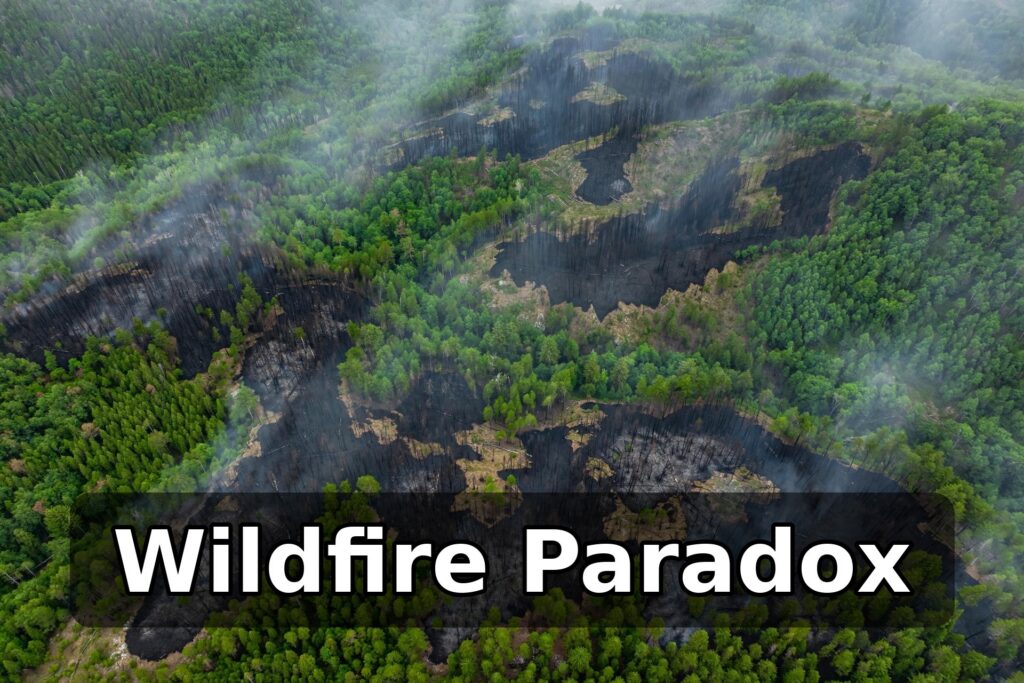
Wildfire Season Is Getting More Extreme in Some Regions—So Why Is Global Burning Falling?
The AP notes a genuine paradox: wildfire damage is worsening in North America and Europe even as total global burned area declines — because most global burning happens in grasslands being fragmented by land-use change, not in forests.
Key points
- In North America and Europe, wildfire seasons have become more extreme: fires are larger, more destructive and more costly, and smoke darkens skies hundreds of kilometres away.
- At the same time, the total area burned across the whole planet has been declining — and both trends are real.
- The decline is driven by tropical grasslands and savannas, especially in Africa, where most of the world’s burning happens and where farming, roads and settlements have broken up the grass that once carried fire.
- Counting hectares alone understates the danger: a boreal forest fire releases far more carbon per hectare than a savanna grass fire and threatens communities in ways a remote grass fire does not.
Here is a puzzle that confounds simple headlines about wildfire. In North America and Europe, wildfire seasons have become more extreme: fires are larger, more destructive and more costly, and smoke from them darkens skies hundreds of kilometres away. Yet at the same time, the total area burned by fire across the whole planet has been declining.
These two trends can coexist, and understanding how is essential to understanding what is really happening to fire on a changing planet. The temptation is to simplify the story into “wildfires are increasing everywhere” or “wildfires are decreasing.” Both simplifications are wrong, and the truth — the paradox itself — is the point.
Fire is not a single global phenomenon. It is many different phenomena, in different ecosystems, driven by different causes and moving in different directions. A wildfire in a Canadian boreal forest, a grass fire on an African savanna and a brush fire in the Mediterranean have almost nothing in common except flame. Their trends reflect different climates, different land uses and different human actions, and adding them together into a single global total obscures as much as it reveals.
Why fire is getting worse in North America and Europe
In the forests of North America and the Mediterranean landscapes of Europe, several forces are converging to make fire seasons more severe. The climate is one. Hotter temperatures dry out vegetation and soils, extend the fire season and increase the number of days when fires can ignite and spread rapidly. Droughts that were once occasional have become more frequent and more prolonged in some regions, leaving forests primed to burn.
When a fire does start under these conditions, it burns hotter, spreads faster and is harder to control. But climate is not the only driver, and in some places it is not even the main one. A century of fire suppression in North America has allowed fuels to accumulate in forests that historically burned frequently at low intensity.
Without those regular, gentle fires to clear undergrowth, forests have grown dense with flammable material, so that when a fire finally escapes control, it burns with an intensity the ecosystem is not adapted to. The policy of suppressing every fire, adopted to protect timber and settlements, has paradoxically made the fires that do occur far more dangerous.
In Europe, a related dynamic is at work. Rural depopulation has left farmland and managed woodland abandoned, and unmanaged vegetation — shrubs, young trees and dry grass — has spread across landscapes that were once grazed, farmed or carefully tended. These unmanaged fuels provide a continuous path for fire to travel, and when a hot, dry summer arrives, the result can be a fast-moving blaze through terrain that no longer has the firebreaks and managed mosaics that once limited its spread.
The abandonment of the countryside, driven by urbanisation and changing agricultural economics, has thus become a fire risk in its own right. The expansion of human settlement into fire-prone areas compounds the danger. More homes, businesses and infrastructure now sit at the edge of forests and shrublands, in what fire managers call the wildland-urban interface.
A fire that once would have burned through empty forest now threatens neighbourhoods, and the cost of damage — in lives, property and firefighting expenditure — has risen sharply even where the area burned has not. The growing severity of wildfire in North America and Europe is therefore partly a story about what is in the fire’s path, not only about how much land burns.
| Driver | North America | Europe |
|---|---|---|
| Climate | Hotter temperatures dry vegetation, extend the fire season, more frequent drought | Hot, dry summers ignite unmanaged vegetation |
| Fuel build-up | A century of fire suppression let fuels accumulate in forests that burned frequently at low intensity | Rural depopulation left abandoned farmland and woodland covered in shrubs and dry grass |
| Human settlement | More homes at the wildland-urban interface | Fewer firebreaks and managed mosaics as the countryside empties |
Why global burned area is falling
If fire is getting worse in these regions, why is the global total declining? The answer lies in the parts of the world where most burning happens, and in how human activity there has changed. The majority of the planet’s burned area is not in forests at all; it is in tropical and subtropical grasslands and savannas, particularly in Africa, where fire has been used for millennia to manage grazing land, clear fields and control pests.
These are the fires that dominate the global statistics, and their extent is shrinking. The reason is land-use change. As savannas are converted to cropland, as grazing patterns change, and as landscapes are fragmented by roads, fields and settlements, the continuous expanses of grass that once carried fire across vast areas are broken up.
A fire that once swept across an open savanna now meets a field, a road or a village and stops. Population growth, agricultural expansion and urbanisation have all reduced the area available to burn, and fire suppression in some regions has added to the effect.
This decline is not necessarily good news for ecosystems. Savanna ecosystems evolved with fire, and many of their plants and animals depend on regular burning to maintain the open grassland structure. When fire is removed, woody shrubs and trees can encroach, changing the habitat and reducing its diversity. The decline in burned area therefore represents a profound transformation of these landscapes, not a simple improvement. It is a sign that human activity is reshaping fire regimes everywhere — sometimes by making fire worse, sometimes by removing it altogether.
Two trends, one planet
The paradox resolves when the two trends are seen as products of the same underlying force: human transformation of landscapes, interacting with a changing climate. In wealthy, forested regions, a history of fire suppression, rural abandonment and development at the forest edge has created conditions for extreme fires, and climate change is amplifying them. In tropical grasslands, agricultural expansion and fragmentation have reduced burning, even as the ecosystems that depended on fire are altered in the process.
| Forested regions (North America, Europe) | Tropical grasslands and savannas (especially Africa) | |
|---|---|---|
| Burned area trend | Fire seasons more extreme; larger, more destructive fires | Total burned area declining |
| Main driver | Hotter, drier climate plus accumulated fuel and settlement at the forest edge | Land-use change: cropland, roads, settlements fragmenting grassland |
| Carbon per hectare | High — carbon stored over decades or centuries in trees and soils | Low — grasses regrow within a season or two |
| Main risk | Lives, property, infrastructure, long-term carbon release | Loss of fire-dependent habitat as shrubs and trees encroach |
Neither trend cancels the other. The decline in global burned area does not mean the wildfire problem is solved, because the fires that matter most for human lives, property and carbon emissions are concentrated in the regions where fire is getting worse.
A boreal forest fire releases far more carbon per hectare than a savanna grass fire, and it threatens communities and infrastructure in ways a remote grass fire does not. Counting hectares alone therefore understates the danger, just as counting only the extreme fires overstates the global trend.
The carbon difference
The carbon implications deserve particular attention. Boreal and temperate forest fires release carbon stored over decades or centuries in trees and soils, and when those forests burn severely, they may take a very long time to recover their carbon stocks — if they recover at all, given that a warming climate may favour different vegetation.
Savanna fires, by contrast, burn grasses that regrow within a season or two, cycling carbon quickly rather than releasing long-term stores. The global burned-area total treats these two kinds of fire as equivalent, but for the climate they are profoundly different.
That difference is why a falling global total can coexist with a worsening climate risk from fire. The hectares that are no longer burning are mostly grass that would have regrown quickly. The hectares that are burning more severely are mostly forest whose carbon took generations to accumulate.
What is still uncertain
A single global total hides the split. Adding a Canadian boreal fire, an African savanna fire and a Mediterranean brush fire into one number obscures the fact that they are different phenomena moving in different directions.
Recovery after severe forest fire is not guaranteed. Forests may take a very long time to recover their carbon stocks, and a warming climate may favour different vegetation instead — but how often recovery fails is not settled by a burned-area total.
Savanna change cuts both ways. Less burning preserves grassland from fire in the short term, yet the ecosystems that evolved with fire can degrade as shrubs and trees encroach. Less fire is not the same as healthier habitat.
What this means
The paradox is a warning against single-number thinking. A global statistic can move in one direction while the risks that matter most move in the other, and a headline that reports only the total will mislead.
Severity matters more than area. What decides the human and climate cost is not only how many hectares burn but what burns, how hot it burns, and what stands in its path.
Both transformations carry consequences. Intensified fire where forests meet a hotter climate and a century of accumulated fuel, and diminished fire where grasslands meet the plough and the road — each demands attention, for opposite reasons.
What should change
In North America and Europe, reduce the severity of fires that do occur. Restore the role of low-intensity fire through prescribed burning, thin overgrown forests, manage fuels around communities, and plan development so that fewer homes sit in the fire’s path. Climate action matters too, because hotter and drier conditions will keep pushing fire behaviour toward the extreme, but adaptation to the fuels and landscapes that already exist is equally urgent.
In tropical grasslands, manage the transition rather than suppressing fire wholesale. Blanket fire suppression in savannas can do as much harm as good, and policies need to distinguish between fires that maintain ecosystems and fires that destroy them, while preserving the livelihoods of people who depend on fire as a land-management tool.
Report fire in more than one number. Burned area, carbon released, homes threatened and ecosystem type all describe different parts of the risk. Any one of them alone tells a misleading story.
Fire, transformed
The honest story of fire in the twenty-first century is not that it is simply increasing or decreasing. It is that fire is being transformed — intensified where forests meet a hotter climate and a century of accumulated fuel, diminished where grasslands meet the plough and the road — and that both transformations carry consequences that demand attention.
Raina





댓글 0
첫 댓글을 남겨보세요.