
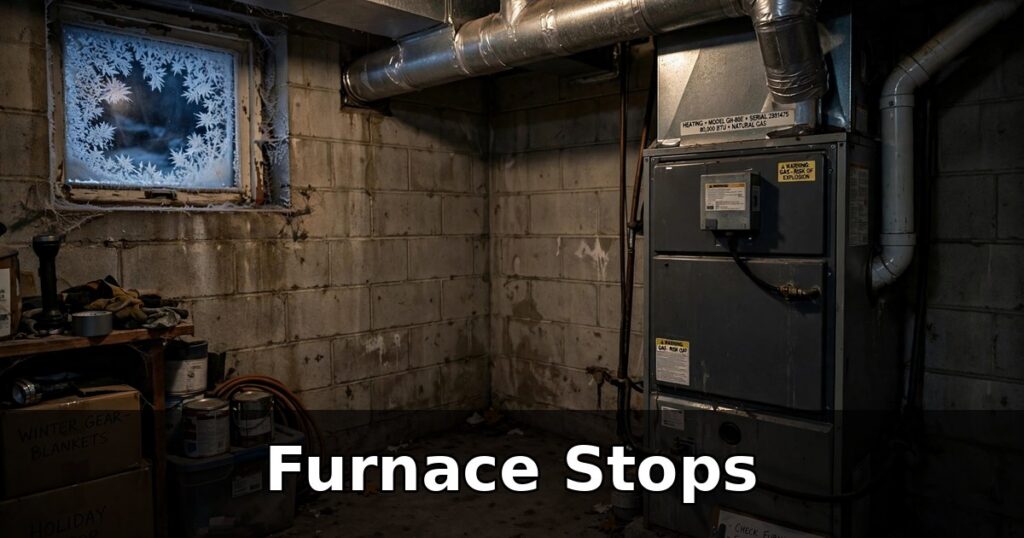
What to Do When Your Furnace Stops in the Middle of a Cold Snap
Key points
- First rule out the simple causes: thermostat setting and batteries, a tripped breaker, the furnace service switch, and a clogged air filter — the most common culprit of all.
- A typical gas furnace lasts 15–20 years. Under about 10–12 years old with a single failed part, repair usually wins; past 15 with repeated breakdowns, replacement starts to make sense.
- Pipes are at serious risk when the outdoor temperature falls to 20°F or below for 6 hours or more. A burst pipe can release more than 250 gallons of water a day from a small crack.
- Water damage and freezing claims average about $15,400 per claim in U.S. industry data — and one insurer’s freeze claims averaged more than $30,000.
- Never heat a home with an oven, a gas range, a grill or a generator indoors. More than 400 Americans die each year from unintentional carbon monoxide poisoning not linked to fires.
A furnace rarely fails on a mild afternoon. It fails at 2 a.m. during the coldest week of the year, when every heating company in town is booked solid and the temperature outside is still falling. The house starts cooling immediately, and the clock that matters is not the repair schedule — it is the pipes.
First, make the house safe
Two dangers kill people during heating failures, and neither is the cold itself. The first is carbon monoxide. More than 400 Americans die each year from unintentional carbon monoxide poisoning not linked to fires, according to the Centers for Disease Control and Prevention. Carbon monoxide has no smell and no colour, and its early symptoms — headache, dizziness, weakness, nausea, vomiting, chest pain and confusion — feel like the flu, which is why it is so often missed.
If a carbon monoxide alarm sounds, or if several people in the house develop those symptoms at once, get everyone outside into fresh air immediately and call emergency services. Do not stay inside to investigate, and do not re-enter until professionals say it is safe. People who are asleep can die from carbon monoxide poisoning before they notice any symptoms, which is why the alarm — not the nose — is the protection.
The second danger is fire from improvised heat. A gas range or oven should never be used to heat a home, and neither should a charcoal grill, a camp stove or a portable generator indoors, in a basement or in a garage.
A gas smell is a third, separate emergency. If gas is smelled, leave the house right away without flipping switches or using a phone indoors, and call the gas utility’s emergency line from outside. Soot, scorch marks around the furnace, or a lazy yellow flame instead of a steady blue one are also reasons to turn the heat off at the thermostat and have the unit inspected. A cracked heat exchanger is a carbon monoxide risk and is the finding that most often ends a furnace’s life.
The five-minute checks
Start at the thermostat. Make sure it is set to heat, not cool or off, and that the set temperature is above the current room temperature. If the thermostat uses batteries, replace them — dead batteries are one of the most common causes of a furnace that simply never receives the call for heat.
Next, check the electrical panel for a tripped breaker labelled furnace, and check the service switch on or near the unit itself. The service switch looks like an ordinary wall switch, and it is easy to bump off. Both take seconds to check.
Then pull the air filter. A clogged filter starves the furnace of air, the unit overheats, and most modern furnaces shut down on a safety limit rather than keep running hot. A filter that is grey and packed with dust should be replaced. While the filter is out, confirm that the furnace’s front panel is seated firmly — most units will not run with the door switch open — and that supply vents and return grilles are not blocked by furniture or rugs.
What the symptoms mean
| Symptom | Most likely cause | What to do |
|---|---|---|
| Furnace completely silent, nothing runs | Thermostat, dead batteries, tripped breaker, service switch off | Run the five-minute checks above |
| Blower runs but no heat comes out | Ignition or flame-sensing fault | Call a technician; do not open the burner area |
| Burners light, then shut off within seconds | Dirty flame sensor | Technician cleaning or replacement; a common, inexpensive repair |
| Furnace starts and stops repeatedly | Clogged filter, flame sensor, pressure switch, condensate blockage | Replace the filter first, then call if cycling continues |
The pattern matters more than any single symptom, so note what the unit does in order: does the blower start, do the burners light, how long do they stay lit? Two parts account for a large share of no-heat calls: the hot surface igniter, which cracks or burns out so the burners never light, and the flame sensor, which becomes coated so the burners light and then shut off within seconds. Both are small parts on an otherwise healthy furnace. Age changes the meaning of the same symptom — an igniter failure on a 7-year-old furnace is routine maintenance, while the same failure on a 19-year-old furnace that has already needed two repairs this winter is a different conversation.
Protect the pipes while you wait
While the furnace is down, the pipes become the emergency. Water freezes at 32°F, but pipes inside a heated house lag well behind the outdoor air. Field research by the University of Illinois Building Research Council puts the serious-risk line at 20°F or below for unprotected pipes in unheated spaces — and uninsulated pipes can freeze solid in 6 to 12 hours at that temperature, or in as little as 2 to 4 hours near 0°F.
When water freezes it expands by about 9%, and that expansion creates pressure that can exceed 2,000 pounds per square inch — enough to crack even metal pipe. The burst usually happens not where the ice forms but between the ice blockage and the nearest faucet, where pressure builds with nowhere to go. A small crack can release more than 250 gallons of water a day, according to State Farm.
The cost is the reason this section comes before the comfort section. Industry data from the Insurance Information Institute puts the average water damage and freezing claim at about $15,400 for 2019–2023. State Farm’s own freeze claims, from 2024 through June 2025, averaged more than $30,000 each across more than 20,000 claims. The pipe itself is usually the cheapest part of the bill; the water damage is the expensive part, and most policies cover the damage but not the pipe.
Four actions, in order, protect the pipes. First, keep the house as warm as possible and hold one temperature day and night — the American Red Cross recommends against setting the thermostat back during extreme cold, and a minimum of 55°F for a home left unoccupied in winter. Second, let faucets drip, starting with the fixture farthest from the water heater or on an exterior wall; moving water freezes more slowly, and an open tap gives pressure somewhere to go. Third, open cabinet doors under sinks so warm air reaches the pipes. Fourth, know where the main water shutoff is, so the water can be stopped in seconds if a pipe bursts.
Keeping warm without the furnace
While waiting for a repair, the goal is to keep people warm in one part of the house, not to heat the whole house by other means. Close off unused rooms, hang a blanket over a doorway, and gather in the smallest well-insulated room. Layers, hats indoors and warm drinks do more than most people expect. Below 64°F indoors, older people, infants and anyone frail or unwell are at real risk.
An electric space heater can help, but it is the most dangerous appliance commonly used in this situation. The U.S. Consumer Product Safety Commission estimates portable heaters were involved in an average of 1,600 fires a year, with 70 deaths, in 2020–2022. Keep at least 3 feet of clearance from anything that can burn, plug the heater directly into a wall outlet rather than an extension cord, and turn it off when sleeping or leaving the room.
Fuel-burning heaters should not be used indoors unless they are designed and vented for it. Unvented kerosene and propane heaters release carbon monoxide and consume oxygen, and several states ban them outright. A fireplace can help if the chimney is clear and the flue is open, but a blocked chimney can push carbon monoxide back into the room.
Repair or replace?
| Furnace age | What to expect | Usual advice |
|---|---|---|
| 0–10 years | Mostly routine upkeep; failures are usually single parts | Repair |
| 10–15 years | More repairs; efficiency can slip | Repair, but start tracking repair frequency and cost |
| 15–20 years | Higher chance of major component failures | Budget for replacement; weigh each repair against it |
| 20+ years | Reliability drops sharply | Replace rather than chase repeated repairs |
A residential gas furnace typically lasts 15 to 20 years with regular maintenance and proper installation — a planning guide, not a deadline: a 17-year-old furnace that starts every time can keep going, while a 9-year-old unit with three service calls in two winters is telling a different story.
Repair usually wins when the furnace is under roughly 10 to 12 years old, has a clean service record, and the problem is a single identifiable part — an igniter, a flame sensor, a capacitor or a pressure switch. Replacement starts to make more sense when several signs line up: the furnace is near or past 15 years, repairs have become frequent, the latest repair involves a major component such as the heat exchanger or the main control board, and heating bills have risen without any change in use.
One rule of thumb used across the industry is cost: if a repair approaches 30–50% of the cost of a new unit, replacement is usually the better value, because the money buys a warranty and a modern efficiency rating rather than a few more months from an aging system. Calling for service more than once in a single heating season, year after year, is a pattern, not bad luck — and an older furnace loses efficiency as it ages, so the same house costs more to heat each winter even when nothing has visibly broken.
What should change
Service the furnace before the heating season, not during it. An annual inspection catches weak igniters, flame-sensing problems and venting issues while the weather is still mild and technicians still have appointments. The cost of a tune-up is small against an emergency call at 2 a.m., and the inspection is also when a cracked heat exchanger or a blocked flue is found before it becomes dangerous.
Put filter changes on a calendar. The most common no-heat cause in this guide is also the most preventable. A filter check every month during the heating season, replaced whenever it is grey and packed, keeps the safety limit from shutting the unit down on the coldest night of the year.
The order that saves the house
A furnace failure in a cold snap is a race, and the race is not against discomfort — it is against the pipes. Safety first, because carbon monoxide and improvised heat kill faster than cold. The five-minute checks second, because the most common causes are also the simplest. The pipes third, because a burst pipe costs thousands and the damage is done in hours. Warmth fourth, in one room, with a space heater kept three feet from anything that burns. And the repair-or-replace decision last, made with the furnace’s age, its repair history and the cost of the fix in hand — after the house is warm again.
Raina





댓글 0
첫 댓글을 남겨보세요.