
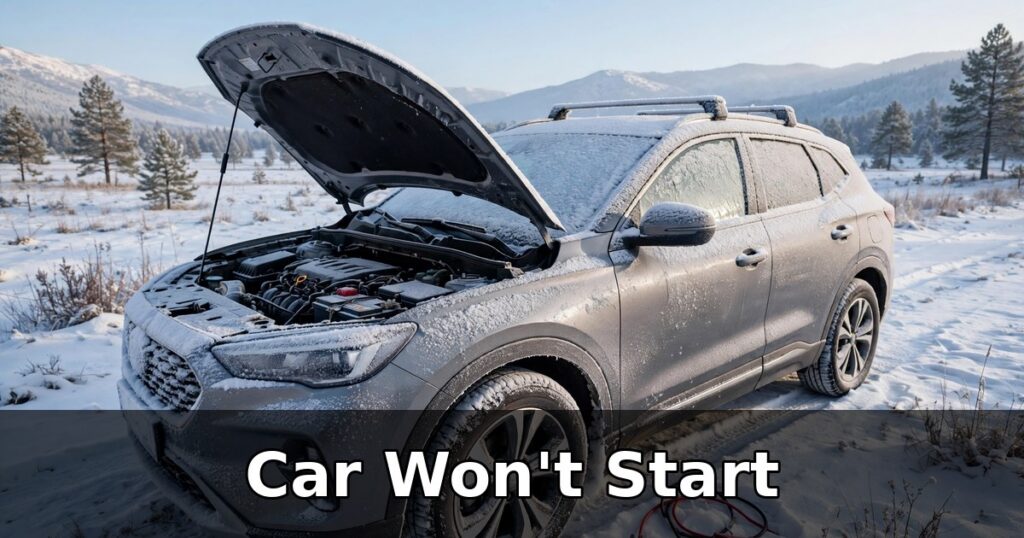
What to Do When Your Car Won’t Start in Extreme Cold
On a cold morning, a car that started without complaint all autumn can fall silent. The key turns, the dashboard lights dim, and the starter motor produces a slow groan or a rapid clicking sound before giving up entirely. The scene is familiar to anyone who lives where winter temperatures fall far below freezing, and it is also one of the most common reasons drivers call for roadside assistance. Consumer Reports, citing figures from the American Automobile Association, reported that battery-related roadside calls still topped 5.7 million in a single recent year. Cold weather does not create the weakness that causes these failures. It exposes a weakness that was already present, at the moment when the car needs the most power and has the least available.
Key points
- A battery loses about 35% of its strength at 32°F and about 60% at 0°F, while the engine needs up to twice the normal current to turn over.
- Battery-related roadside calls still topped 5.7 million in a single recent year.
- A fully charged battery reads about 12.6 volts at rest; 12.4 volts or below means a charge is needed, and 11.9 volts or below is generally a dead battery.
- The average car battery lasts three to five years, and a battery in its fourth winter should be tested even with no symptoms.
- If a jump start fails after three attempts, stop cranking and call for roadside assistance.
On a cold morning, a car that started without complaint all autumn can fall silent. The key turns, the dashboard lights dim, and the starter motor produces a slow groan or a rapid clicking sound before giving up entirely. The scene is familiar to anyone who lives where winter temperatures fall far below freezing, and it is one of the most common reasons drivers call for roadside assistance. Consumer Reports, citing figures from the American Automobile Association, reported that battery-related roadside calls still topped 5.7 million in a single recent year.
Why cold drains a battery
The American Automobile Association estimates that a battery loses about 35% of its strength at 32°F and about 60% at 0°F. The Battery Council International gives a similar figure, reporting that capacity can fall by up to 60% at 0°F. A battery that was already weakened by age or by a low state of charge has even less to give, which is why the first hard freeze of the season produces a wave of failures among batteries that seemed healthy a week earlier.
Age is the most important factor after temperature. The American Automobile Association puts the average life of a car battery at three to five years, and batteries in the coldest northern regions tend to last longer than batteries in hot southern climates, because heat accelerates the corrosion that ages a battery. A battery in its fourth winter is therefore a candidate for testing even when it shows no obvious symptoms. Testing is simple and usually free at auto parts stores, and a load test measures what matters: the ability of the battery to deliver a large current under load, rather than the resting voltage alone. A battery that reads a healthy voltage with no load can still collapse when the starter demands hundreds of amps.
The state of charge matters just as much as age. A fully charged battery should read about 12.6 volts at rest, according to guidance from Interstate Batteries. A reading below 12.4 volts indicates that a charge is needed, and a reading at or below 11.9 volts is generally treated as a dead battery. Short trips make the problem worse, because starting the engine consumes a large amount of charge and a short drive does not give the alternator enough time to replace it. Repeated short trips in cold weather can leave a battery progressively more discharged.
A discharged battery is vulnerable in a second way. According to Interstate Batteries, a fully charged battery will not freeze until the temperature falls far below zero, while a discharged battery can freeze at about 15°F. A frozen battery can be damaged permanently, so keeping the battery charged matters more in winter than at any other time of year.
Why the engine needs more power
While the battery is losing strength, the engine is asking for more of it. Engine oil thickens as the temperature falls, and thick oil resists the motion of the crankshaft, the pistons, and the bearings. The starter motor must overcome that resistance, and the extra effort draws a larger current from a battery that has less current to give. The American Automobile Association notes that a car can need up to twice the normal current to start in freezing conditions.
The effect is strongest in older engines and in engines filled with a heavy grade of oil, and it is one reason why manufacturers specify lighter winter oil grades for cold climates. A multi-grade oil such as 5W-30 flows far more readily at low temperatures than a single-grade oil, and the first number in the grade is the measure that matters in winter.
Cold cranking amps and what to buy
The rating that matters most for winter starting is cold cranking amps, usually shortened to CCA. The CCA rating is defined by a standard test: a new, fully charged battery is chilled to 0°F, and the CCA figure is the current the battery can deliver for 30 seconds while staying at or above 7.2 volts. A higher CCA rating means more starting power in the cold, and the rating is printed on the battery label.
When a battery is replaced in a cold climate, choosing a battery with a CCA rating at or above the vehicle manufacturer’s specification is the single most useful decision. A battery with a higher CCA rating than specified does no harm, while a battery with a lower rating will struggle on the coldest mornings.
The first checks when the car will not start
| What you see or hear | What it usually means |
|---|---|
| Bright dashboard lights, engine turns slowly | Battery weak but not dead; a jump may work |
| Dim or absent lights | Battery deeply discharged, or a connection has failed |
| Bright lights, rapid clicking, engine does not turn | Enough voltage but not enough current — common in cold weather |
| Engine turns over normally but does not catch | More likely fuel or ignition than battery; further cranking only drains the battery |
The battery terminals deserve a look before any jump start is attempted. Corrosion appears as a white, blue, or green crust around the terminals, and it increases resistance exactly where the current must flow. Loose terminals can be wiggled by hand, and a loose terminal can produce all the symptoms of a dead battery. Cleaning the terminals with a wire brush and tightening the clamps restores the connection, and applying a thin coat of petroleum jelly or a purpose-made terminal protector slows the return of corrosion. The ground connection, where the negative cable meets the body of the car, should be checked as well, because a corroded ground produces the same symptoms as a weak battery.
Jump-starting safely
A jump start is safe when the battery is merely flat, and it is dangerous when the battery is damaged. The American Automobile Association warns against jumping a battery with cracks, a bulging case, or a strong smell of rotten eggs, because those are signs of leaking acid and of hydrogen gas, which is explosive. A frozen battery should never be jumped, because a frozen battery can rupture or explode when current is applied. If the case is swollen, or if ice is visible, the correct action is to call for roadside assistance and let a professional handle the replacement. Both vehicles must use 12-volt systems, because connecting a 24-volt system from a commercial truck to a car can destroy the electronics of the car immediately.
The connection order is the part of the procedure that matters most, and the American Automobile Association publishes the same sequence that appears in most vehicle manuals. The two cars should be parked close together but not touching, both ignitions should be switched off, and the parking brakes should be set. The first red clamp goes to the positive terminal of the dead battery, and the other red clamp goes to the positive terminal of the good battery. The first black clamp goes to the negative terminal of the good battery, and the final black clamp goes to a clean, unpainted piece of metal on the engine of the car with the dead battery, such as a thick bolt on the engine block. The final clamp is the one that can spark, and placing it on the engine block keeps the spark away from the battery and away from any hydrogen gas around it.
Once the cables are connected, the healthy car should be started and allowed to run for three to five minutes, with the engine held slightly above idle, so that some charge builds up in the dead battery. The car with the dead battery can then be started. If the engine does not start after a few attempts, the American Automobile Association advises stopping after the third try, because a battery that will not start after three attempts has most likely failed completely. The cables should be removed in exactly the reverse order: black from the engine metal, black from the good battery, red from the good battery, and finally red from the revived battery, with the clamps kept apart as they come off.
The revived car should then be driven for at least 30 minutes, because idling alone does not recharge a deeply discharged battery quickly, and the battery should be tested as soon as possible to find out whether it can hold a charge.
Portable jump starters and block heaters
A block heater is the most effective cold-weather accessory for a car that must start reliably at very low temperatures. The heater warms the engine coolant, which in turn warms the engine block and the oil, so the starter has less resistance to overcome and the battery has more power to give. In many northern regions, block heaters are factory equipment, and the car is supplied with a cord that plugs into a household outlet. The heater should be plugged in for a few hours before the car is needed, and a timer can switch it on in the early morning so that electricity is not wasted all night. A battery blanket or a battery warmer serves a similar purpose for the battery itself, keeping the battery closer to a temperature at which the chemistry works well. Parking in a garage, even an unheated one, also helps, because the temperature inside a garage is typically several degrees warmer than the temperature outside, and the car is sheltered from wind.
Prevention through the winter
| Measure | Detail |
|---|---|
| Battery test | Before winter; every year once the battery is more than 3 years old |
| Terminals | Cleaned, tightened, and protected against corrosion |
| Oil | Changed to the winter grade specified by the manufacturer |
| Fuel tank | Kept at least half full in winter, to reduce condensation and leave a margin if the car must idle for warmth |
| Coolant | Checked so the mixture protects the engine below the coldest expected overnight low |
When the car still will not start
A stranded car in extreme cold is also a safety problem for the people inside it. If the car will not start and help is on the way, the occupants should stay with the car, because a car provides shelter from wind and is easier for rescuers to find than a person on foot. The exhaust pipe should be kept clear of snow if the engine is running, because a blocked exhaust can force carbon monoxide into the cabin. Warm clothing, a blanket, and a charged phone should be part of the winter emergency kit in the trunk, along with jumper cables, a flashlight, and a small shovel. The kit is rarely needed, and on the morning it is needed, it is the difference between an inconvenience and an emergency.
What this means
Testing the battery in autumn, keeping it charged, using the correct oil, and knowing the safe jump-start procedure address the problem at every point where it can be addressed. The cold itself cannot be changed, but the condition of the battery and the engine can be, and that is what determines whether the car starts on the coldest morning of the year.
Raina





댓글 0
첫 댓글을 남겨보세요.