
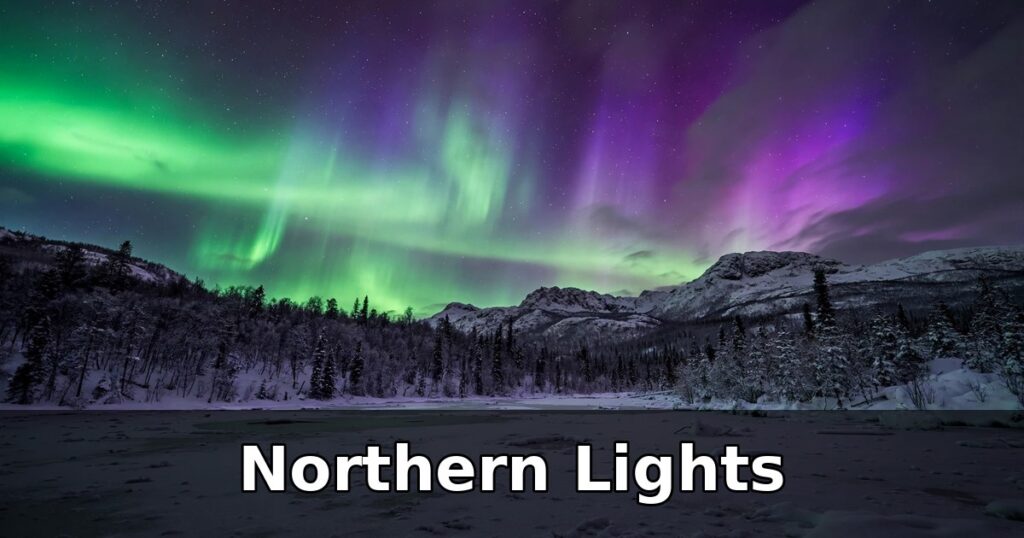
What Causes the Northern Lights? The Solar Wind, Explained
Key points
- The northern lights begin with the solar wind — a stream of charged particles from the Sun, usually travelling at about 400 km/s.
- When the solar wind’s magnetic field points south, magnetic reconnection lets particles slip past Earth’s magnetic shield and flow toward the poles.
- The particles collide with oxygen and nitrogen at 100 to 300 km altitude. Oxygen makes the familiar green light at 557.7 nm; oxygen higher up makes red, and nitrogen makes blue and purple.
- The strongest storms reach G5 (Kp 9). In the May 2024 Gannon storm, auroras were photographed as far south as Texas, Florida and Mexico, near 25°N.
On a clear winter night in the far north, the sky can begin to move. A pale green arc appears low on the horizon, brightens, and starts to ripple like a curtain in a wind nobody can feel. Then it may break into rays, fold over itself, and sweep across the whole sky in a matter of minutes. People who have seen it once tend to remember the silence most of all: the brightest display in the sky makes no sound at all.
The northern lights look like weather, but they are not weather in the ordinary sense. No cloud, no rain and no wind in the lower atmosphere is involved. The display is made high above the weather, in the thin air 100 to 300 kilometres overhead, and its real cause is 150 million kilometres away — on the Sun.
The short answer is that the lights are sunlight’s after-effect. The Sun constantly throws off a stream of electrically charged particles called the solar wind. Most of those particles are turned aside by Earth’s magnetic field. A few get through, are funnelled toward the poles, and crash into the gases of the upper atmosphere. Each collision gives an atom a jolt of energy, and when the atom settles back down it releases that energy as light.
The solar wind: a stream, not a breeze
The solar wind is a continuous flow of charged particles — mostly protons and electrons — streaming outward from the Sun’s outer atmosphere, the corona. In its usual, quiet state it travels at about 400 km/s. That is fast enough to cross the distance from the Sun to Earth in roughly four days, and it never stops. Earth sits permanently inside this stream, the way a rock sits permanently in a river.
The wind is not always steady. Sometimes the Sun throws off a far larger burst called a coronal mass ejection, or CME. A CME is a cloud of billions of tonnes of charged material, and it can travel at millions of kilometres per hour. A fast CME can reach Earth in as little as one day; a slower one takes up to four days. When a CME arrives, the solar wind presses much harder on Earth’s magnetic field, and the aurora becomes brighter, more active and visible much further from the poles.
Earth’s magnetic shield — and how particles get past it
Earth’s magnetic field acts as a shield. It deflects most of the solar wind around the planet, forming a vast magnetic bubble called the magnetosphere. Without it, the solar wind would strip away the atmosphere over time and the aurora would not exist in its present form, because the particles would hit the atmosphere everywhere rather than being channelled to the poles.
The shield has a weak point, and it depends on direction. When the magnetic field carried by the solar wind points south — opposite to Earth’s field at the dayside boundary — the two fields can join together in a process called magnetic reconnection. The joined field lines open a door: solar wind particles can flow in, and energy stored in the magnetic field is released into the magnetosphere.
Once inside, the particles are guided by Earth’s magnetic field lines toward the poles, like beads sliding along wires. They spiral down into the upper atmosphere above the polar regions, where the air is thin but not empty. That is where the light is made.
Why the lights are green, red and purple
The colours of the aurora are set by which gas is hit, and at what height. The particles collide with oxygen and nitrogen atoms in the upper atmosphere, transferring energy to them. An excited atom cannot hold that energy for long; when it returns to its normal state, it emits light at a wavelength characteristic of that atom.
Green is the colour most people picture, because it is by far the most common. It comes from oxygen atoms at altitudes of about 100 to 240 km, emitting light at a wavelength of 557.7 nanometres. The green light appears quickly after the collision, so it dominates in bright, active displays.
Red comes from oxygen too, but higher up — above about 200 km, where the air is thinner. There, an excited oxygen atom can stay excited for longer before colliding with another atom, and when it finally releases its energy it emits red light at 630 nm. Red auroras are rarer and often appear as a soft glow above the green curtain.
Blue and purple come from nitrogen, at lower altitudes. Nitrogen emissions are weaker and shorter-lived, so blue and purple usually appear as fringes along the lower edge of a bright display, or in the rays of a particularly intense storm. The shape matters too: when the aurora is viewed from below, its long vertical rays look like curtains, because the light is spread along magnetic field lines that point almost straight up at the poles.
| Colour | Gas | Altitude | Wavelength |
|---|---|---|---|
| Green (most common) | Oxygen | 100–240 km | 557.7 nm |
| Red | Oxygen | Above 200 km | 630 nm |
| Blue and purple | Nitrogen | Lower altitudes | — |
The auroral oval and the storm scale
The aurora does not appear randomly over the sky. It forms in a ring around the magnetic pole called the auroral oval. In quiet conditions the oval sits over the high Arctic, roughly above northern Canada, Alaska, Greenland, Iceland, northern Scandinavia and Siberia. That is why the lights are a familiar sight in Tromsø and Fairbanks and a rarity in London or New York.
During a geomagnetic storm, the oval expands toward the equator. The stronger the storm, the further south the lights can be seen. The strength of storms is measured on NOAA’s G scale, from G1 (Kp 5), a minor storm, to G5 (Kp 9), the most extreme. At G5, the aurora can be visible below magnetic latitude 30° — far into the mid-latitudes.
NOAA estimates that a solar cycle of about 11 years contains, on average, about four days of G5 storm conditions. That rarity is part of what makes a great storm memorable: most people will see one, at most, a handful of times in a lifetime, and many will see none at all.
The Gannon storm of May 2024
The most recent great storm arrived in May 2024. Between 10 and 12 May, a series of eruptions from sunspot region AR 3664 — including X-class flares and at least seven CMEs between 8 and 10 May — produced the first G5 storm since the Halloween storms of October 2003. The planetary K-index reached Kp 9, and the Dst index, which measures the disturbance of Earth’s magnetic field, fell to a minimum of -412 nT.
The aurora that followed was seen far beyond the Arctic. It was photographed in Texas, Florida and Mexico, down to geographic latitude about 25°N, and in Spain, the Canary Islands, southern Japan, northern India and Hawaii. For many observers in those places, it was the first aurora of their lives — and for some, it may be the only one they ever see.
The Carrington Event of 1859
The benchmark for auroral storms is older than the electric grid. In September 1859, the Carrington Event — the strongest geomagnetic storm on record — disabled telegraph systems around the world. Operators reported sparks, fires and messages sent with batteries disconnected. Auroras were seen in the tropics, including Cuba and Hawaii, and were bright enough in some places to read by.
A reminder of that vulnerability came in March 1989, when a strong geomagnetic storm knocked out power in Quebec. About six million people lost electricity for about nine hours. The cause was not the aurora itself — the lights are harmless — but the electric currents the storm induced in the ground and in long power lines. The lights and the blackout are two effects of the same disturbance.
What the research says
The scientific story of the aurora began before spaceflight. In 1908, the Norwegian physicist Kristian Birkeland proposed that electric currents flow along magnetic field lines into the polar atmosphere, carried by charged particles from the Sun. The currents that bear his name — Birkeland currents — are now a measured part of the system: satellites have mapped them flowing into and out of the ionosphere above the auroral oval.
Dungey’s 1961 theory of magnetic reconnection gave the mechanism by which solar wind energy enters the magnetosphere. It explained why the aurora brightens when the interplanetary magnetic field turns southward, and why storms are episodic rather than continuous. NASA’s MMS mission, flying in formation through reconnection sites, has since measured the process in detail, including the speed at which field lines break and rejoin and the way electrons are accelerated in the process.
What is still uncertain
Forecasting exactly where and when the aurora will appear is hard. The key factor is the direction of the solar wind’s magnetic field — known as Bz — and it is measured only about an hour before the wind reaches Earth, by spacecraft sitting upstream. A southward turn can arrive with little warning, and a northward turn can end a display just as quickly.
Arrival times are uncertain too. A CME’s travel time depends on its speed and on the solar wind it travels through, so predictions of when a storm will hit can be off by hours. For aurora watchers, that means a forecast of a good night can fizzle, and a quiet forecast can be overtaken by a sudden brightening.
The Kp index is coarse. Because it is averaged over three hours, it smooths out short bursts of activity. A display that flares for twenty minutes and fades may barely register in the index, while a long, moderate disturbance can produce the same Kp as a brief, intense one. Local conditions — cloud cover, moonlight, light pollution — then decide whether the lights are actually visible from any given spot.
What this means
The aurora is a space weather report written in light. Its colours say which gases are being hit; its height says how much energy the particles carry; its spread says how hard the solar wind is pressing. A green arc low in the north means quiet conditions. A red-topped display reaching overhead means a storm is under way.
The same storm that paints the sky can strain the grid. The 1989 Quebec blackout is the clearest modern example, and the Carrington Event is the warning of what a larger storm could do. The lights themselves are safe to watch; the risk lies in the currents they accompany, in power lines and pipelines and satellites.
Great displays are rare, and they cluster around solar maximum. With Solar Cycle 25 peaking in October 2024, the years around the peak are the best time to look. The next chance of a G5 display may be years away, and when it comes, it may last only a night.
Light from the Sun, borrowed by the sky
The northern lights are the visible end of a chain that starts on the Sun: a stream of charged particles, a magnetic door opened by reconnection, a fall along field lines toward the poles, and a collision with oxygen and nitrogen a hundred kilometres overhead. Each part of the picture is a measurement, written in colour, of what the solar wind is doing to Earth.
Raina





댓글 0
첫 댓글을 남겨보세요.