
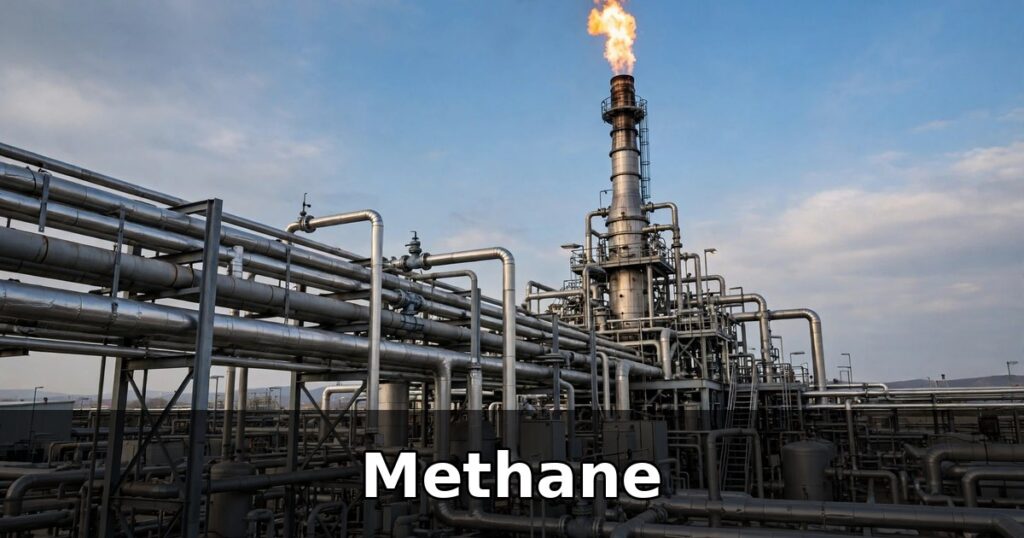
The Methane Problem: The Greenhouse Gas We Keep Overlooking
When people picture climate change, they usually picture carbon dioxide. It comes from chimneys, exhaust pipes, and power stations, it stays in the atmosphere for a very long time, and it dominates…
Key points
- Global methane emissions reached about 352 million tonnes per year in 2020 and are projected to rise to 369 million tonnes by 2030 under current legislation — a roughly 5 percent increase, not the cut the pledge demands.
- Methane is responsible for approximately 30 percent of the rise in global temperatures since the Industrial Revolution, yet it breaks down in the atmosphere over roughly a decade.
- Agriculture produces 42 percent of emissions, energy 38 percent, and waste 20 percent. The G20-plus group accounts for about 65 percent of the total.
- Implementing all technically feasible reductions could cut emissions by 32 percent by 2030, about 131 million tonnes, and avoid about 0.2 degrees Celsius of warming by 2050.
- Roughly 85 percent of emissions go unseen by satellites, because most sources are too small, too diffuse, or too intermittent to detect from space.
When people picture climate change, they usually picture carbon dioxide. It comes from chimneys, exhaust pipes, and power stations, it stays in the atmosphere for a very long time, and it dominates most climate targets. Methane is quieter, less visible, and easier to overlook, yet it has played an outsized role in the warming observed so far. It leaks from oil and gas equipment, rises from livestock and rice fields, and escapes from landfills and wastewater. It does not last as long in the atmosphere as carbon dioxide, but while it is there, it traps heat far more powerfully.
That combination — short life, strong effect — makes methane both a serious problem and an unusually fast opportunity. Cut it now, and the climate benefit arrives relatively quickly. Ignore it, and warming in the next decade or two will be higher than it needs to be. Methane is also a story about measurement. For years, emissions were estimated from activity data and standard factors, rather than measured directly. A country or company might report how much gas it produced or how many cattle it kept, then multiply by an assumed leakage rate. Satellites, aircraft, and ground sensors are now revealing a messier picture, with large, intermittent leaks — sometimes called super-emitters — that estimates missed.
A sobering report from late 2025
According to the United Nations Environment Programme, the Global Methane Status Report 2025 was launched on 17 November 2025 on the sidelines of COP30 in Belém, Brazil. The report, produced by UNEP and the Climate and Clean Air Coalition, serves as a mid-term evaluation of the Global Methane Pledge, which aims to cut methane emissions by at least 30 percent below 2020 levels by 2030. The pledge is now backed by 159 countries, according to reporting on the report.
The headline finding was sobering. Global anthropogenic methane emissions reached approximately 352 million tonnes per year in 2020, and under current legislation are projected to rise to 369 million tonnes by 2030, a roughly 5 percent increase instead of the reduction needed. In other words, on current policies, the world is heading in the wrong direction for methane, even though the pledge points the other way. UNEP noted that the projected rise has slowed since 2021, linked to better waste rules in Europe and North America and weaker expansion in natural gas markets, which lowered expected 2030 emissions by 14 million tonnes compared with an earlier baseline. That improvement is real, but it is not enough to change the overall direction.
The report also set out where methane comes from. Agriculture produced the largest share, accounting for 42 percent of emissions. Energy followed at 38 percent. Waste contributed 20 percent. The G20-plus group accounts for about 65 percent of total emissions. Full implementation of today’s national climate plans and methane action plans would cut emissions by 42 million tonnes by 2030, according to UNEP reporting, still short of the pledge. By contrast, implementing all technically feasible reductions could cut emissions by 32 percent by 2030, or about 131 million tonnes, which UNEP said could avoid about 0.2 degrees Celsius of warming by 2050 and more than 180,000 premature deaths annually by 2030 through improved air quality. Those figures are projections based on modelling, not observed outcomes, and they depend on measures actually being deployed at scale. They are useful, however, for showing the size of the prize.
Why methane punches above its weight
Methane’s importance comes from a trade-off between potency and lifetime. Carbon dioxide accumulates over centuries, which is why cumulative carbon dioxide emissions largely determine long-term warming. Methane, by contrast, breaks down in the atmosphere over roughly a decade, mainly through chemical reactions. While it is present, however, each tonne traps far more heat than a tonne of carbon dioxide over a short period. That is why methane is often described as responsible for approximately 30 percent of the rise in global temperatures since the Industrial Revolution, according to UNEP reporting on the 2025 report, even though its concentration in the atmosphere is far lower than that of carbon dioxide.
This distinction has practical consequences. Cutting carbon dioxide is essential for stopping long-term warming, because carbon dioxide keeps accumulating. Cutting methane is essential for slowing warming in the near term, because methane’s effect is strong and fast-acting, and because reductions show up relatively quickly as old methane breaks down and less new methane replaces it. The two tasks are complementary, not substitutes. A climate strategy that only cuts carbon dioxide will still leave a powerful, fast-acting warming agent largely untouched. A strategy that only cuts methane would slow warming for a decade or two but would not prevent long-term warming from continued carbon dioxide accumulation.
Three sectors, three different problems
| Sector | Share of emissions | The core difficulty |
|---|---|---|
| Agriculture | 42% | Millions of farmers, animals, and fields; solutions must protect food production |
| Energy | 38% | Leaks from valves, flaring, venting, and ageing equipment; often cheap to fix |
| Waste | 20% | Landfills and wastewater; systems differ enormously between cities |
The energy sector, at 38 percent, is often described as the lowest-hanging fruit. Oil and gas production, processing, and transport can leak methane through faulty valves, incomplete flaring, venting, and ageing equipment. Coal mining also releases methane trapped in coal seams. Many of these leaks can be found with cameras, sensors, and satellites, and fixed with known techniques such as leak detection and repair, replacing high-emitting equipment, and banning routine venting and flaring where alternatives exist. In some cases, capturing the gas and selling it can pay for the fix, which is why UNEP notes that over 80 percent of technically feasible reduction potential is available at low cost. That claim should not be read as meaning every fix is free or profitable in every location, because costs vary with geology, infrastructure, regulation, and gas prices, but it does suggest that energy-sector methane is unusually actionable compared with many other climate problems.
Agriculture, at 42 percent, is larger and harder. Livestock produce methane through enteric fermentation — essentially digestion — and manure management adds more. Rice cultivation produces methane when fields are flooded and organic matter decomposes without oxygen. Unlike a leaking valve, these sources involve millions of farmers, animals, and fields, with strong links to food security, livelihoods, and culture. Solutions exist, including improved livestock management, feed additives in some systems, better manure handling, and alternate wetting and drying for rice, but they must be adapted to local conditions, and they cannot simply be switched off without affecting food production. Progress here will be slower, more diffuse, and more dependent on extension services, finance, and trust than a pipeline repair programme.
Satellites can see some leaks, but not most emissions
One of the most important developments in methane science is the Methane Alert and Response System, known as MARS, operated through UNEP’s International Methane Emissions Observatory. Satellites can now detect very large methane plumes from oil and gas facilities, coal mines, and other concentrated sources, and alerts can prompt operators and regulators to investigate. This is a major advance over a system that relied almost entirely on self-reported estimates.
It is not, however, a complete solution. According to UNEP reporting, roughly 85 percent of emissions go unseen by satellites, because many sources are too small, too diffuse, or too intermittent for current satellites to detect reliably. A single large leak from a gas facility may be visible from space, but methane from millions of cattle, small farms, or scattered waste sites will not show up as a neat plume. Ground measurement, better inventories, and reporting based on actual measurement rather than generic factors are therefore essential. UNEP’s Oil and Gas Methane Partnership 2.0, which encourages companies to move from estimates to measurement-based inventories, is one attempt to close that gap, and the European Union’s methane regulations build on a similar principle. Without that groundwork, satellite alerts risk creating a false sense of precision, where the most visible leaks get fixed while the larger, diffuse background remains unaddressed.
Why pledges alone have not bent the curve
The Global Methane Pledge, launched in 2021, was designed to focus attention on a gas that had long been treated as a secondary issue. The fact that 159 countries now back it, and that 127 countries now include methane measures in their nationally determined contributions, a 38 percent increase from pre-2020 levels according to the 2025 report, shows that political attention has grown. Yet the report also found that only six countries — Canada, Japan, Moldova, Norway, the United States, and Vietnam — have national targets directly comparable to the pledge. Many other countries have methane measures, but not in a form that adds up cleanly to the 30 percent goal.
What cutting methane well would actually look like
A credible methane strategy would start with the energy sector, because that is where the cheapest, fastest, and most verifiable cuts are available. It would require regular leak surveys, rapid repair timelines, bans on routine venting, and measurement-based reporting, with penalties for non-compliance and public data so that citizens and researchers can check progress. It would also address coal-mine methane, which UNEP has begun tracking through a global database covering around 200 mines, because coal remains a significant, often overlooked source.
What is still uncertain
The benefits are modelled, not counted. The 0.2 degrees Celsius of avoided warming by 2050 and the 180,000 premature deaths avoided annually by 2030 are projections that depend on measures actually being deployed at scale, and on assumptions about exposure, population, and health effects.
The overlooked gas, reconsidered
Methane has been overlooked for understandable reasons. It is invisible, it comes from unglamorous places — a valve, a cow, a landfill — and it does not fit neatly into the carbon dioxide accounting that dominates climate policy. Yet the 2025 UNEP report makes the cost of that neglect clear. On current legislation, methane emissions are projected to rise, not fall, by 2030. The pledge to cut them by 30 percent remains technically feasible, according to UNEP, but only if proven measures are deployed at full scale across energy, agriculture, and waste.
That finding should not be read as a counsel of despair, nor as a claim that a single report can settle a complex science. It should be read as a prompt to treat methane as a first-order climate issue, alongside carbon dioxide, with its own targets, regulations, measurement systems, and finance. Cutting methane will not solve climate change on its own, because carbon dioxide’s long-term accumulation remains the central challenge. But failing to cut methane will make every other part of the task harder, by adding fast, powerful warming in the decisive next decade. The gas we keep overlooking may, in the end, be one of the fastest ways to buy time — if we choose to look at it directly, measure it honestly, and fix what we find.
Raina





댓글 0
첫 댓글을 남겨보세요.