
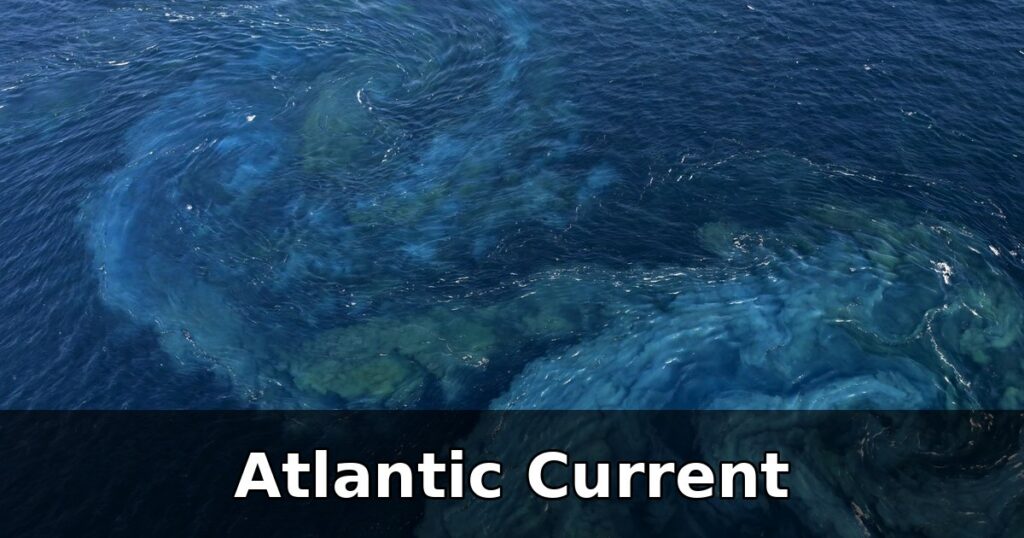
The Atlantic Current Is Slowing — and Weather Patterns Are Shifting With It
There is a patch of ocean south of Greenland that has stubbornly refused to follow the warming trend seen almost everywhere else. While much of the planet's surface has warmed, this region has stayed…
Key points
- A patch of ocean south of Greenland, the cold blob, has stayed cooler than expected while most of the planet warmed — and in some periods has even cooled.
- A study from the University of California, Riverside, published in June 2025, found the cold blob is caused by a weakening of the Atlantic Meridional Overturning Circulation (AMOC).
- A separate 2025 calculation put the slowing at about one Sverdrup per decade — a substantial change in how much water the system moves.
- The circulation has not stopped, and no timetable for a stop can be given — but the change is already leaving a fingerprint on North Atlantic surface temperatures and on the background conditions for weather.
There is a patch of ocean south of Greenland that has stubbornly refused to follow the warming trend seen almost everywhere else. While much of the planet’s surface has warmed, this region has stayed cooler than expected, and in some periods has even cooled. Oceanographers have long called it the cold blob, and for years it was treated mainly as a curiosity, a regional exception in an otherwise warming world.
A study from the University of California, Riverside, published in June 2025, gave that exception a clearer explanation. The cold blob, the researchers found, is caused by a weakening of one of the most important circulation systems in the Atlantic Ocean: the Atlantic Meridional Overturning Circulation, usually shortened to AMOC.
What the AMOC is
The AMOC is not a single river in the sea so much as a vast, slow-moving loop. Warm, salty water travels northward near the surface, carried in part by the Gulf Stream system, and as it reaches the high latitudes of the North Atlantic it cools, becomes denser, and sinks. That sinking water then returns southward at depth, completing a circuit that moves heat, salt, nutrients, and carbon around the ocean.
How much it has slowed
A separate 2025 paper added a measure of how much this circulation has changed. According to that calculation, the AMOC has slowed by about one Sverdrup per decade. A Sverdrup is a unit oceanographers use to describe very large volumes of water transport, and a decline of that size per decade, sustained over time, represents a substantial change in how much water the system moves.
It does not mean the circulation has stopped, and it does not mean it will stop on any particular timetable. What it does mean is that a system long assumed to be relatively stable on human timescales is measurably changing, and that change is already leaving a fingerprint on surface temperatures in the North Atlantic.
What the cold blob tells us
The cold blob matters because it is not just a map anomaly. It is evidence that a change in ocean circulation can override, locally at least, the broader warming signal. When less warm water arrives from the south, the surface ocean south of Greenland stays cooler. That cooler surface can in turn affect the air above it, the formation of storms, and the position of atmospheric patterns that steer weather across Europe and eastern North America.
It is important to be precise here. A cooler patch of ocean in one region does not contradict global warming, and it does not mean the planet is cooling. Global and regional trends can move in different directions for a time, especially when a circulation change redistributes heat rather than removing it from the climate system. Heat that is not delivered to one region may remain elsewhere, or be stored at depth, or be transported by a different route. The cold blob is therefore best understood as a sign of redistribution, not reversal.
The June 2025 UC Riverside study is valuable precisely because it connects a well-observed regional pattern to a physical cause. Scientists had previously discussed several possible explanations for the cold blob, including changes in wind patterns, increased freshwater from melting ice, and internal variability in the ocean itself. By identifying AMOC weakening as the cause, the study narrows that discussion and gives other researchers a clearer hypothesis to test against new observations.
Why a slower current changes weather far away
Ocean currents do not create weather directly in the way a storm does, but they set the conditions in which weather forms. Sea surface temperature influences how much moisture evaporates into the air, how stable or unstable the lower atmosphere becomes, and where the sharp temperature contrasts that drive mid-latitude storms tend to sit. When the North Atlantic warms unevenly, with a cooler patch beside warmer waters, those contrasts can shift.
Untangling cause and effect in a coupled system is difficult, and scientists are careful not to attribute any single storm, heatwave, or cold spell to a change in the AMOC. What can be said with more confidence is that a persistent change in the ocean’s heat transport is likely to affect the background conditions for weather over seasons and years, rather than determining the outcome of any individual weather event.
For Europe, this matters because the North Atlantic is upwind for much of the continent. Warmer or cooler waters, and shifts in storm tracks, can influence rainfall patterns, the persistence of blocking patterns that hold weather in place, and the character of winters and summers. For eastern North America, the Atlantic is likewise a key influence, particularly for coastal weather and for the storms that travel northward along the coast.
Why it happened: the science
| Factor | What it does |
|---|---|
| Warmer surface water | Warmer water is less dense and less likely to sink, weakening the sinking branch that drives the circulation. |
| More freshwater | Increased freshwater from rainfall, river runoff, and melting ice dilutes salty surface water in the North Atlantic, also making it less dense and less likely to sink. |
| Winds and sea ice | Winds, seasonal sea-ice changes, and basin shape also shape the circulation, so the AMOC responds to more than temperature alone. |
| Redistribution, not removal | Heat not delivered to one region may remain elsewhere, be stored at depth, or travel by a different route — which is why a cold patch can coexist with global warming. |
As the climate warms, several mechanisms could weaken the overturning circulation, and both of the main ones point in the same direction: a weaker sinking branch, and therefore a weaker overall circulation. That does not prove that every year-to-year wobble in the AMOC is human-caused, but it does mean the observed slowing is consistent with what basic physics would expect in a warming world, and it gives scientists reason to treat the trend as more than a curiosity.
Natural variability and human-caused change
A decade of observations, on its own, can therefore be difficult to interpret. Is a change part of a longer trend, or is it a phase of natural variability that will later reverse? The reason the recent findings attract attention is that they fit within a longer line of evidence and physical reasoning, not because a single decade settles the question.
What is still uncertain
No single storm can be blamed on the AMOC. A persistent change in heat transport shifts the background odds for weather over seasons and years. It does not determine whether a particular storm forms, or whether a particular winter is cold.
The exact pace is uncertain. The figure of about one Sverdrup per decade is an estimate from one calculation. Different methods give somewhat different answers, and the direction of change is more robust than the precise rate.
A threshold is the biggest open question. No single measurement will settle how fast the AMOC will weaken, or whether it could approach a threshold beyond which change becomes much more abrupt. Some models suggest the circulation could weaken substantially over the coming century if warming continues; others suggest a more gradual decline. Different assumptions about freshwater input, warming, and ocean mixing lead to different outcomes.
Headlines that promise a simple outcome are misleading. The idea that a slowing current will simply make Europe colder, as if the circulation were a heater being switched off, is too simple. Greenhouse warming continues to warm the planet overall, and that warming does not disappear because one circulation weakens. In some regions and seasons, the warming effect may dominate; in others, the redistribution effect may be more visible.
Weather patterns are shifting, but not in a simple way
There is also an important distinction between weather and climate. Weather describes conditions over days and weeks: a storm, a heatwave, a cold snap. Climate describes the longer-term statistics of weather: how often such events occur, how intense they tend to be, and how seasons typically behave over decades. A single unusual season cannot, on its own, prove that the AMOC has changed weather patterns, just as a single normal season cannot prove that it has not.
What researchers look for is a shift in the odds and in the persistent background patterns, sustained over years, that aligns with physical understanding and with multiple lines of evidence. The value of studies like the June 2025 UC Riverside work is that they help build that longer, more careful picture, rather than offering a ready-made explanation for the latest weather.
What scientists are watching next
Because the AMOC is so large and so slow to change, monitoring it requires patience and sustained investment. Researchers track temperature and salinity at key locations, measure currents across the Atlantic, monitor freshwater input from the Arctic and Greenland, and compare observations with climate models that simulate how the circulation responds to warming.
What this means
The cold blob now has a cause, not just a name. The June 2025 study ties a long-observed cool patch south of Greenland to a weakening AMOC, narrowing a debate that previously included winds, freshwater, and internal variability.
Slowing is measurable, stopping is not on the table. About one Sverdrup per decade is a substantial change in transport, but the circulation has not stopped, and no timetable for a stop can be given from the evidence available.
The risk is a less predictable background, not one forecast. Rainfall, blocking patterns, and storm tracks around the North Atlantic may shift in ways that differ by region and season, on top of continued greenhouse warming.
A slower current in a warmer world
The Atlantic current story is, in the end, a story about connections. A change in sinking water near Greenland can influence surface temperatures hundreds or thousands of kilometres away. A change in surface temperatures can influence the air above, and the air can influence weather on land. A change in weather patterns can influence agriculture, water supply, energy demand, and the risks faced by coastal cities.
The task now is to keep watching, to keep distinguishing short-term variability from long-term change, and to avoid both overstatement and dismissal. A slowing current does not mean the ocean has stopped, and it does not mean the climate has stopped warming. It means one of the great systems that distributes heat around the planet is changing, and that weather patterns shaped by that system are shifting with it.
Raina





댓글 0
첫 댓글을 남겨보세요.