
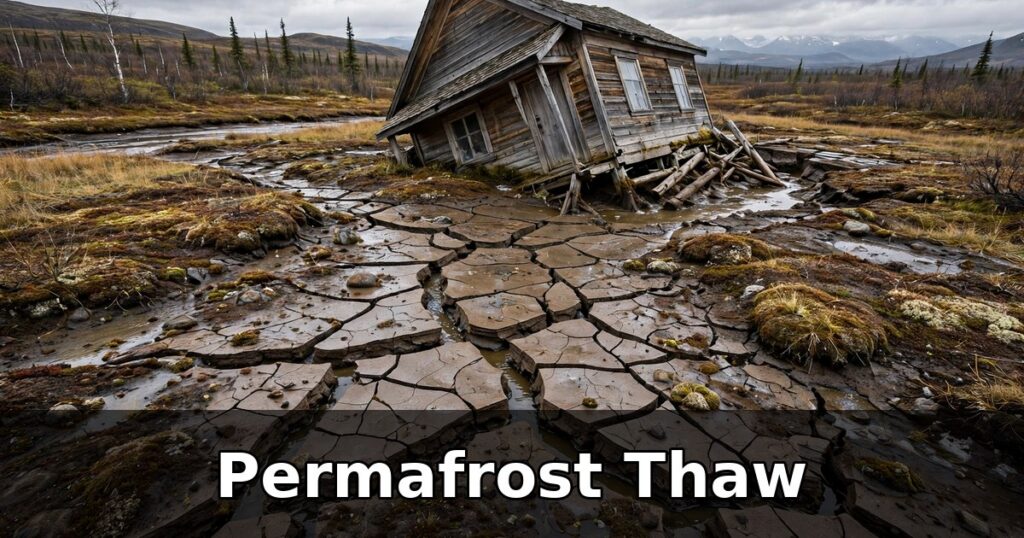
Permafrost Thaw: The Ground That Was Supposed to Stay Frozen
In the far north, the ground itself has long been a kind of foundation, literally and figuratively. Permafrost is ground that remains frozen for at least two consecutive years, and in many places it…
Key points
- Permafrost is ground that remains frozen for at least two consecutive years; in many places it has stayed frozen for centuries or millennia.
- A 2025 study estimated losses to buildings and roads in Alaska from permafrost thaw at $37 to $51 billion.
- In August 2024, a coastal bluff failure at Utqiagvik, Alaska, showed how thaw and coastal erosion can combine to undermine land long assumed stable.
- Thaw releases greenhouse gases gradually, over decades and centuries — a feedback that adds to human emissions, not a single sudden burst.
In the far north, the ground itself has long been a kind of foundation, literally and figuratively. Permafrost is ground that remains frozen for at least two consecutive years, and in many places it has stayed frozen for centuries or millennia. It underlies large parts of Alaska, Canada, Siberia, and other northern regions, supporting roads, buildings, pipelines, and entire communities.
The scale of what is at stake is difficult to grasp, partly because permafrost is invisible. It is not a glacier you can photograph, or a coastline you can watch erode, although thaw can produce all of those visible effects. It is soil, rock, and ice beneath the surface, and its thaw often announces itself indirectly: a road that buckles, a house that tilts, a hillside that slumps, a lake that drains suddenly, or a coastline that collapses into the sea.
What permafrost is, and why it is thawing
Permafrost is defined by temperature, not by a particular type of soil. If ground stays at or below freezing for two years or more, it qualifies, regardless of whether it is rich in ice or relatively dry. Above permafrost lies the active layer, a surface layer that thaws each summer and refreezes each winter. Plants root in this layer, animals burrow in it, and roads and buildings are often founded in or above it.
Below the active layer, permafrost can extend tens or hundreds of metres deep, containing ice in pores, lenses, and wedges that formed over long periods. Warming affects this system in several ways. Warmer air temperatures increase the depth of summer thaw in the active layer. Warmer winters mean the ground may not refreeze as completely.
Once thaw begins, it can become self-reinforcing in ice-rich areas: as ice melts, the ground subsides, water may pool in the resulting depression, and that water absorbs heat and thaws more ground around it, forming features known as thermokarst lakes and slumps. The process feeds on itself once the ice that held the ground together is gone.
How thaw reinforces itself
| Factor | What it does |
|---|---|
| Warmer air | Deepens summer thaw in the active layer and leaves ground less fully refrozen in winter. |
| Thicker snowpack | Insulates the ground and can keep it warmer through winter. |
| Earlier snowmelt | Exposes dark ground to spring sunlight sooner, so it absorbs more heat. |
| Fire and disturbance | Removes the insulating surface layer or darkens the ground, accelerating thaw. |
| Pooled water | Water in a thaw depression absorbs heat and thaws more ground around it, forming thermokarst lakes and slumps. |
Once thaw begins in ice-rich ground, each of these factors can reinforce the others, so the ground keeps subsiding and more frozen material is exposed.
The carbon question: a slow release with long consequences
The most widely discussed consequence of permafrost thaw is the release of greenhouse gases. When organic material that has been frozen for centuries thaws, microbes can begin to decompose it, releasing carbon dioxide, and, in waterlogged, oxygen-poor conditions, methane. Both are greenhouse gases, although they behave differently in the atmosphere: carbon dioxide persists for a very long time, while methane is more potent in the short term but breaks down more quickly.
Scientists are careful about how they describe this risk. Permafrost carbon release is not expected to happen all at once, like a burst, but gradually, over decades and centuries, as more ground thaws and as previously frozen material becomes available to microbes. That gradual release still matters, because it adds to emissions from human activities and can make it harder to stabilise temperatures.
It also represents a feedback: warming thaws permafrost, thaw releases greenhouse gases, those gases cause more warming, which thaws more permafrost. Feedbacks of this kind do not mean runaway, unstoppable warming is inevitable, but they do mean that the climate system has internal amplifiers that must be accounted for in planning. Reducing human emissions remains the primary lever, because it slows the warming that drives thaw in the first place.
Roads, houses, and communities built on ice
For people who live on permafrost, the carbon question, while globally important, is often secondary to a more immediate concern: the ground under their homes and roads is changing. Infrastructure in permafrost regions was often designed with the assumption that the ground would stay frozen. Buildings were placed on piles driven into permafrost, with air gaps underneath to keep heat from the building from thawing the ground. Roads were built on embankments that insulated the permafrost below. Pipelines were designed to avoid thawing the ground around them, or to accommodate movement.
As permafrost thaws, those designs can fail. Piles can lose their grip as ice melts. Roads can sink, crack, and become uneven, requiring frequent repair. Buildings can tilt or crack as the ground subsides unevenly. Water and sewage systems, already difficult to maintain in remote northern communities, can be damaged by ground movement. In coastal areas, thaw can combine with sea ice loss and storm waves to accelerate erosion, threatening homes, cultural sites, and infrastructure that cannot easily be moved.
The 2025 estimate of $37 to $51 billion in losses to buildings and roads in Alaska from permafrost thaw gives a sense of the financial scale, but money alone does not capture the human cost. That range is an estimate, not a precise prediction, and it reflects uncertainty about how fast thaw will proceed, how infrastructure will be maintained, and how costs are counted. But even the lower end of the range illustrates a central point: permafrost thaw is not only an environmental change, but a major infrastructure and financial challenge for northern communities, governments, and industries that built on the assumption of permanently frozen ground.
Utqiagvik and the changing Arctic coast
Utqiagvik, formerly known as Barrow, sits on Alaska’s Arctic coast, where permafrost, sea ice, and ocean meet. The coastal bluff failure there in August 2024 is a reminder that permafrost thaw does not act alone. Coastal bluffs in the Arctic often contain large amounts of ground ice. When that ice thaws, the bluff weakens. When sea ice forms later and melts earlier, waves can attack the coast for longer each year. When storms occur during open-water periods, erosion can be rapid and dramatic, removing metres of coastline in a single event.
Such events are difficult to attribute to a single cause, and researchers are careful not to claim that any one bluff failure was caused solely by permafrost thaw or solely by climate change. Erosion has always occurred along Arctic coasts. What has changed is the set of conditions: warmer ground, less protective sea ice, warmer ocean water, and more frequent open-water storms. Together, these conditions increase the likelihood and rate of erosion, even if individual events still involve natural variability and local geology.
A single event is weather and geology; a pattern of increasing erosion across many Arctic coasts is climate change acting through multiple pathways. For coastal Arctic communities, this pattern has practical consequences for planning. Setback distances that were safe a generation ago may no longer be safe. Infrastructure placed near the coast for access to the sea may need to be moved inland, at great cost.
What is still uncertain
How fast thaw will proceed is uncertain. The $37 to $51 billion Alaska estimate is a range, not a precise prediction, because it depends on the pace of thaw, on maintenance, and on how costs are counted.
How much carbon will be released, and when, is uncertain. Models differ on how much carbon is stored, how much is vulnerable, how quickly microbes decompose it, and whether thawed ground becomes wetter or drier. The direction — a net addition of greenhouse gases over time — is more robust than any single total.
No single event has a single cause. The August 2024 Utqiagvik bluff failure combined thawed ground ice, longer open-water seasons, and storm waves. A pattern across many coasts is stronger evidence than any one collapse.
What can be done, and what cannot be undone
Permafrost thaw cannot be reversed quickly by local action alone. Once ground ice has melted and ground has subsided, refreezing the same ice is not a realistic option on human timescales, even if temperatures were to stabilise. That does not mean adaptation is futile.
Engineering approaches can slow thaw or accommodate movement: thermosyphons that draw heat from the ground in winter, insulation and ventilation under buildings, adjustable foundations, and road designs that allow for settlement and repair. Monitoring networks that track ground temperature and movement can provide early warnings and help prioritise maintenance. Land-use planning can avoid building new, long-lived infrastructure on the most ice-rich and vulnerable ground.
At a larger scale, the only way to slow permafrost thaw over the long term is to slow global warming itself, by reducing greenhouse gas emissions. That is a global task, not one that northern communities can accomplish alone, and it underscores a question of fairness: the people most affected by permafrost thaw have contributed least to the emissions driving it.
What this means
The assumption of permanence has failed. Infrastructure, planning, and cost estimates built on permanently frozen ground now face a ground that thaws unevenly and sometimes dramatically.
The costs are already real. The August 2024 bluff failure at Utqiagvik and the 2025 estimate of $37 to $51 billion in Alaska building and road losses are two data points in a much larger story — measured in billions of dollars and in the stability of people’s homes.
Slowing thaw means slowing warming. Engineering can accommodate movement and buy time, but only lower global emissions slow the warming that drives thaw over the long term.
Ground that was supposed to stay frozen
The phrase in this post’s title — the ground that was supposed to stay frozen — captures both a physical fact and a planning assumption. For centuries, permafrost was treated as permanent, a stable platform on which to build and a safe storehouse for ancient carbon. That assumption is no longer valid. The ground is thawing, unevenly and sometimes dramatically, with consequences for infrastructure, communities, ecosystems, and the global climate.
Permafrost thaw is a slow change with fast moments — a road that suddenly buckles, a bluff that suddenly collapses, a lake that suddenly drains. Understanding it requires both perspectives: the long, patient work of measuring ground temperatures year after year, and the urgent work of helping communities adapt to a landscape that is no longer as stable as it once was. The ground was supposed to stay frozen. It is not staying frozen. How we respond to that fact will shape the future of the North, and, through carbon release and sea-level effects, the future of the planet.
Raina





댓글 0
첫 댓글을 남겨보세요.