
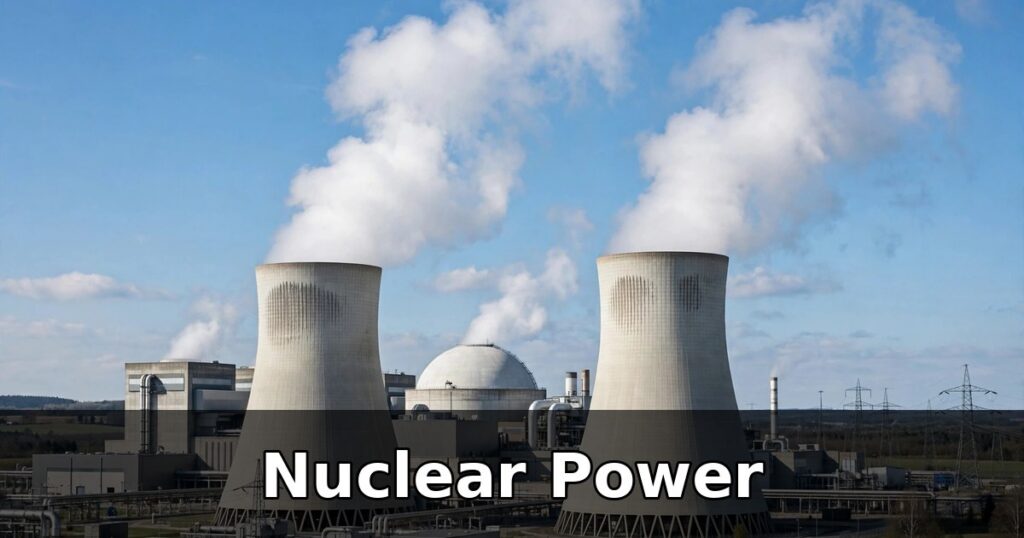
Nuclear Power’s Second Act: Old Plants, New Promises
Nuclear power has lived several lives. It was once hailed as the energy source that would be too cheap to meter, then feared after accidents, then sidelined as costs rose and renewable prices fell,…
Key points
- More than 40 countries now include nuclear power in their energy strategies, and global capacity could grow by at least one third, and potentially up to 70 percent, by 2035.
- More than 70 gigawatts of new capacity is under construction worldwide, one of the highest levels in 30 years — yet in 2025, 3 gigawatts of new capacity came online and 3 gigawatts retired, leaving total capacity flat at 420 gigawatts.
- Around 30 gigawatts of interest in small modular reactors is linked mainly to powering data centres, including the first power purchase agreement between Google and Kairos Power.
- Over the past decade, 94 percent of reactors that started construction were of Chinese or Russian design, and half of the 78 gigawatts now under construction is in China.
- Small modular reactors remain a promise, not yet proof: only one land-based SMR operates, in China, and one marine-based SMR, in Russia.
Nuclear power has lived several lives. It was once hailed as the energy source that would be too cheap to meter, then feared after accidents, then sidelined as costs rose and renewable prices fell, then reconsidered as climate and energy-security concerns returned. Now, according to the International Energy Agency, it is experiencing a revival — not a return to the building boom of the 1970s and 1980s, but a new phase in which old plants are kept running longer, new large plants are under construction at one of the highest levels in decades, and smaller, modular designs attract interest from governments and technology companies alike.
What the IEA reported in 2025
According to the International Energy Agency’s World Energy Outlook 2025, nuclear energy is experiencing a strong revival, with rising investment in both conventional reactors and new designs such as small modular reactors. The IEA reported that more than 40 countries now include nuclear power in their energy strategies. After more than two decades of stagnation, global capacity could grow by at least one third, and potentially up to 70 percent, by 2035, depending on the scenario. In the IEA’s Net Zero Emissions by 2050 scenario, capacity expands by as much as 70 percent, while less ambitious scenarios still anticipate substantial growth of at least one third.
The IEA also reported that more than 70 gigawatts of new capacity is currently under construction worldwide, one of the highest levels in 30 years. Technology companies are driving demand for small modular reactors, with around 30 gigawatts of interest linked mainly to powering data centres. Several recent announcements focus on extending the life of existing plants. Google and Kairos Power, for example, have signed the first power purchase agreement for a demonstration small modular reactor to supply a data centre, according to reporting on the outlook. In the IEA’s Stated Policies Scenario, nuclear energy generates an additional 190 terawatt-hours for data centres by 2035, a projection that illustrates the scale of new electricity demand from digital infrastructure, not a measurement of power already delivered.
A later IEA update, in its Global Energy Review 2026, provided a more grounded snapshot for 2025 itself. In 2025, 3 gigawatts of new nuclear capacity came online, with China, India, and Russia each completing work on a new reactor. However, these additions were offset by the retirement of 3 gigawatts of nuclear capacity, two-thirds of which was in Belgium. In total, global nuclear capacity remained at 420 gigawatts at the end of 2025, with reactors in operation in over 30 countries.
There were ten construction starts in 2025 — nine in China and one in Russia — with a total capacity of 12.2 gigawatts. Over the past decade, 94 percent of nuclear reactors that started construction were of Chinese or Russian design, according to the IEA. Nuclear reactors with a combined capacity of 78 gigawatts are currently under construction in 15 countries, according to the same review, with half of capacity under construction in China.
| Measure | Figure |
|---|---|
| Global nuclear capacity, end of 2025 | 420 GW, in over 30 countries |
| New capacity online in 2025 | 3 GW (China, India, Russia — one reactor each) |
| Capacity retired in 2025 | 3 GW, two-thirds in Belgium |
| Capacity under construction | 78 GW in 15 countries; half in China |
| Construction starts in 2025 | 10 starts, 12.2 GW (9 in China, 1 in Russia) |
| Projected growth by 2035 | At least one third; up to 70% in the net-zero scenario |
| SMR interest, mainly for data centres | Around 30 GW |
Why nuclear is being reconsidered
Three drivers explain the renewed interest, as IEA Executive Director Fatih Birol outlined in a keynote at the World Nuclear Exhibition in Paris on 4 November 2025, where he declared that nuclear is back. The first is energy security. After gas supply disruptions and price volatility, many governments want domestic, stable electricity sources that do not depend on imported fossil fuels. Nuclear plants, once built, can operate for decades with relatively small volumes of fuel, much of which can be stockpiled, offering a different security profile from gas plants dependent on continuous pipeline or liquefied natural gas supplies.
The second driver is climate change. Nuclear power produces very low greenhouse gas emissions during operation, comparable to wind power on a lifecycle basis in many assessments, though lifecycle emissions depend on uranium mining, construction, and other factors. Unlike solar and wind, it provides firm, dispatchable power that can operate regardless of weather, which is valuable in a system with growing shares of variable renewables. That firmness is often cited as nuclear’s key advantage: it can complement renewables by providing steady output during cloudy, windless periods, reducing the need for fossil backup or very long-duration storage.
Old plants: the cheapest clean power, or a safety question?
The most immediate part of nuclear’s second act is not building new plants at all, but keeping old ones running longer. Life extension — refurbishing and relicensing existing reactors beyond their original design life — is often far cheaper and faster than building a new plant, because the site, grid connection, and much of the infrastructure already exist. Japan continues to restart reactors whose operations had been suspended, according to the IEA, and other countries, including in Europe and North America, have extended the lives of existing fleets or reversed planned closures. In climate terms, keeping an existing low-carbon plant running avoids the need to replace its output with fossil generation or with new capacity that takes years to build.
New large plants: proven, but slow and expensive in the West
New large reactors, typically above 1,000 megawatts each, dominate current construction, according to the IEA. Nearly all reactors currently under construction are large-scale, most with capacities above 1,000 megawatts. In China, Russia, and South Korea, such projects have often been delivered closer to planned schedules and budgets, according to reporting on the World Energy Outlook 2025, partly because of standardised designs, continuous construction programmes, and state support. In Europe and the United States, by contrast, large projects have faced delays and cost overruns, typically finishing years late and at much higher costs than initially estimated.
Small modular reactors: promise, not yet proof
Small modular reactors, or SMRs, are the most talked-about new promise. They are generally defined as reactors with capacities up to about 300 megawatts, designed to be built in factories in modules and assembled on site, rather than constructed entirely on site as a bespoke project. Proponents argue that factory production, standardisation, and smaller size could reduce costs, shorten construction times, and allow nuclear power to serve smaller grids, remote communities, industrial sites, and data centres that cannot support a large plant.
China already operates one land-based SMR, and Russia operates a marine-based one, according to the IEA. There is one 125-megawatt commercial SMR under construction in China and one with 300 megawatts of capacity in Russia. Additional SMRs are likely to begin construction in the near term in Canada, Korea, the United Kingdom, and the United States, according to the IEA. That list shows both progress and limits. SMRs exist, but commercial deployment at scale has not yet been demonstrated in most Western markets.
The first projects will be crucial tests: can they be built on time and on budget, can they meet safety and licensing requirements efficiently, can they achieve the cost reductions promised from factory production, and can they find customers willing to pay for first-of-a-kind power? History counsels caution. Many novel energy technologies have promised factory learning curves that took longer to materialise than expected, and nuclear regulation, for good reason, does not allow shortcuts on safety. SMRs may yet become a significant part of the energy mix, but today they should be described as a promising technology in early deployment, not as a proven, scalable solution.
Waste, the unresolved legacy
No discussion of nuclear’s second act is complete without waste. Spent nuclear fuel remains hazardous for thousands of years, and while technical solutions for deep geological disposal exist and are being implemented in a few countries, such as Finland, many countries still store spent fuel at reactor sites or in interim facilities while awaiting a permanent repository. That unresolved legacy is both a technical and a political issue.
Both points have merit, and they point to a practical requirement for any nuclear expansion: progress on waste disposal must accompany progress on new construction, or public trust will remain fragile. A second act that builds new plants while ignoring waste will be seen, fairly, as incomplete.
What is still uncertain
Whether Western large-reactor projects can control costs. The record in China, Russia, and South Korea is better than in Europe and the United States, but it is not yet clear whether standardisation and sustained programmes can close that gap in Western markets.
Whether SMRs deliver on factory economics. Only one land-based SMR operates today, and the first commercial projects in the West have not yet been built. The promised cost and schedule advantages are unproven at scale.
Whether waste disposal keeps pace with construction. Finland shows geological disposal can be implemented, but most countries still have no permanent repository, and siting remains politically difficult.
A measured verdict
Nuclear power’s second act is best understood as a conditional revival. Old plants, kept running safely, can provide valuable low-carbon, firm power in the near term. New large plants, where they can be built on time and on budget, can add significant clean capacity, particularly in countries with standardised programmes. SMRs, if they prove themselves commercially, could open new markets and applications, including for data centres and industry. Together, under IEA scenarios, they could increase global nuclear capacity by at least one third by 2035, and by up to 70 percent in a net-zero scenario — projections that describe what could happen if investment, policy, and construction performance align, not what has already happened.
Whether nuclear delivers on its second-act promise will be judged not by announcements, expressions of interest, or scenarios, but by reactors completed, costs achieved, safety maintained, and waste managed. The IEA’s 2025 snapshot — flat net capacity despite new additions, because retirements offset them — is a reminder of how much work remains. If the current pipeline of 78 gigawatts under construction is completed, if life extensions are managed safely, and if SMRs move from demonstration to commercial operation, nuclear could play a larger role in a clean electricity system than it has for decades. If costs overrun, timelines slip, and waste remains unresolved, the revival may prove to be another false dawn. The second act is underway. Its ending has not yet been written.
Raina





댓글 0
첫 댓글을 남겨보세요.