
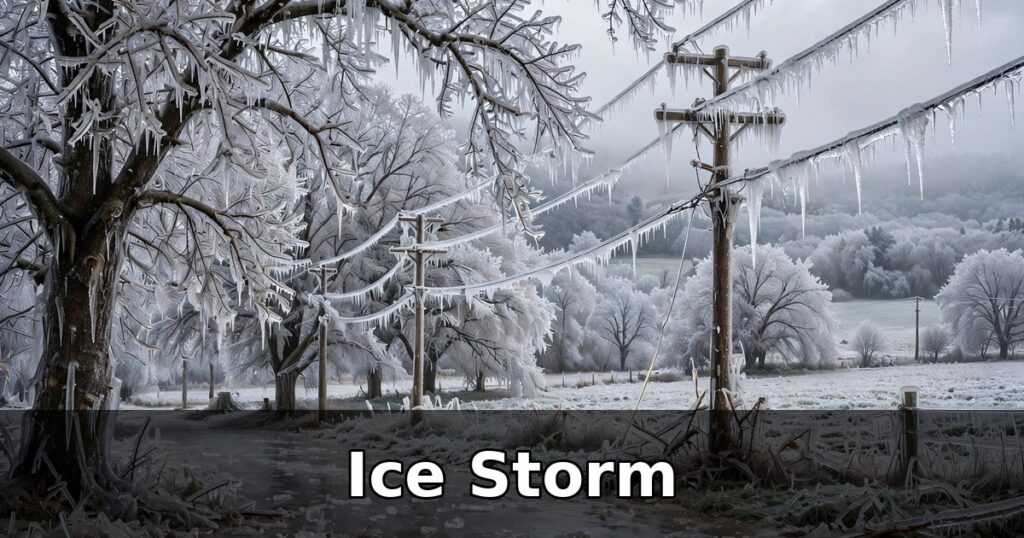
How to Prepare Your Home for a Multi-Day Ice Storm
Key points
- An Ice Storm Warning is generally issued when 0.25 inch of ice is expected; at 0.5 inch, damage becomes widespread and outages can last for days.
- A half inch of ice can add about 500 pounds of extra weight to a span of power line, and ice can make tree branches up to 30 times heavier.
- FEMA’s Ready.gov advises storing at least 1 gallon of water per person per day for several days, and preparing to manage without help for at least 72 hours.
- Winter Storm Uri in February 2021 left more than 4.5 million people in Texas without power and caused 246 deaths, most of them from hypothermia.
- Generators must run outdoors, at least 20 feet from windows, doors and vents, because carbon monoxide is colourless and odourless.
An ice storm does not look dramatic at first. Rain falls, the temperature hovers near freezing, and a thin glaze forms on the sidewalk. It looks manageable. Then the glaze thickens, a branch cracks, the lights flicker, and the house goes dark — and stays dark for days.
The danger is not the cold alone. Ice brings down the power lines, the power cut removes the heat, and the ice on the roads keeps repair crews from reaching the damage. Each failure makes the next one worse.
The science: how freezing rain forms
Freezing rain begins as snow falling through a layer of warm air above the ground. The warm layer melts the snowflakes completely into raindrops. The drops then fall through a shallow layer of sub-freezing air near the surface. They do not have time to refreeze into pellets in mid-air. Instead they become supercooled liquid water — liquid below freezing point — that turns to solid ice the instant it touches a cold surface.
That is what makes freezing rain different from sleet. Sleet refreezes before it lands, so it does not accumulate on trees and wires. Freezing rain coats everything it touches in glaze ice, and the coating grows thicker with every hour the rain continues.
The weight is what destroys infrastructure. Ice can increase the weight of tree branches by up to 30 times. A half inch of ice on a standard span of power line adds roughly 500 pounds of extra weight. Wind on an ice-loaded line adds further stress, and the combination snaps branches, poles and even steel transmission towers. A tenth of an inch of ice already makes highways impassable.
| Ice thickness | What it means | What to expect |
|---|---|---|
| 0.10 inch | Glaze on roads and surfaces | Slick travel; scattered outages possible |
| 0.25 inch | Ice Storm Warning threshold | Tree and line damage begins; outages likely |
| 0.50 inch | Crippling ice storm | Widespread damage; outages lasting days |
| 1 inch or more | Devastating storm | Severe tree damage; outages lasting weeks in the worst cases |
What past ice storms show
The January 1998 ice storm remains the benchmark. Five successive waves of freezing rain fell from 4 to 10 January 1998 across eastern Ontario, southern Quebec and the north-eastern United States. Ice accumulation reached about 5 inches (130 mm) in the worst-hit areas. More than 1,000 transmission towers collapsed. Over 4 million people lost power, some for more than a month, and the longest residential blackouts lasted 33 days. Damage totalled more than $4 billion, and about 40 people died. In Montreal, 80% of the trees on Mount Royal were damaged. Winter Storm Uri in February 2021 left more than 4.5 million people in Texas without power and caused 246 deaths, of which 158 were from hypothermia.
| Storm | When | Power lost | How long | Deaths |
|---|---|---|---|---|
| North American ice storm | January 1998 | More than 4 million people | Up to 33 days | About 40 |
| Arkansas to Ohio Valley | January 2009 | 1.3 million customers | Days to weeks | — |
| Winter Storm Uri, Texas | February 2021 | More than 4.5 million people | Up to 4 days | 246 |
Before the storm: the 72-hour baseline
FEMA’s Ready.gov advises every household to store enough basic supplies to manage for at least 72 hours without help, including at least 1 gallon of water per person per day. For a family of four, that is 12 gallons for three days. Plan for three days first, then build toward a week, because the 1998 storm left some homes without power for a month.
Water deserves first place because an ice storm can take it away in two ways at once. A power cut can stop a well pump or a municipal treatment plant, and frozen pipes can cut off the supply inside the house. Store water before the storm, and keep a separate supply of drinking water that does not depend on the taps.
Food should need no cooking and no refrigeration. Canned goods, dried fruit, nuts, crackers, peanut butter and energy bars cover three days without a stove or a refrigerator. A manual can opener belongs in the kit, because an electric one is useless without power. Refrigerated food typically remains safe for about 4 hours during an outage if the refrigerator door is kept shut, according to the U.S. Department of Agriculture. Flashlights, a battery radio, a charged power bank, warm clothing, blankets, a week’s medicine, a first-aid kit and cash in small bills complete the kit.
During the outage: heat, water and pipes
When the power fails, the goal is not to heat the whole house. It is to keep one small interior room warm enough to live in. Close off unused rooms, hang blankets over doorways, and gather the household in the smallest interior room, away from exterior walls and windows. A typical home loses 1 to 2°F per hour in sub-freezing weather once the heat is off, so the warm-room plan has to start immediately.
Never use a gas stove or oven for heating, and never bring a charcoal grill, a camp stove or a portable gas heater indoors. The U.S. Centers for Disease Control and Prevention counts roughly 400 unintentional carbon monoxide deaths per year in the United States. Carbon monoxide is colourless and odourless. Battery-powered carbon monoxide alarms on every level are a basic part of ice-storm preparation.
Pipes are the second priority after people. If the heat is off, let faucets drip, open cabinet doors under sinks on exterior walls, and keep the thermostat at no lower than 55°F while the heat is still working. If the power is out for more than a day and the house is cooling fast, shutting off the main water valve and draining the lines can prevent a burst pipe.
Generators must run outdoors only, at least 20 feet from windows, doors and vents, and never in a garage. Never connect a generator directly to a household outlet; that practice, known as backfeeding, can electrocute utility workers. Stay off the roads during freezing rain, and assume every fallen line is live.
What the research says
The February 2021 failure was investigated in detail. The joint report by the Federal Energy Regulatory Commission and the North American Electric Reliability Corporation, published in November 2021, found that 75.6% of the unplanned generating unit outages, derates and failures to start were caused by freezing issues and fuel issues. At the worst point, the Texas grid operator ordered 20,000 megawatts of firm load shed. The Texas Comptroller calculated a statewide average outage of 42 hours, with 31 hours consecutive.
The same report makes a point that matters for household preparation: the grid failure was not a single broken part. It was many parts failing at once in cold they were not prepared for. A grid that fails in many places at once cannot be repaired in many places at once, and the repair queue is measured in days.
What is still uncertain
Forecast ice totals are not the same as ice on the wires. Models predict how much precipitation will fall as freezing rain, but the amount that actually accretes on a power line depends on wind, temperature, the shape of the surface and how long the rain continues. Two storms with the same forecast total can cause very different damage.
Outage duration cannot be predicted from the storm alone. It depends on how many crews are available, how many roads are blocked by fallen trees, and whether the damage is to local distribution lines or to the large transmission towers that take weeks to replace. A household can prepare for three days and still face a week, or prepare for a week and be restored in a day.
Carbon monoxide risk is underestimated by most households. People know generators are dangerous in theory, but during a cold, dark outage the temptation to bring a heater or a generator closer to the house is strong. The deaths in Texas in 2021 included 19 from carbon monoxide poisoning, alongside the 158 from hypothermia. Both causes were preventable.
Environmental impact
An ice storm is a tree disaster before it is a power disaster. In Montreal in 1998, 80% of the trees on Mount Royal were damaged, and across the affected region millions of trees were broken or uprooted. Orchards, sugar maple stands and forests lost limbs and whole trees, and farms lost livestock, stored feed and milk when power failed.
What this means
An ice storm is a multi-day event, even when the rain lasts one day. The rain may stop in 24 hours, but the ice stays on the lines, the trees stay on the roads, and the repairs take days. A plan that covers one night is not a plan for an ice storm.
The official minimum is a floor, not a target. FEMA’s 72-hour baseline assumes help arrives on the fourth day. In 1998, help did not arrive for some households for a month. Building from three days toward a week is the difference between a difficult few days and a dangerous one.
Cold kills more people than the storm itself. In Texas in 2021, hypothermia caused about two out of three deaths. The victims were disproportionately older people, and many died in their own homes. Warmth, not food or light, is the first priority when the power fails in winter.
What should change
Prepare in autumn, not during the warning. Water, food, batteries, fuel and warm clothing should be in the house before the first ice forecast. Once freezing rain starts, the roads are already dangerous and the shops may already be closed or without power.
Protect the pipes before the power fails. Insulate exposed pipes, seal air leaks, know where the main water shutoff is, and keep the heat at 55°F or higher while it is still working. If a long outage is expected and the house is cooling, shut off the water and drain the lines before the pipes freeze, not after.
Test the generator before the storm, and check on neighbours. A generator that will not start in the cold is worse than no generator, because it creates a false sense of security. Test it in autumn, store fuel safely, and keep it 20 feet from the house. The Texas death data shows the risk is concentrated among people aged 60 and older.
Wait it out, warm and supplied
A multi-day ice storm rewards the household that prepared in advance and punishes the one that improvised. The ice itself cannot be fought once it starts falling. What can be controlled is what was stored before the storm, which room stays warm, whether the pipes are protected, and whether the generator stays outside where it belongs.
The storms of 1998 and 2021 set the scale: 4 million people without power for up to a month, 4.5 million without power for up to four days, 246 deaths in a single state. Those numbers are not a reason to panic. They are a reason to buy the water, charge the power bank, insulate the pipe and choose the warm room while the weather is still fine.
Raina





댓글 0
첫 댓글을 남겨보세요.