
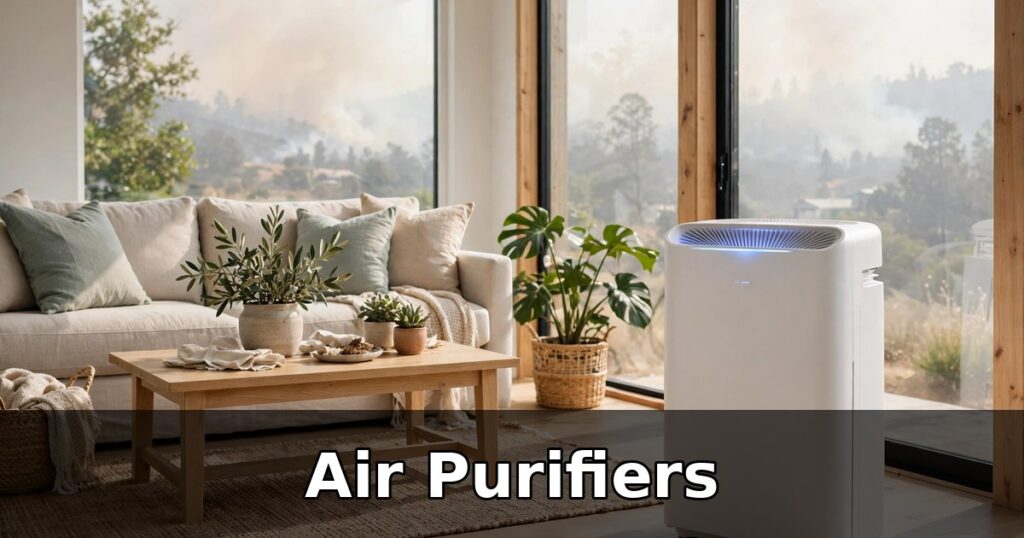
How to Choose the Right Air Purifier for Smoke Season
Wildfire smoke has become a recurring seasonal event across much of North America, and the smoke does not stop at the front door. Fine particles from burning vegetation travel hundreds of kilometres, seep through gaps around windows and doors, and accumulate indoors, where residents spend most of the time. Outdoor air quality alerts describe the problem in broad terms, yet the air inside a home can remain unhealthy for hours after the sky outside has cleared, because particles that enter a building have few ways to leave. A portable air purifier is one of the few tools that can lower indoor particle levels quickly, and during smoke season it often becomes the difference between a home that offers refuge and a home that merely looks like one.
Key points
- Wildfire smoke is mostly PM2.5 — particles 2.5 micrometres or smaller that reach deep into the lungs. On a clear day outdoor PM2.5 sits below 10 micrograms per cubic metre; during a major smoke event it can exceed 150 and pass 250.
- A true HEPA filter captures at least 99.97% of particles at 0.3 micrometres in a single pass.
- For smoke, buy a smoke CADR roughly equal to the room’s floor area: a 300-square-foot room needs a smoke CADR of about 300, not the 200 the everyday rule allows.
- Never buy an ozone generator. Check for CARB certification: the ozone ceiling is 0.050 parts per million.
- The best strategy is one clean room — usually the bedroom — sealed off, with the purifier running continuously on high.
Wildfire smoke has become a recurring seasonal event across much of North America, and the smoke does not stop at the front door. Fine particles travel hundreds of kilometres, seep through gaps around windows and doors, and accumulate indoors, where people spend most of their time.
Why wildfire smoke is different from ordinary dust
Wildfire smoke consists largely of fine particulate matter known as PM2.5, particles with a diameter of 2.5 micrometres or less. Particles of this size are small enough to pass deep into the lungs and, in the smallest fractions, to enter the bloodstream.
On a clear day, outdoor PM2.5 in many North American cities sits below 10 micrograms per cubic metre, within the range the agency classifies as Good. During a major smoke event, the same measurement can exceed 150 micrograms per cubic metre, a level the agency classifies as Unhealthy, and in severe episodes it can pass 250. The health effects range from irritated eyes and asthma to reduced lung function and strain on the cardiovascular system, with older adults, children, and people with heart or lung disease at greatest risk.
Indoor levels track outdoor levels with a delay, and studies of indoor air during wildfire episodes have repeatedly found that indoor PM2.5 rises substantially even in homes with windows closed. Smoke enters through cracks, vents, and open doors, and once inside it lingers, because indoor air is exchanged with outdoor air only slowly in a closed home. Sealing the home alone is therefore incomplete: sealing slows the smoke, but a purifier is what removes it.
How HEPA filtration works
Under the definition cited by the United States Environmental Protection Agency, a HEPA filter must capture at least 99.97 percent of particles at 0.3 micrometres in a single pass, and particles larger or smaller than that size are captured even more efficiently. That figure matters because smoke particles cluster around the most penetrating size range: much of the mass of wildfire smoke sits between 0.1 and 1 micrometre.
A HEPA filter captures particles only. It does not remove gases, odours, or volatile organic compounds, which pass through the fibre mat unchanged. A HEPA-only machine can make the air measurably lower in PM2.5 while leaving the smell of smoke behind, and for many people that trade is acceptable, because the particles carry most of the health risk. Where odour matters, a second stage is needed, and that stage is activated carbon.
CADR and the two-thirds rule
The single most useful number on a purifier box is the Clean Air Delivery Rate, or CADR, measured in cubic feet per minute. CADR was developed by the Association of Home Appliance Manufacturers as a standardised measure of how much filtered air a machine delivers, combining the volume of air the fan moves and the fraction of particles the filter captures. CADR is reported separately for three particle types — tobacco smoke, dust, and pollen — and for smoke season, the smoke CADR is the number that matters.
Smoke particles are the smallest of the three test categories, roughly 0.09 to 1 micrometre, and therefore the hardest to capture, so the smoke CADR is almost always the lowest of the three figures. Comparing machines by the pollen CADR, often the largest number on the box, gives a flattering and misleading picture of smoke performance. AHAM publishes a simple rule of thumb for sizing: the CADR should be at least two-thirds of the room floor area in square feet, assuming an 8-foot ceiling, which corresponds to cleaning the room air about 4.8 times per hour.
| Room size | Everyday smoke CADR (two-thirds rule) | Smoke-season smoke CADR (full area) |
|---|---|---|
| 150 sq ft | 100 | 150 |
| 200 sq ft | 133 | 200 |
| 300 sq ft | 200 | 300 |
| 450 sq ft | 300 | 450 |
| 600 sq ft | 400 | 600 |
For wildfire smoke, AHAM raises the bar: it recommends a smoke CADR roughly equal to the full floor area of the room rather than two-thirds of it, about 50 percent more clean-air power than the everyday rule. A 300-square-foot room therefore calls for a smoke CADR of about 300 during a smoke event, and a 200-square-foot bedroom calls for about 200. The United States Environmental Protection Agency publishes a sizing table that works out to a similar figure, about 0.65 cubic feet per minute per square foot, with examples of 195 for a 300-square-foot room and 390 for a 600-square-foot room.
Rooms with ceilings higher than 8 feet need proportionally more CADR. A room with a 10-foot ceiling needs roughly a quarter more capacity than the same floor area with an 8-foot ceiling.
The clean-room strategy
Homes are not a set of sealed boxes, and a purifier rated for a 300-square-foot room will perform as rated only if the room is reasonably closed off from the rest of the house. Open-plan living areas, rooms with wide archways, and spaces connected by hallways share air with neighbouring rooms, so the effective volume is larger than the floor area of the room where the machine sits. In such layouts, size for the connected space rather than for the single room.
A useful strategy during smoke season is to create a single clean room rather than attempting to purify an entire home with one machine. A bedroom is the natural choice, because people spend roughly a third of the day there, and sleep is the period when the body is least able to compensate for poor air. The clean room should be the smallest room that can be closed off with a door, with windows sealed, gaps under the door blocked with a towel, and the purifier sized to the room at the wildfire rate.
Activated carbon and the smell of smoke
Activated carbon is a second filter stage made of charcoal treated to create a vast internal surface area, and it captures gases by adsorption, holding gas molecules on the surface of the carbon pores. In a smoke purifier, the carbon stage addresses the gaseous fraction of smoke: volatile organic compounds, odours, and some of the irritant gases that a HEPA filter cannot touch. A machine with a substantial carbon filter will reduce the smell of smoke noticeably, while a machine with a thin carbon sheet, or none at all, will leave the odour largely unchanged.
What to avoid: ozone generators and ionizers
Not every device sold as an air purifier improves indoor air, and some make it worse. Ozone generators are the clearest case: these devices deliberately produce ozone, a reactive gas, on the claim that it destroys odours, allergens, and mould. The United States Environmental Protection Agency states that ozone generators sold as air cleaners should not be used in occupied spaces, and that no federal agency has approved them for such use.
| Technology | What it does | Why to avoid it for smoke |
|---|---|---|
| Ozone generator | Deliberately produces ozone | EPA says do not use in occupied spaces; ozone is a lung irritant and removes no particles |
| Ionizer | Charges particles so they stick to surfaces | Particles are relocated, not removed; may generate ozone as a byproduct |
| Electrostatic precipitator | Collects charged particles on plates | May emit ozone; relatively ineffective against larger allergen particles |
| UV light / plasma stage | Claims to kill germs or break down gases | EPA notes research has not shown these remove gases effectively in portable home units |
The California Air Resources Board provides a practical check. Under California rules, air cleaners sold in the state must be tested and certified for ozone emissions, with a ceiling of 0.050 parts per million, and must carry the state ozone-limits label. A CARB certification mark is a reasonable minimum for any purifier, and a HEPA unit without an ionizer stage, or with the ionizer switched off, is the safest choice.
Placement, settings, and daily operation
A purifier can only clean the air that reaches it, so placement matters as much as capacity. The machine should sit where air can flow freely into the intake and out of the outlet, at least a few feet from walls, curtains, and furniture, and away from corners where air stagnates. Windows and doors should stay closed while the purifier runs, and the home should be sealed as far as practical: weather stripping, window film, and damp towels under doors reduce the inflow of smoke.
During a smoke event, the purifier should run continuously, on the highest speed that is tolerable, rather than in short bursts. Particle levels fall gradually as the machine works, and every hour the machine is off allows levels to climb again toward the outdoor concentration. Running on high brings levels down fastest, and the speed can be reduced to medium once the air has cleared, provided the reduction does not allow levels to rise again.
Many machines carry a built-in particle sensor and an automatic mode, yet the sensors in consumer machines vary widely in accuracy, and during heavy smoke they may read low or respond slowly. Run the purifier on manual high during the worst hours regardless of what the built-in sensor reports.
Filters, running costs, and replacement
The purchase price of a purifier is only part of the cost, and for smoke season the running cost can exceed it within a few years. HEPA filters are consumables, and a filter that lasts twelve months under ordinary use will last a shorter interval under continuous smoke exposure, because the fibre mat loads with particles and airflow falls.
When a purifier is not enough
A portable purifier is a powerful tool, yet it has limits, and recognising them is part of choosing well. A purifier cannot clean air in a room it does not serve, and it cannot overcome a home that leaks smoke freely. During a severe event, the best results come from combining the purifier with sealing, a clean room, and reduced indoor particle sources, rather than from buying a larger machine and leaving windows open.
Central heating and cooling systems can help if the filter in the system is rated MERV 13 or higher, a grade that captures a substantial fraction of fine particles. Yet many residential systems cannot push air through such a dense filter without strain, and a heating and cooling contractor should be consulted before upgrading the filter grade. The final test of a purchase is measurement: a modest particle monitor, placed in the clean room, shows whether the purifier is holding PM2.5 near the level that corresponds to an Air Quality Index below 50, the range the Environmental Protection Agency describes as Good.
If the monitor shows levels far above that range despite the machine running on high, the room is too large, the filter is loaded, or smoke is entering faster than the machine can remove it — and the remedy is a larger machine, a fresh filter, or better sealing, in that order. A purifier chosen on the basis of CADR, true HEPA filtration, and a clean-room strategy, and then verified by measurement, gives a home a genuine refuge during smoke season, and the same machine serves year-round.
Raina





댓글 0
첫 댓글을 남겨보세요.