
How Much Did Extreme Weather Cost German Farmers? What the Estimates Include
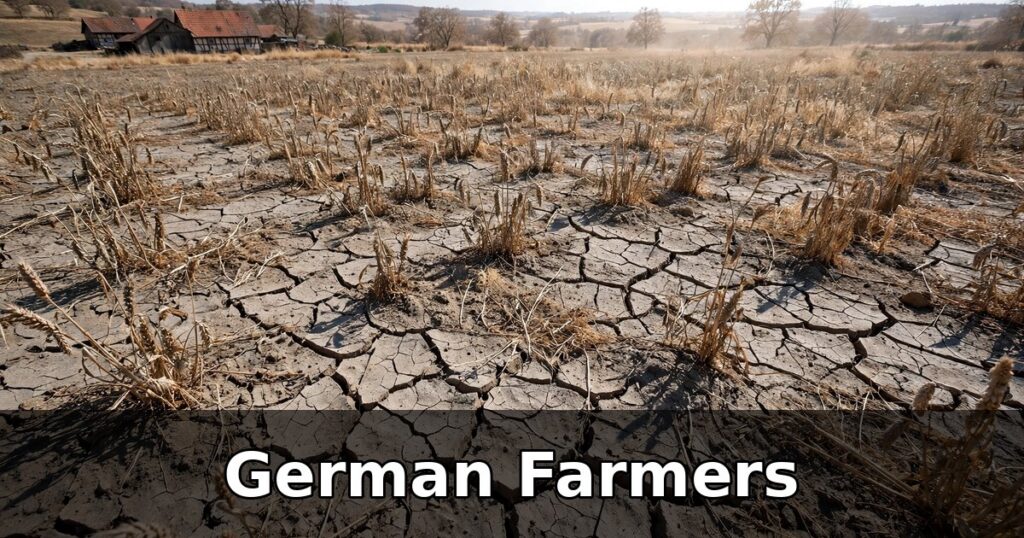
When a drought scorches a maize field in Brandenburg or a heatwave wilts wheat in Bavaria, the loss is visible in a way that climate statistics rarely are: cracked soil, stunted plants, a harvest that fills fewer trailers than the farmer expected.
Key points
- Climate change cost German agriculture an average of about €287 million per year in revenue between 2018 and 2020, through extreme weather alone — about 2.8% of total counterfactual revenue.
- That is roughly one-third of the direct extreme-weather damage in the same period; the other two-thirds would have occurred even without warming.
- Silage maize lost the most, −3.21%, while winter barley actually gained +1.04% — and temperature, not rainfall alone, drove most of the attributable loss.
- The figure covers only three drought years. It is not a fixed annual cost of climate change, and it captures only biophysical yield losses, not the full economic fallout.
When a drought scorches a maize field in Brandenburg or a heatwave wilts wheat in Bavaria, the loss is visible in a way that climate statistics rarely are: cracked soil, stunted plants, a harvest that fills fewer trailers than the farmer expected. But turning that visible loss into a number, and then into a claim about climate change, is a much harder task.
How much of the loss was caused by the weather itself, how much by the fact that the weather was made more extreme by human-caused warming, and how much by everything else that affects a harvest, from pests to prices to farming practice? A study by Mansi Nagpal and colleagues, published in Environmental Research: Climate, volume 5, article 021001, on 7 April 2026, attempts to answer those questions for Germany with unusual precision.
By comparing simulated crop yields under factual, observed conditions with yields under a counterfactual world without human-caused climate change, the authors estimate that climate change cost German agriculture an average of about €287 million per year in revenue between 2018 and 2020, through extreme weather alone. The number is both smaller and more significant than it first appears: smaller, because it is only a fraction of total agricultural revenue, and more significant, because it isolates a specifically climate-attributable share of losses that farmers, insurers and policymakers have previously been forced to guess at.
The drought years in context
The context is a period German farmers will remember vividly. The years 2018 to 2020 included severe drought and heat across much of northern and central Europe, with 2018 standing out as an exceptionally dry year in Germany. According to the study’s framing, annual direct damage from droughts and other co-occurring extremes in Germany averaged €781 million between 2016 and 2022, with €1.7 billion in 2018 alone, figures drawn from earlier work by Nagpal and colleagues published in 2025.
Those totals represent the full biophysical damage of extreme weather, regardless of cause: every euro lost because the weather was extreme, whether or not climate change made that weather more likely or more intense. The new study asks a narrower and more policy-relevant question. Of that total damage, how much is attributable to human-induced climate change?
How the climate share was isolated
To isolate that share, the researchers used crop-specific statistical models, building on earlier work by Heilemann and colleagues, and simulated yields under two sets of climate data. In the factual case, the models were driven by observed climate conditions — the weather as it actually happened. In the counterfactual case, they were driven by climate data from which the human influence had been removed, representing the weather that might have occurred in a world without anthropogenic warming.
Which crops lost most
The headline results show a clear pattern, and one that varies sharply by crop. Across Germany, the study finds that extreme-weather-driven yield losses were statistically significantly affected by human-induced climate change, with the strongest negative impacts, averaged over 2018 to 2020, for silage maize.
| Crop | Attributable yield change, 2018–2020 average | 95% range across 23 climate models |
|---|---|---|
| Silage maize | −3.21% | −4.73% to −1.68% |
| Winter wheat | −0.39% | −0.72% to −0.07% |
| Winter barley | +1.04% | +0.67% to +1.42% |
Silage maize, grown widely as animal feed, is a thirsty summer crop, and its sensitivity to heat and drought makes it a natural candidate for the largest losses. Winter crops, which grow through the cooler months and are harvested earlier in the year, showed smaller losses or even gains. That contrast is agronomically plausible. A warmer winter can reduce frost damage and extend the growing season for winter crops, partially offsetting the harm from summer extremes, whereas a summer crop like maize has nowhere to hide from a hot, dry July and August.
The study also finds a pronounced north-south gradient, with greater losses in northern and central Germany, the regions that bore the brunt of the 2018 to 2020 droughts, compared with the south, where conditions were less extreme or where crops and soils responded differently.
The bill in euros
Translated into money, the national picture is as follows. The authors estimate an average annual revenue loss of €287 million, with a range of €212 million to €363 million, equivalent to 2.8% of total counterfactual revenue, with a range of 2.2% to 3.3%. That loss accounts for roughly one-third of the estimated direct extreme-weather-driven damages for German agriculture over the same period.
The fraction is important for interpretation. It says that about two-thirds of the damage from extreme weather in those years would, on the study’s modelling, have occurred even without climate change, because extreme weather is a natural feature of German agriculture. The remaining third is the additional damage that warming added.
Why it happened: temperature, not just rainfall
The study also investigates what drives the attributable losses, and here the answer is temperature. Decomposition analysis reveals that the impacts are predominantly driven by temperature increases, rather than by changes in precipitation alone. That finding aligns with a broader pattern in climate impact research: warming increases evaporative demand, drying soils even when rainfall does not fall dramatically, and it pushes crops past heat thresholds during critical growth stages, such as flowering and grain filling, when a few days of extreme heat can do disproportionate damage.
For maize, heat stress during pollination is particularly damaging, because it reduces kernel set in a way that later rain cannot undo. For winter crops, the temperature effect is more mixed, because warmer winters can help even as warmer summers hurt. The decomposition does not mean that precipitation is irrelevant; drought, by definition, involves a lack of water, and the study’s extreme weather events include droughts and co-occurring extremes. It means that, within the counterfactual comparison, the removal of the warming signal accounts for most of the difference between factual and counterfactual yields.
A grimmer global backdrop
| Figure | Amount | What it measures |
|---|---|---|
| Germany, climate-attributable, 2018–2020 average | €287 million per year | Revenue loss through extreme weather only |
| Germany, all direct extreme-weather damage, 2016–2022 average | €781 million per year | Total damage, regardless of cause |
| Germany, direct damage, 2018 alone | €1.7 billion | Total damage in the worst drought year |
| 2003 European heatwave, agricultural sector | €8.5 billion | Total damage from reduced production (COPA-COGECA) |
| Global climate-related disasters, agriculture | €13 billion per year | Total annual agricultural damages (FAO) |
What is still uncertain
The number does not capture the full economic consequences. The study covers only the biophysical yield impacts of extreme weather, translated into revenue at given prices. It does not capture higher feed costs for livestock farmers, knock-on effects on food processing, changes in market prices when supply falls, or the costs of emergency measures such as drought aid. Nor does it capture adaptation farmers may already have undertaken, such as switching varieties or adjusting sowing dates, except insofar as those adaptations are reflected in the statistical yield models.
A statistical model is a simplification of a farm. It cannot fully represent soil heterogeneity, irrigation infrastructure, pest dynamics or management decisions, all of which mediate how weather becomes yield. The uncertainty ranges reported in the paper — for example the €212 to €363 million range for revenue loss — reflect variation across climate models, but they do not capture every source of uncertainty in the chain from climate data to crop model to revenue.
The period is short and exceptional. The years 2018 to 2020 were drought years, not average years, and the attributable losses estimated for them should not be extrapolated mechanically to a normal year or to a future decade. In a wet, cool year, the climate-attributable effect on yields might be small or even positive for some crops, as the winter barley gain hints. The average annual figure is an average over three extreme years, not a permanent annual tax on German agriculture.
The counterfactual is a construct, not a place. The world without climate change depends on how climate models represent the warming that has already occurred and how they remove it, and different models produce different counterfactuals — which is why the study uses 23 climate models and reports ranges.
The method travels unevenly. Germany has detailed district-level yield statistics, a well-studied set of major field crops, and a climate modelling infrastructure that can produce credible counterfactual datasets. Many countries where agriculture is most vulnerable to climate change, particularly in sub-Saharan Africa and South Asia, have far sparser yield records, more diverse cropping systems, including smallholder farms growing multiple crops on small plots, and a larger role for factors statistical models struggle to capture, such as informal irrigation, intercropping and subsistence production that never enters market revenue statistics. The method is transferable in principle, but its precision in Germany should not be mistaken for a promise of equal precision elsewhere.
What this means
Climate change added a surcharge to an existing risk; it did not replace that risk. Roughly a third of extreme-weather damage in a drought period, about €287 million a year, can be attributed to human-caused warming, with maize farmers in the north and centre bearing the heaviest burden. That figure strengthens the case for adaptation investment, from irrigation and soil health to heat-tolerant varieties and diversified rotations, and for insurance and support mechanisms that recognise that drought risk is no longer stationary but is being shifted by warming.
What should change
Adaptation should target heat, not only water. Because temperature drives most of the attributable loss, heat-tolerant varieties, earlier sowing and irrigation deserve as much attention as water conservation alone.
Longer studies are needed. Covering both drought and non-drought years will be needed to establish a representative annual figure, rather than quoting the drought-period average as if it were permanent.
The margin, measured
The value of Nagpal and colleagues’ work is that it allows the conversation about climate costs to be held with numbers, ranges and crop-by-crop detail, rather than with competing anecdotes about a single bad summer. The headline is neither that climate change explains everything nor that it explains nothing. It explains about a third of the damage in three hard years — €287 million a year — and that third is large enough to matter, and precise enough to plan around.
Raina





댓글 0
첫 댓글을 남겨보세요.