
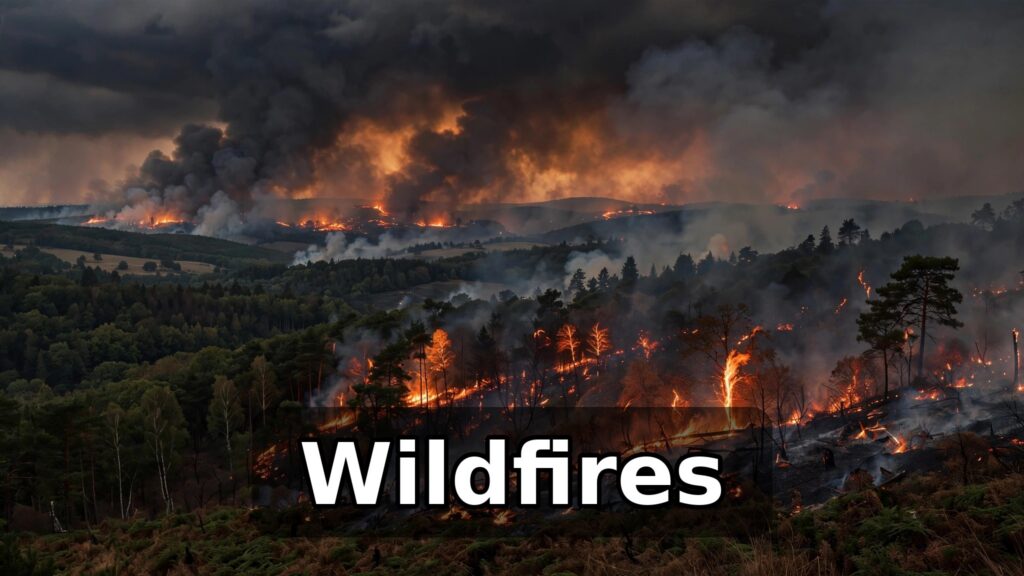
How Do Heat and Drought Turn European Wildfires More Dangerous?
Reuters reported on 2026 wildfires in Spain and France, where the WMO explained that consecutive heat waves, dry soil, and drought combined to create conditions in which fires start more easily, spread faster, and resist control for longer — a chain that demands both landscape management and early response now and emissions cuts for the longer term.
Key points
- A wildfire needs three things: fuel, oxygen and heat — and in 2026, consecutive heat waves, parched soil and prolonged drought brought them together more often in Spain and France.
- The World Meteorological Organization’s explanation, cited by Reuters, points to a chain of conditions — heat, then dry soil, then drought — rather than a single cause.
- In thoroughly dry vegetation, fire moves faster, climbs into tree canopies, generates its own wind, and jumps roads and rivers that once acted as barriers.
- Burning forests release stored carbon, adding to warming — a feedback loop that makes the next severe fire season slightly more probable.
A wildfire needs three things: fuel, oxygen, and heat. Europe has always had forests and dry summers, and it has always had fires. What changed in 2026, as Reuters reported from Spain and France, is how often and how intensely those ingredients came together. Consecutive heat waves, parched soil, and prolonged drought created conditions in which fires could start more easily, spread faster, and resist control for longer.
It is worth starting with a common misconception. People often imagine a wildfire as a single event with a single cause: a lightning strike, a careless spark, a hot day. In reality, whether that spark becomes a catastrophe depends far more on what it lands in than on how it started. A spark in a damp forest in a wet spring is a small story. The same spark in a landscape that has been baked for weeks is a different story altogether.
The chain: heat, dry soil, drought
A single hot day does not make a landscape flammable. Danger builds over time. First comes heat, and not just one heat wave but several in succession, each one baking the ground a little more. Then comes dry soil: as moisture evaporates from the earth, vegetation dries from the roots up. Finally comes drought, the long absence of rain that means nothing replenishes what the heat has taken.
By the time a spark arrives — from lightning, from a discarded cigarette, from farm machinery — the landscape is ready to burn. This is the sequence the WMO described behind the 2026 fires in Spain and France. It is not mysterious, and it is not new in principle. What is new is how frequently the full sequence now runs to completion, and how long the dangerous conditions last once they arrive. A fire season that once lasted weeks can now stretch for months.
Drought is what happens when that drying is not interrupted. Drought is not simply a lack of rain on a given week. It is the accumulation of weeks and months in which evaporation exceeds precipitation, so that every part of the water system — soil, streams, vegetation, even the air near the ground — becomes drier than usual. In a drought, there is no damp refuge for a fire to run into and die out. The fire can keep moving because everywhere it goes, it finds fuel that is ready to burn.
How time turns heat into flammability
A landscape’s flammability is not determined by today’s temperature alone. It is determined by the history of heat, rain and soil moisture over the preceding weeks and months. Two summers with the same peak temperature can produce very different fire seasons, depending on whether the heat arrived in one burst with rain in between, or in a relentless sequence with no recovery.
Why fires behave differently in a hotter landscape
When vegetation is thoroughly dry, fire behaves differently. It moves faster through grass and undergrowth, climbs more readily into tree canopies, and generates its own wind as superheated air rises and draws in fresh oxygen. Flames can jump roads and rivers that once acted as natural barriers. In extreme cases, fires create their own weather, with towering columns of smoke and heat that make aerial firefighting dangerous and ground crews’ work nearly impossible.
Spain and France in 2026
Reuters’ reporting on the 2026 fires in Spain and France illustrates how these conditions played out in real places. Both countries have long Mediterranean fire traditions, with landscapes shaped by hot, dry summers. But tradition is a poor guide when the climate shifts. Forests and scrub that burned in a manageable way in the past now burn with greater intensity, and fires reach areas that previously saw little fire activity.
The pattern in both countries was familiar: heat wave followed heat wave, soils dried out, and drought deepened. When fires ignited, they found a landscape primed to carry them. The reporting did not present these fires as freak accidents. It presented them as the predictable outcome of conditions that are becoming more common — a distinction that matters for how societies respond.
That expansion of the fire zone is one of the most consequential features of the 2026 fires. A community that has never experienced a major fire has no memory of evacuation, no cleared defensible space around homes, and no local expectation that fire is a threat to plan for. When fire arrives in such a place for the first time, the human cost can be disproportionate, not because the fire is uniquely large, but because the community is unprepared for any fire at all. As the conditions that favour fire spread to new areas, the number of such unprepared communities grows.
Evacuation and smoke: impacts beyond the burn area
The human consequences follow quickly. Communities that once had hours to evacuate may have far less time. Roads out of a burning area can be cut off. Smoke travels far beyond the fire itself, choking towns that never see a flame and sending people with respiratory conditions to hospitals. Firefighters, already stretched by longer seasons, face more days of extreme danger.
Evacuation is a moment of acute stress and difficult judgment, carried out under smoke, heat and uncertainty. People must decide what to take, which road to trust, and whether to leave animals and property behind. When a fire moves fast and throws embers ahead of itself, the safest road can become unsafe in minutes, and the decision to leave early — before the fire is visibly threatening — becomes the decision that saves lives. Yet leaving early is psychologically difficult, especially for people who have lived through previous fires that never reached them.
Smoke extends the fire’s reach far beyond the burned area, and its effects are often underestimated because they are invisible compared with flames. Fine smoke particles travel for long distances, settling over towns, cities and farmland that never see a fire. For healthy people, a smoky day is unpleasant. For children, older people, and anyone with asthma or heart conditions, it can be a medical emergency. Hospitals see more admissions for respiratory and cardiovascular problems during prolonged smoke episodes.
The costs beyond the burned area
Wildfire damage is usually counted in hectares burned and homes destroyed. Those numbers, stark as they are, miss much of the cost. Smoke degrades air quality across entire regions, affecting millions of people who never come near a flame. Burned slopes, stripped of vegetation, become vulnerable to erosion and mudslides when rain finally returns. Water supplies can be contaminated by ash and debris. Tourism, agriculture and forestry all suffer, sometimes for years after the fire is out.
The post-fire landscape carries its own hazards, and they arrive after the flames are gone, when attention has moved on. A slope that has lost its vegetation has lost its anchor. The roots that once held soil in place are dead, and the soil itself may have become water-repellent from intense heat, so that rain runs off the surface instead of soaking in. When heavy rain eventually falls, water rushes down bare slopes, carrying ash, sediment and debris into streams and rivers. The result can be flooding and mudslides in communities that survived the fire itself.
The carbon feedback loop
There is also a feedback effect worth understanding. When forests burn, they release the carbon they stored over decades, adding to the greenhouse gases that warm the climate. That warming, in turn, makes future heat waves and droughts more likely. Each severe fire season thus makes the next one slightly more probable — a cycle that can only be broken by reducing both emissions and the vulnerability of landscapes and communities.
This feedback is why wildfire cannot be treated as a purely local land-management problem. A fire in Spain or France is a local disaster, but the carbon it releases contributes to warming everywhere, including in the regions that will experience the next fire season. Conversely, emissions from far away contribute to the heat and drought that make European fires more likely. The loop connects local fires to global warming in both directions.
What should change
Not every hot, dry summer must become a disaster. The difference between a fire and a catastrophe often comes down to preparation. Forests can be managed to reduce fuel loads: clearing undergrowth, creating breaks in continuous vegetation, and restoring landscapes that are less prone to crown fires. Communities can be built and planned with fire in mind, with evacuation routes, defensible space around homes, and building materials that resist embers.
Landscape management is slow, unglamorous work, and its benefits are invisible when it succeeds. A fire in a managed landscape moves more slowly, stays lower, and gives crews a chance to stop it. A fire in an unmanaged landscape, where fuel is continuous from the ground to the canopy, gives crews no such chance. The challenge is scale: prioritising fuel management near communities, along evacuation routes, and around critical infrastructure, while accepting that remote forests will burn and in some cases should burn, as part of their natural cycle.
Early warning and rapid response matter enormously. A fire caught in its first hour is a different event from a fire that burns for a day before crews reach it. Investment in detection, in trained firefighters, and in the aircraft and equipment they need is the difference between a contained incident and a regional emergency. Detection has improved, with satellites, cameras and sensors able to spot new ignitions faster than ever. But detection is only useful if it is matched by the capacity to respond.
Community preparation is the other half of early response. Evacuation routes must be planned, maintained and known to residents before a fire arrives, not improvised during one. Homes need defensible space — cleared vegetation around the building — and ember-resistant materials, because in a severe fire, it is often wind-blown embers, not the flame front itself, that ignite houses. Warnings must reach everyone, including people who do not follow official channels or who live in isolated properties.
Breaking the chain also requires cutting the emissions that are lengthening fire seasons in the first place. Fire services are staffed, equipped and funded for a season of a certain length and intensity. When the season lengthens by months and the number of extreme fire days multiplies, the same service faces more fires with the same or only modestly greater resources. At some point, even a well-managed landscape and a well-prepared community cannot compensate for conditions in which fires ignite faster than they can be fought.
Landscape management and early response determine how much harm the next fire season causes. Emissions cuts determine how many future fire seasons will be severe, and how severe they will be. Both are necessary, and neither can substitute for the other. The 2026 fires in Spain and France, understood through the WMO chain of heat, dry soil and drought, make the case for both tracks at once — and for starting both now, while there is still a manageable fire season left to protect.
Raina





댓글 0
첫 댓글을 남겨보세요.