
Great Lakes Winters Are Shortening by Two Weeks a Decade—What Does the Evidence Show?
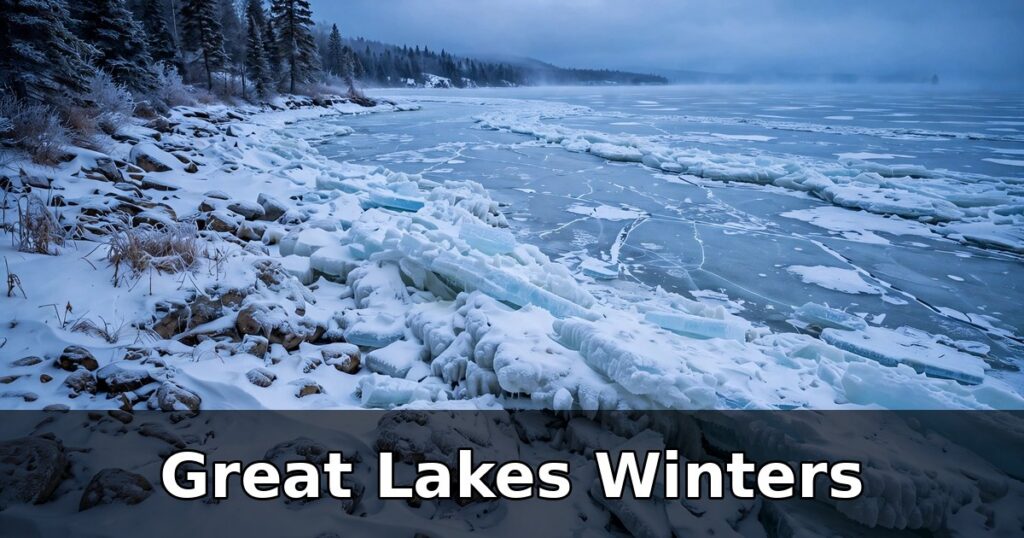
Stand on the shore of Lake Superior in February in a cold year and the lake looks like a white plain, solid enough to walk on in places, with pressure ridges and open leads that shift with the wind.
Stand on the shore of Lake Superior in February in a cold year and the lake looks like a white plain, solid enough to walk on in places, with pressure ridges and open leads that shift with the wind. Stand there in February 2024 and the picture was startlingly different: satellite images showed the Great Lakes almost entirely ice-free at the time of year when ice should have been at its peak. The question that image raises is not whether a single warm winter can happen, because warm winters have always happened, but whether winter itself is shrinking as a season on the lakes, and what that shrinkage means for everything that depends on ice. According to a study published in Environmental Research Letters in early 2025, led by Eric Anderson, an environmental engineering professor at the Colorado School of Mines, the answer is yes, and the rate is striking: the Great Lakes have been losing an average of 14 days of winter conditions each decade since 1995, or roughly two weeks per decade, as measured by ice cover and by near-freezing surface water temperatures. That is not a forecast for a distant future. It is a measured change in the recent past, and its consequences are already visible in shoreline erosion, in lake-effect weather and in the ecosystems that evolved around a long, cold winter.
What Losing Winter Means for a Lake
To understand what “losing winter” means for a lake, it helps to define winter in lake terms rather than calendar terms. For researchers, winter on the Great Lakes is not simply December to February. It is the period when ice covers a significant part of a lake’s surface, or when surface water is at or near freezing, conditions that change how the lake exchanges heat and moisture with the air, how light reaches organisms below, and how waves reach the shore. Anderson and his colleagues arrived at their findings by examining ice conditions and surface water temperatures, drawing largely on satellite data and on monitoring stations, because winter is, as Anderson himself noted, typically a blind spot for researchers: it is difficult to obtain measurements when there is less ice to stand on and when conditions are harsh. By combining those two measures, ice and cold water, they could track winter even on lakes that rarely freeze completely. Only Lake Erie, the shallowest of the five lakes, typically sees heavy ice cover each winter, whereas the other lakes often retain areas of open water even in cold years. The 14-days-per-decade figure therefore does not mean that 14 days have simply been deleted from the calendar. It means that, on average, there are 14 fewer days each decade on which the lakes are in that cold, icy winter state, a loss of about 1.4 days per year, compounded over thirty years into a winter that is more than a month shorter than it was in the mid-1990s.
A Longer Record Already Pointed Down
That finding builds on a longer record that was already alarming before Anderson’s study. Research summarised in reporting on the study had already found that the Great Lakes are losing ice cover at a rate of about 5 percent each decade, for a total loss of 25 percent between 1973 and 2023. Yale Environment 360, reporting on the winter of 2024, put the same trend in visual terms: ice cover usually peaks in late February or early March, when ice typically sprawls across more than 40 percent of the lakes, but in February 2024 ice cover stood at just around 4 percent, and for the past half-century ice cover has trended down as winters have grown warmer, declining by a quarter on average since 1973, while the ice season has shortened by nearly a full month. The winter of 2023 to 2024, which produced that image, was the warmest winter on record for the Great Lakes basin, according to the Great Lakes Integrated Sciences and Assessments summary for 2024, and it produced a record-low annual average ice cover of only 4.3 percent. That 4.3 percent figure is an annual average, not a single day’s minimum, which makes it more significant: it means that, averaged over the whole ice season from December 2023 through April 2024, less than one-twentieth of the lakes’ surface was ice-covered. The Environmental Law and Policy Center’s 2025 Update to the Assessment of Climate Change Impacts on the Great Lakes, released in July 2025 and developed by scientists from major Midwest universities, repeats the same headline, noting that 2024 recorded the lowest average winter ice cover on record for the Great Lakes, at only 4.3 percent, and warning that less ice disrupts ecosystems, worsens shoreline erosion and hurts tourism and fishing economies.
Why Warmer Air and Water Delay Freezing
The broader warming context in that 2025 update explains why ice is declining even though individual winters still vary. Since 1951, annual average air temperatures have increased by 2.9 degrees Fahrenheit in the United States Great Lakes region, according to the update, which draws on Great Lakes Integrated Sciences and Assessments data, and total precipitation has increased by 15 percent over the same period. Winter is the fastest-warming season in the region, according to reporting on the update, which is precisely the season that determines ice formation. A lake does not freeze because the calendar says January; it freezes because the air above it has been cold enough, for long enough, to remove heat from the water and to allow a skin of ice to form and thicken. When winter air temperatures rise, that cooling takes longer, the ice that does form is thinner and more vulnerable to a midwinter thaw, and spring melt arrives earlier. Summer water temperatures have also risen, with Lake Superior’s summer water temperatures warming by 4.8 degrees Fahrenheit between 1979 and 2023, according to the update, and Lakes Michigan, Huron, Erie and Ontario all seeing record-high average temperatures in the most recent year covered. A warmer lake in autumn starts winter with more heat stored in its water, so it takes even longer to cool to freezing, a feedback that helps explain why the loss of winter days has accelerated since 1995 rather than proceeding at a steady pace since the 1970s.
Shorelines Lose Their Ice Armour
One of the most immediate consequences of less ice is felt on the shoreline, and it is counterintuitive to people who associate erosion with storms rather than with calm water. Ice acts as a protective armour for the shore. When a lake is ice-covered, waves cannot reach the beach, bluffs and infrastructure with their full force, because the ice dampens wave energy and, in places, forms a frozen barrier along the shore itself. When ice is absent or arrives late and leaves early, the shore is exposed to wind-driven waves for more weeks each year, including during the autumn and spring storms that are themselves becoming more intense. The result, according to the 2025 update, is worsening shoreline erosion, with implications for homes, roads, water-treatment plants and the bluffs that define much of the Great Lakes coast. Erosion is not only a property problem; it changes the nearshore habitat where fish spawn, it increases sediment in the water, and it can undermine the very infrastructure that coastal communities rely on for drinking water. The Great Lakes provide drinking water to about 40 million people, according to the update’s background, so a change in shoreline stability is not a local aesthetic issue but a water-supply issue as well. High water levels in recent years have compounded the problem, because waves acting on a higher lake surface reach further up the beach and bluff, and the update notes greater fluctuation in lake levels as another consequence of a warmer, wetter climate.
Lake-Effect Snow, Changed Not Simply Gone
Lake-effect weather, the phenomenon that gives cities like Buffalo, Cleveland and Marquette their legendary snowfalls, is also changed by less ice, in ways that are more complicated than simply more or less snow. Lake-effect snow forms when cold air moves over relatively warm, open lake water, picking up heat and moisture that then condenses and falls as snow downwind. Ice suppresses that process, because it caps the lake and prevents evaporation. Open water in winter therefore provides more fuel for lake-effect snow, and in the short term, a winter with less ice can produce heavier lake-effect events, even as the overall climate warms. Over the longer term, however, the air itself becomes warmer, so the temperature contrast between air and water shrinks, and more precipitation falls as rain rather than snow, or falls in a narrower window before the lake itself cools. Researchers are therefore careful not to predict a simple increase or decrease in lake-effect snow. What they do predict is change: a shift in timing, in the rain-snow boundary, in the places that receive the heaviest snow, and in the frequency of the most intense bursts. For communities that plan snow removal, water supply and winter tourism around a predictable lake-effect season, that unpredictability is itself a cost, even if the annual snowfall total does not move in a single direction.
Ecosystems Built Around a Long Winter
The ecological consequences are equally profound, because Great Lakes organisms evolved with a long winter as a normal part of their life cycle. Ice cover changes light penetration, oxygen levels and water mixing. In winter, many lakes undergo a process in which colder, denser water sinks and the lake mixes from top to bottom, redistributing nutrients and oxygen. When winter shortens and surface waters warm earlier, that mixing pattern changes, which can affect everything from plankton blooms in spring to the oxygen available to fish eggs on the lake bed. Ice also provides a platform for some species and a refuge from predators for others, and its loss can favour invasive species that are less tolerant of prolonged cold. The 2025 update notes disappearing fish populations and harm to ecological health among its findings, and it links those changes to the same warming that is reducing ice: hotter summers, fewer cold nights, worsening storms and rising lake temperatures. Commercial and recreational fishing, which depend on cold-water species such as lake trout and whitefish, are therefore not just facing warmer summers but a fundamentally shorter cold season in which those species can thrive and reproduce. Winter tourism faces a parallel loss: ice fishing, snowmobiling and ice skating depend on reliable ice and snow, and the 2024 summary notes that warm conditions and lack of ice and snow impacted winter tourism in that record-low year. A winter that is two weeks shorter each decade is, for a resort or a fishing guide, a season that is steadily less bankable.
A Natural Cycle That May Pause, Not Reverse, the Trend
It is important to add a nuance that later research has raised, because it prevents a simple straight-line extrapolation from being mistaken for a forecast. A study from the Cooperative Institute for Great Lakes Research at the University of Michigan, reported in 2026, reconstructed ice cover back to 1898 using air temperature records and found that ice cover has also varied with slow natural cycles, including a roughly 60-year cycle linked to the Atlantic Multidecadal Oscillation, the pattern of North Atlantic sea surface temperatures. That study suggested that the rate of ice loss might slow, or even temporarily reverse, for a time as the natural cycle moves toward a phase that favours more ice, even against a background of warming. Its authors were explicit that such a pause should not be interpreted as climate recovery, but as a temporary respite from background warming that has continued over the past 125 years. That nuance does not overturn Anderson’s finding that winters have shortened by 14 days per decade since 1995, nor the 2025 update’s finding that 2024 set a record low. It does mean that the next decade might not lose ice at exactly the same rate as the last three, because natural variability rides on top of the warming trend. For planners, that is a reason to prepare for variability, including occasional cold winters with more ice, rather than to assume that every winter will be warmer than the last in a smooth progression. It is not a reason to assume the long-term trend has reversed.
Beyond the Lakes: Heat, Storms and Water Supply
The human dimension of a shorter winter extends beyond tourism and fishing to the infrastructure and public-health findings in the 2025 update. Hotter summers, with urban areas like Chicago projected to experience more than 200 hours above 95 degrees Fahrenheit by the 2030s, up from just 30 hours in recent years, according to the update, mean that the same region losing winter ice is also gaining summer heat stress. More days with at least two inches of rain or snow, up 6 percent in 2017 to 2024 compared with the 1986 to 2016 average, mean that stormwater systems designed for a previous climate face more intense bursts. Those changes are connected to ice loss through the same mechanism: a warmer atmosphere holds more moisture and delivers it in heavier events, while a warmer lake stores more heat and releases it differently through the year. The Great Lakes are sometimes described as inland seas, and that description is apt for climate purposes: they are large enough to modify their own regional climate, to store heat through summer and release it through winter, and to generate their own weather downwind. When their winter changes, the region’s climate changes with it, not just the lakes themselves.
Why Winters Are Shortening
Why, then, are Great Lakes winters getting shorter by two weeks a decade? Because winter air temperatures in the region are rising faster than temperatures in other seasons, because warmer autumn lake temperatures delay the onset of freezing, because thinner ice melts earlier in spring, and because those effects have compounded since 1995 into a measured loss of about 14 days of icy, near-freezing conditions per decade, according to Anderson and colleagues in Environmental Research Letters. The record-low average ice cover of 4.3 percent in 2024, confirmed by both the Great Lakes Integrated Sciences and Assessments summary and the Environmental Law and Policy Center’s 2025 update, is the most visible symptom of that shortening, but the consequences extend well beyond a satellite image of a blue lake in February. They include more exposed shorelines and erosion, a changing lake-effect snow regime, disrupted mixing and fish habitat, and a winter economy built on reliable cold that is becoming less reliable. A shorter winter on the Great Lakes is not an abstraction. It is a season that now arrives later, leaves earlier, and protects the shore, the fish and the towns around the lakes for fewer weeks each year than it did a generation ago.
Raina





댓글 0
첫 댓글을 남겨보세요.