
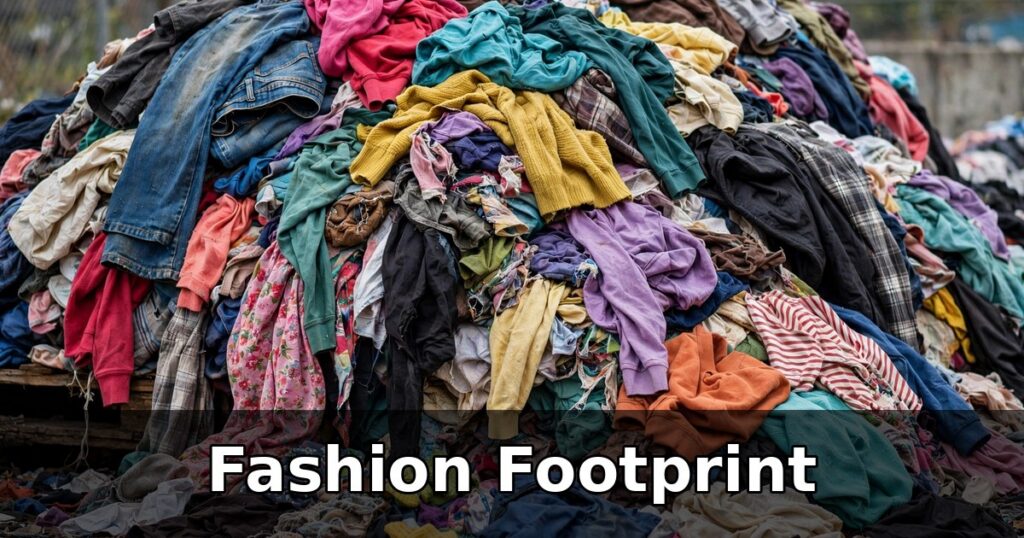
Fashion’s Carbon Footprint: The Clothes We Wear and the Climate
Open a wardrobe in almost any home and you will find a small history of globalisation: cotton grown in one country, spun in another, dyed in a third, sewn in a fourth, shipped across oceans, worn for…
Key points
- Every year, 92 million tonnes of textile waste is produced globally, according to UNEP.
- Clothing production doubled from 2000 to 2015, while the duration of garment use decreased by 36 percent over the same period.
- The fashion industry accounts for roughly 8 to 10 percent of global carbon emissions — an approximation, not a precise measurement.
- Only 8 percent of textile fibres in 2023 were made from recycled sources, and 11 percent of plastic waste comes from clothing and textiles.
Open a wardrobe in almost any home and you will find a small history of globalisation: cotton grown in one country, spun in another, dyed in a third, sewn in a fourth, shipped across oceans, worn for a season or a few years, and then discarded. Each step in that journey uses energy, water, chemicals, and transport, and each step produces emissions. Fashion is often treated as a frivolous topic compared with energy, transport, or industry, but its climate footprint is substantial, its waste problem is visible in landfills around the world, and its supply chain touches millions of workers, many in low-income countries.
A recent United Nations Environment Programme (UNEP) statement puts the waste side of that footprint in stark terms. Ahead of the International Day of Zero Waste 2025, UNEP noted in a press release dated 27 March 2025, from Nairobi, that 92 million tonnes of textile waste is produced globally each year, that production doubled from 2000 to 2015 while garment use duration fell by 36 percent, that 11 percent of plastic waste comes from clothing and textiles, and that only 8 percent of textile fibres in 2023 were recycled. The 2025 focus shone a spotlight on waste in the fashion and textiles industry. As UNEP Executive Director Inger Andersen said, unsustainable fashion is aggravating the triple planetary crisis of climate change, nature loss, and pollution and waste, and a circular economy approach valuing sustainable production, reuse, and repair is needed.
Where the footprint comes from
Fashion’s carbon footprint is not a single number. It is the sum of emissions across a long, fragmented supply chain, from fibre production and manufacturing to transport, consumer use, and disposal. According to UNEP and other widely cited sources, the fashion industry accounts for roughly 8 to 10 percent of global carbon emissions, often compared with international aviation and maritime shipping combined. That comparison is useful for scale, but estimates vary by methodology, year, and scope, and the 8 to 10 percent range is an approximation, not a precise measurement. What is not in doubt is that the footprint is large, has grown as production has grown, and is driven by volume as much as by any single process.
Fibre production is the first major source. Cotton requires land, water, and, in conventional farming, fertilisers and pesticides whose production produces emissions. Synthetic fibres, led by polyester, are derived from fossil fuels, and their production is energy-intensive and linked to oil and gas extraction and refining. Synthetic fibres now account for a large share of global textile production, and their growth has been a major driver of fashion’s footprint. Other fibres have their own profiles: wool involves methane from livestock, viscose involves wood pulp and chemical processing, and recycled fibres remain a small share of supply, as UNEP’s 8 percent figure for 2023 illustrates.
Manufacturing is the second major source, and often the largest. Spinning, weaving, knitting, dyeing, and finishing textiles require large amounts of energy, much of it from fossil fuels in major manufacturing countries, as well as water and chemicals. Dyeing and finishing are particularly energy- and water-intensive, and can pollute wastewater if not properly treated. Garment assembly, by contrast, is labour-intensive but less energy-intensive per garment, so its climate footprint is smaller than manufacturing’s, even though its social footprint — wages, working conditions, and safety — is profoundly important. Transport is generally a smaller share than manufacturing, except when garments are air-freighted, which is far more emissions-intensive than shipping by sea.
Consumer use and disposal complete the picture. Washing and drying uses energy and water, and washing synthetics releases microfibres, tiny plastic particles that can enter waterways. The UNEP statement’s note that 11 percent of plastic waste comes from clothing and textiles points to that broader plastic dimension, including microfibre shedding and the disposal of synthetic textiles. When clothes are discarded, most end up in landfill or incineration. In landfill, natural fibres decompose and release greenhouse gases, while synthetic fibres persist for decades or centuries, and incineration releases carbon dioxide directly. Only a small fraction of discarded clothing is recycled into new clothing, rather than downcycled into rags or insulation, or exported for reuse elsewhere.
Fast fashion and the volume problem
| Measure | Figure | Source and period |
|---|---|---|
| Textile waste produced each year | 92 million tonnes | UNEP, 2025 |
| Growth in clothing production | Doubled | 2000–2015 |
| Fall in garment use duration | −36% | 2000–2015 |
| Share of plastic waste from clothing and textiles | 11% | UNEP, 2025 |
| Textile fibres from recycled sources | 8% | 2023 |
| Fashion’s share of global carbon emissions | ~8–10% | Widely cited approximation |
The most important change in fashion over the past two decades has not been how a single garment is made, though that matters. It has been how many garments are made, how quickly they are produced, and how briefly they are worn. Production doubled from 2000 to 2015, according to UNEP, while garment use duration fell by 36 percent. That combination — more clothes, worn less — is the core of the fast fashion model.
Low prices are central to that model, made possible by low labour costs, cheap synthetic fibres, economies of scale, and externalised environmental and social costs — costs borne by workers, communities, rivers, and the climate, not reflected in the price tag. A garment that costs a few dollars at retail cannot cover the full cost of sustainable fibre production, safe dyeing, living wages, durable construction, and responsible disposal. Something, or someone, pays the difference.
The volume problem also creates a waste problem that is visible far from where clothes are bought. Discarded clothing often ends up in low-income countries, where poor waste infrastructure leads to dumping, burning, and severe environmental and social consequences. Export for reuse is not inherently bad; second-hand markets provide affordable clothing and livelihoods in many countries. But when exports consist largely of low-quality, unsellable fast fashion items, they become waste transfer rather than reuse, burdening receiving communities with disposal costs they did not create. That dynamic is increasingly recognised as an environmental justice issue, not just a waste management one.
What the numbers mean, and what they do not
It is also important to distinguish between a garment’s footprint and a person’s footprint. A person who buys few, durable garments and wears them for many years may have a far lower fashion footprint than a person who buys many cheap garments and discards them quickly, even if both spend the same amount. Doubling the number of times a garment is worn, from 30 to 60 wears, reduced its functional greenhouse gas footprint by about 50 percent in an analysis by Mistra Future Fashion, while the Ellen MacArthur Foundation puts the saving at 44 percent. Those figures are estimates per wear, not per garment. They illustrate a simple principle: the most effective way to reduce a garment’s footprint per use is to use it more. A durable garment worn 100 times has a far lower footprint per wear than a flimsy garment worn five times.
What a lower-footprint fashion system could look like
A lower-footprint fashion system would change at every stage, not just at the checkout. At the fibre stage, it would shift toward lower-impact and recycled fibres and farming practices that protect soil, water, and biodiversity, recognising that no fibre is impact-free and that volume reduction matters more than fibre substitution alone. At the manufacturing stage, it would decarbonise energy, improve water and chemical management, and ensure safe working conditions.
At the consumer stage, the most impactful actions are unglamorous: buy less, choose well, wear longer, care for clothes properly, repair rather than replace, buy second-hand where appropriate, and dispose responsibly. Cold washing and line-drying can reduce use-phase emissions and extend garment life. None of these actions alone will transform the industry, and framing fashion’s footprint as solely a consumer responsibility would be unfair, given the power of brands, retailers, and policymakers to shape what is produced and sold. But consumer behaviour shapes demand, and a culture that values durability over novelty makes systemic change easier.
Policy is starting to shift the costs
The European Union’s revised Waste Framework Directive, which entered into force on 16 October 2025, makes textile producers pay for the collection, sorting, and recycling of used clothing, under extended producer responsibility, and gives member states 30 months to set up their schemes, with fees varying with a product’s environmental performance. Large companies must also publicly report how much unsold stock they discard, with a standardised reporting format applying from February 2027. Those measures, if enforced, shift costs back to producers and create incentives for durability and recyclability that voluntary pledges alone have not achieved.
What is still uncertain
The 8 to 10 percent emissions figure is an approximation. It aggregates studies with different scopes, years, and methods, and it is not a precise measurement like a national emissions inventory. It is useful for scale, not for exact accounting.
What this means
Volume is the core problem, not any single garment. Production doubled in fifteen years while garments were worn 36 percent less. A system that makes more clothes and wears each one less will keep growing its footprint.
Use matters at least as much as material. Doubling wears from 30 to 60 cuts the footprint per wear by roughly half. Durability, care, and repair are climate actions, not just thrift.
The costs are being exported, not avoided. Cheap prices depend on costs borne by workers, rivers, and communities that receive unusable discarded clothing. Until those costs sit with producers, the price tag will keep lying about the true cost.
What should change
Make producers pay for the end of a garment’s life. Extended producer responsibility, as in the EU directive that entered into force on 16 October 2025, puts collection, sorting, and recycling costs on the companies that profit from volume.
Design for wears, not for seasons. Durability, repairability, and recyclability should be design requirements, with transparent information on materials, origin, and care, so a buyer can tell a garment made to last from one made to be discarded.
Count what is discarded, not only what is sold. Public reporting of unsold stock, with a standardised format from February 2027, makes overproduction visible. What gets measured gets managed; what stays hidden keeps growing.
The wardrobe as a climate choice, and its limits
Fashion is personal in a way that power plants and pipelines are not. Clothes express identity, culture, profession, and mood, and telling people to stop caring about clothes would be both unrealistic and culturally tone-deaf. A lower-footprint fashion future does not require drab uniformity or the end of creativity. It requires a shift from quantity to quality, from disposability to durability, from opacity to transparency, and from take, make, dispose to make, use, repair, reuse, recycle.
That shift will not happen through consumer guilt alone, nor through corporate pledges alone, nor through policy alone. It will require all three, aligned: consumers who value longevity, brands that design for it, and policymakers who set standards, enforce extended producer responsibility, and keep the costs of waste and pollution from being exported to communities with the least power to refuse them. UNEP’s 2025 message is a reminder that fashion is not a side issue: it is a lens on sustainable consumption — meeting human needs for clothing, identity, and livelihoods within planetary limits, without treating the planet, or the people who make our clothes, as disposable.
Raina





댓글 0
첫 댓글을 남겨보세요.