
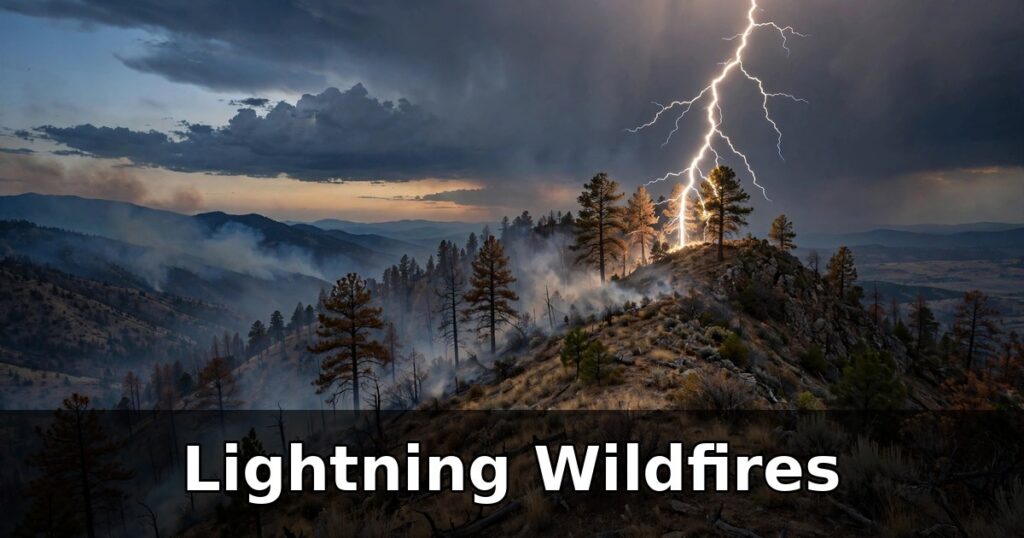
Could Lightning-Started Wildfires Become More Common Across the Western U.S.?
On a summer afternoon in the mountains of the American West, a single bolt of lightning can do what no careless campfire or downed power line need do: it can reach places no person can easily reach, strike a ridge miles from the nearest road, and smoulder quietly in dry duff until the wind picks up hours or even days later.
Key points
- Lightning is responsible for more than two-thirds of the area burned by wildfires in the western United States.
- By 2031–2060, 98% of western lands susceptible to fire will see more days posing a risk for lightning-started wildfires.
- Many grid cells in the northern West gain 4–12 additional lightning days per year, with up to 12 more days per summer by 2060 in Oregon, Idaho and Montana.
- The risk rises even where lightning days do not, because lightning increasingly coincides with high fire-weather days.
On a summer afternoon in the mountains of the American West, a single bolt of lightning can do what no careless campfire or downed power line need do: it can reach places no person can easily reach, strike a ridge miles from the nearest road, and smoulder quietly in dry duff until the wind picks up hours or even days later. That is why lightning has always been a central character in the story of western wildfire, and why a new study of its future has drawn attention well beyond fire science.
According to a paper by Dmitri Kalashnikov and colleagues published in Earth’s Future on 26 August 2025, lightning-ignited wildfires are set to become more likely across nearly the whole fire-prone West within a few decades, not because lightning alone is increasing, but because lightning is increasingly arriving on days when the landscape is ready to burn.
A region-wide increase
The headline finding is stark. According to the American Geophysical Union, which covered the study on 10 September 2025, lightning is responsible for more than two-thirds of the area burned by wildfires in the western United States, and the study found that essentially all of the region, 98 percent of western lands susceptible to fire, will see an increase in days posing a risk for lightning-started wildfires as early as 2031 to 2060.
That near-term window matters. Earlier climate projections often looked to the end of the century, a horizon far enough away to feel abstract. This study looks at the mid-twenty-first century, a period that, as Kalashnikov himself noted, starts in just a few years and is, in his words, on our doorstep. The question it raises is not only whether there will be more lightning, but why the overlap between lightning and fire-friendly weather is widening, and what that means for forests, communities and the people who fight fires.
Why lightning fires differ
To understand the result, it helps to start with what makes a lightning fire different from other fires. Human-caused ignitions tend to cluster near roads, towns, campgrounds and power infrastructure, which means they are often detected quickly and reached relatively fast. Lightning ignitions, by contrast, are scattered across remote terrain. A strike in a roadless wilderness area may burn for a long time before anyone sees smoke, and by the time a crew arrives, the fire may already be large.
Teaching models to predict lightning
The challenge for scientists has been that lightning is not something most global climate models simulate directly. Climate models are very good at representing temperature, moisture and large-scale circulation, but a lightning flash is a small-scale electrical process inside a thunderstorm cloud, far below the resolution at which these models operate. To get around this, Kalashnikov and his team built a workaround grounded in physics.
They trained convolutional neural networks, a form of machine learning, to predict daily cloud-to-ground lightning from three thermodynamic variables that climate models do represent well: the ratio of surface moist static energy to saturation moist static energy at 500 hectopascals, the lapse rate between 700 and 500 hectopascals, and relative humidity at 500 hectopascals. In plain language, these variables capture how much warm, moist energy is available near the surface, how quickly temperature falls with height, and how humid the middle atmosphere is. Together they describe an atmosphere primed for deep, vigorous convection, the kind of towering cloud in which charge separation and lightning occur.
More lightning days in the north
What the projections show is a widespread increase in cloud-to-ground lightning days across much of the region by the mid-twenty-first century, with the largest changes in the northern West. According to the paper’s abstract, many grid cells in the northern western United States experience four to twelve additional cloud-to-ground lightning days compared with 1995 to 2022, driven by increases in all three thermodynamic variables.
| Region | Projected change in lightning days | Period |
|---|---|---|
| Northern West (many grid cells) | 4–12 additional cloud-to-ground lightning days | 2031–2060 vs 1995–2022 |
| Oregon, Idaho, Montana | Up to 12 more days per summer | By 2060 |
| Southwest | Fewer increases; declines in some areas | 2031–2060 |
| All fire-susceptible western lands | 98% see more lightning-fire risk days | 2031–2060 |
When lightning meets fire weather
But lightning days alone do not make a wildfire. A bolt that strikes wet ground during a soaking storm starts nothing. The dangerous days are the ones when lightning coincides with dry fuels, low humidity and wind, the combination that allows an ignition to take hold and spread. That is why the second half of the study matters as much as the first.
The researchers matched their lightning projections with projections of the Fire Weather Index, a widely used measure of how favourable the weather is for wildfire on a given day. The Canadian Forest Fire Weather Index, created in 1968, combines temperature, humidity, wind and precipitation into an index of fire danger, and it has become a standard tool for comparing fire weather across regions and decades. By counting the days when cloud-to-ground lightning and high Fire Weather Index values occur together, the team produced a measure of lightning-ignited wildfire risk that is closer to what fire managers actually worry about than a count of strikes alone.
The finding was that by 2031 to 2060, cloud-to-ground lightning will coincide more frequently with high Fire Weather Index days, although the size of the increase relative to lightning days alone varies across the region. Even in the Southwest, where lightning days themselves increase less or even decline in places, the region is still expected to see a rise in days with a likelihood of wildfires ignited by lightning. That is a subtle but important point. Fire risk is a product of two changing quantities, and if the fire-weather side of the product grows fast enough, it can more than compensate for a flat or falling lightning trend. In the northern West, both sides of the product grow together, which is why the increase in risk there is largest. Elsewhere, the overlap still grows, because hotter, drier conditions make a larger fraction of whatever lightning does occur dangerous.
Why should warming increase lightning?
Why should warming increase lightning in the first place? The mechanism runs through moisture and instability. A warmer atmosphere can hold more water vapour, and when that moisture is lifted into a thunderstorm, it releases more latent heat, invigorating the updraughts that separate electrical charge inside the cloud. At the same time, changes in the vertical temperature profile can make the atmosphere more unstable, meaning that a parcel of warm surface air, once nudged upward, keeps rising more vigorously.
Risk days are not fires
The distinction between risk days and actual fires matters for interpretation. A projected increase in lightning-ignited wildfire risk days does not mean that burned area will increase by the same percentage, or that every additional risk day will produce a fire. Whether a strike becomes a blaze depends on what it hits, how dry the fuel is at that exact spot, whether rain follows the strike, and how quickly the fire is detected and suppressed.
What the research says
Kalashnikov and colleagues (Earth’s Future, 26 August 2025) trained convolutional neural networks on summers 1995–2022 to predict daily cloud-to-ground lightning from three thermodynamic variables, then applied them to the Community Earth System Model version 2 Large Ensemble under a moderate warming scenario. The headline result: 98% of fire-susceptible western lands see more lightning-fire risk days by 2031–2060, with the northern West gaining 4–12 lightning days and Oregon, Idaho and Montana gaining up to 12 more days per summer by 2060.
What is still uncertain
Dry lightning is not separated out. One open question is the role of dry lightning, strikes that arrive with little or no rain at the surface, which are especially dangerous because there is no accompanying wetting to suppress ignition. The study’s use of daily lightning occurrence and the Fire Weather Index captures part of this danger, since high fire-weather days tend to be dry, but it does not explicitly separate wet from dry strikes.
Simultaneous ignitions are beyond the map. Another is the behaviour of individual storms: a warming climate may change not only how many days produce lightning, but also how lightning is distributed within storms, how often strikes occur in clusters that overwhelm suppression resources, and how often multiple fires start on the same day, a phenomenon known as a lightning bust that can exhaust crews and aircraft. The authors’ grid-cell approach is well suited to mapping risk days, but the operational challenge of simultaneous ignitions is a step beyond what a daily risk map can show.
The result depends on the scenario. The projections were made under a moderate warming scenario, which means that a world that warms more rapidly would be expected to show larger changes, while a world that cuts emissions sharply might show smaller ones. The study is therefore best read not as a fixed forecast, but as a conditional statement: if warming follows a moderate path, this is how lightning-ignited wildfire risk shifts by mid-century. That conditional framing is a strength, not a weakness, because it connects the result to choices about emissions. It also means that the 98 percent figure should not be quoted without its qualifiers: it refers to western lands susceptible to fire, to risk days rather than to fires themselves, and to the 2031 to 2060 period under the scenario modelled.
What this means
A double exposure. For people who live in the West, the practical message is less about lightning as an abstraction and more about the compounding of risks. A hotter climate does not only dry the forest; it also changes the sky above the forest. The same warming that lengthens the fire season and dries fuels also loads the atmosphere with more of the energy and moisture that produce lightning, and it does so most strongly in exactly the northern forests where lightning fires are already a dominant force. The result is a double exposure: more sparks, and more days on which a spark can grow.
Adaptation must work on both sides. Adaptation will therefore need to work on both sides of the equation, from reducing fuel loads and hardening communities, to improving lightning detection networks, speeding initial attack in remote areas, and planning for summers in which several lightning fires may start at once. The study does not prescribe any single policy, but it sharpens the question that policymakers and fire agencies must answer: how do you prepare for a fire regime in which nature itself is striking the match more often, on more days, and in more places than before?
Raina





댓글 0
첫 댓글을 남겨보세요.