
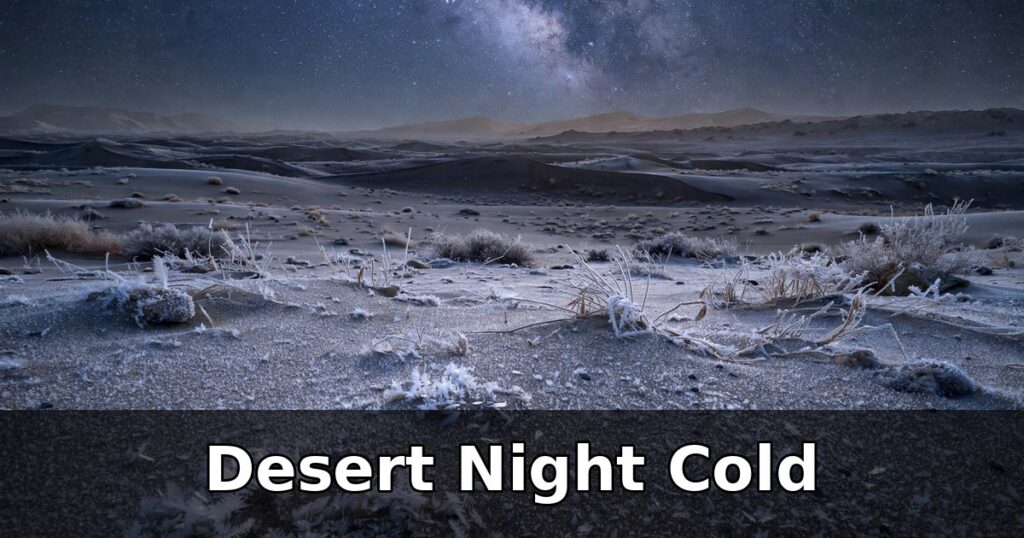
Why Do Deserts Turn Freezing Cold at Night After Scorching Days?
Key points
- A typical hot desert swings by about 42°C (75°F) in a single day — from a daytime average near 38°C (100°F) to a night average near -3.9°C (25°F).
- In the Sahara, afternoons can pass 50°C and clear winter nights can fall close to 0°C. A daily swing of more than 30°C is common there.
- The cause is not one factor but four working together: dry air, clear skies, low-heat-capacity ground, and almost no water or vegetation to store heat.
- Deserts are defined by rainfall — less than 250 mm a year — not by heat. Some parts of the Atacama receive less than 1 mm a year.
By mid-afternoon in a hot desert, the ground can be too hot to touch. Sand shimmers, shade feels like the only shelter, and the air itself seems to press down. A few hours later, after sunset, the same place can demand a jacket, then a blanket. The change is so fast and so large that it feels like a trick of the landscape.
It is not a trick. It is physics, and it follows directly from what a desert is missing. A desert has very little water vapour in the air, very few clouds, very little vegetation, and ground made mostly of sand and rock. Each of those absences removes something that, in a wetter place, would slow the daily heating and cooling. Take them all away at once, and the temperature has almost nothing to hold it steady.
The numbers make the point clearly. NASA gives a typical hot desert a daytime average of about 38°C (100°F) and a night average of about -3.9°C (25°F). That is a swing of roughly 42°C, or about 75°F, between the average day and the average night. Few other landscapes on Earth change that much that fast.
The scale of the swing
The Sahara offers the most dramatic version of the pattern. Afternoon temperatures there can exceed 50°C, and on clear winter nights the temperature can fall close to 0°C. A daily range of more than 30°C is common. The midday surface of the sand itself can reach 70 to 80°C — hot enough to burn bare feet, and far hotter than the air a metre or two above it.
The Sonoran Desert in the southwestern United States shows the same pattern at a smaller scale. According to the United States National Park Service, summer temperatures there pass 40°C and commonly reach 48°C. Yet the daily temperature range exceeds 15°C in every season, including winter. Even in the cooler months, the desert does not hold its daytime warmth into the night.
| Place | Daytime high | Night low or daily range |
|---|---|---|
| Typical hot desert (NASA averages) | About 38°C (100°F) | About -3.9°C (25°F); swing about 42°C |
| Sahara | Over 50°C in the afternoon | Near 0°C on clear winter nights; swing over 30°C common |
| Sonoran Desert | Over 40°C in summer, commonly 48°C | Daily range over 15°C in every season |
| Sahara sand surface at midday | 70 to 80°C | Surface, not air temperature |
A desert is defined by rain, not heat
One common misunderstanding should be cleared away first. A desert is defined by how little rain it receives — less than 250 millimetres a year — not by how hot it gets. That is why the definition covers cold deserts too, including parts of Antarctica and the Gobi, where winter temperatures fall far below freezing.
The Atacama Desert in Chile shows how dry a desert can be. Some parts of the Atacama receive less than 1 millimetre of rain a year. In the driest stretches, years can pass with no measurable rain at all. The air there holds almost no water vapour, the ground holds almost no moisture, and the sky is almost always clear.
Why it happens: four reasons
| Factor | What it does |
|---|---|
| Dry air | Water vapour acts as a blanket that traps heat leaving the ground. Desert air often has humidity below 20%, so that blanket is thin. |
| Clear skies | With almost no clouds, there is nothing to catch the infrared radiation escaping from the surface at night. |
| Sand and rock | Sand and rock have a low specific heat: they heat up quickly in the sun and cool down just as quickly after dark. |
| Almost no water or vegetation | There is little moisture to store heat in the soil and almost no plants to shade the ground or release moisture into the air. |
The first reason is the dry air. Water vapour is the most important greenhouse gas in the atmosphere, and it works like a blanket over the ground. During the day it absorbs some of the sun’s energy; at night it absorbs the infrared radiation the ground gives off and sends some of it back down. In a desert, where humidity is often below 20%, that blanket is thin. Heat escapes to space almost unimpeded once the sun goes down.
The second reason is the clear sky. Clouds do the same job as water vapour, on a larger scale: they intercept outgoing infrared radiation and return part of it to the surface. A cloudy night in a temperate climate is usually a mild night, for exactly this reason. Deserts have few clouds, so the night sky is open. The ground radiates its heat straight upward, and nothing sends it back.
The third reason is the ground itself. Sand and rock have a low specific heat, which means they need relatively little energy to warm up — and they give that energy up just as readily. A patch of sand in full sun can be scorching by noon and cold to the touch a few hours after dark. Wet soil behaves very differently: water has a high specific heat, so damp ground warms slowly and cools slowly, smoothing out the daily swing.
The fourth reason is the absence of water and vegetation in the landscape as a whole. In a wetter place, moisture in the soil stores daytime heat and releases it at night. Plants shade the ground during the day and release water vapour into the air, which both cools the surface by evaporation and thickens the atmospheric blanket at night. A desert has almost none of this. There is no reservoir of stored heat to draw on after sunset, and no evaporative cooling to blunt the midday peak.
The hottest ground on Earth
The official record for the highest air temperature ever measured stands at 56.7°C (134°F), recorded at Death Valley in California on 10 July 1913 and certified by the World Meteorological Organization. It has stood for more than a century, and it is also one of the most argued-over numbers in meteorology.
The modern measured maximum is lower: 54.4°C (130°F), recorded at Death Valley in both 2020 and 2021. Some researchers have questioned the 1913 reading, pointing to the instruments and practices of the time, and the 2020 and 2021 readings are sometimes described as the highest reliably measured air temperatures in the modern era.
Ground surface temperatures — the temperature of the sand or rock itself, as seen from a satellite — run far higher. In 2005, satellite measurements in Iran’s Lut Desert recorded a surface temperature of 70.7°C (159.3°F). A later analysis covering 2002 to 2019 found maximum surface temperatures of up to 80.8°C (177.4°F) in the Lut and Sonoran deserts. Those are surface temperatures, not air temperatures, and they should never be quoted as if a person standing there would experience that heat in the air. But they show how hot bare desert ground becomes when the sun strikes it without interruption.
| Record | Value | Note |
|---|---|---|
| Highest air temperature, WMO-certified | 56.7°C (134°F), Death Valley, 10 July 1913 | Some researchers question the 1913 reading |
| Highest modern measured air temperature | 54.4°C (130°F), Death Valley, 2020 and 2021 | Highest reliably measured in the modern era |
| Highest satellite surface temperature, 2005 | 70.7°C (159.3°F), Lut Desert, Iran | Ground surface, not air temperature |
| Highest satellite surface temperature, 2002–2019 | 80.8°C (177.4°F), Lut and Sonoran deserts | Ground surface, not air temperature |
What the research says
The satellite record of extreme desert heat comes from Mildrexler and colleagues, writing in the Bulletin of the American Meteorological Society in 2011. Their work used satellite data to map the highest land surface temperatures on Earth, and it established the Lut Desert’s 70.7°C reading as the highest surface temperature recorded by satellite at the time.
A second line of research looks at how deserts are changing as the planet warms. Huang and colleagues, in Nature Climate Change in 2017, found that dry regions are warming faster than wet regions — a pattern known as desert amplification. The mechanisms are the same ones that cause the daily swing: with little moisture to buffer change, dry land responds more strongly to added heat.
The Intergovernmental Panel on Climate Change, in its Sixth Assessment Report, projects that dry areas will expand as warming continues. That does not mean every desert will get hotter at the same rate, but it does mean that the conditions that produce the swing — dry air, clear skies, bare ground — are expected to cover more land.
What is still uncertain
The 1913 Death Valley record is disputed. The World Meteorological Organization still certifies 56.7°C as the highest air temperature on record, but some researchers argue that the measurement was affected by the instruments and the exposure of the station at the time. The 2020 and 2021 readings of 54.4°C are not disputed in the same way, which is why they are often cited as the modern maximum.
Surface temperature is not air temperature. Satellite readings of 70.7°C and 80.8°C describe the ground itself, measured from orbit. A weather station a metre or two above that ground would record a much lower number. The two kinds of measurement answer different questions, and mixing them up produces misleading claims about how hot a desert “really” gets.
The daily swing is not the same everywhere in a desert. Valleys, slopes, rocky outcrops and patches of vegetation all change the local picture. Cold air drains into low ground at night, so a valley floor can be colder than the slopes above it. A rocky slope facing the morning sun warms earlier than one facing away. The averages — 38°C by day, -3.9°C by night — describe the typical desert, not every square metre of it.
What this means
The swing is a feature of dryness, not of heat. A desert is cold at night for the same reason it is hot by day: it has almost nothing to store heat, trap heat, or slow the change. The same physics explains why a humid tropical coast, with the same midday sun, cools by only a few degrees overnight.
Survival in a desert is a two-sided problem. The danger by day is heat; the danger by night is cold. Anyone travelling in a hot desert needs protection from both, and the transition between them can take only a few hours. That is why desert travellers, and desert animals, are built around the swing rather than around a single temperature.
The pattern is a warning about warming drylands. If dry regions warm faster than wet ones, as Huang and colleagues found, then the places that already swing hardest are also the places changing fastest. The daily swing itself may not be the main risk — the risk is that hotter days, on top of an already extreme range, push conditions further beyond what people, animals and plants there can tolerate.
A landscape with no blanket
A desert at night is cold because it has nothing to keep the day’s heat. No water vapour in the air, no clouds overhead, no moisture in the ground, no canopy of leaves. The sun’s energy arrives, the sand takes it up quickly, and as soon as the sun sets the ground gives it back to a clear sky. The swing from 38°C to -3.9°C is not an anomaly of desert weather. It is desert weather, working exactly as the physics says it should.
Raina





댓글 0
첫 댓글을 남겨보세요.