
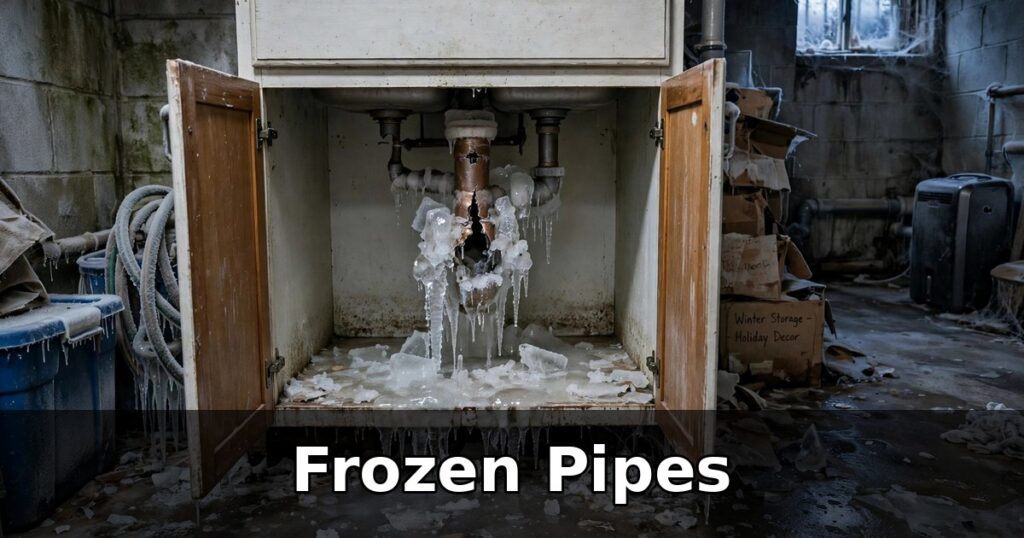
Why Your Pipes Can Freeze Even When the House Feels Warm
Key points
- Water freezes at 32°F (0°C), but a pipe inside a cold wall cavity can reach that temperature while the room beside it feels comfortable.
- Risk rises sharply when outdoor temperatures stay at or below 20°F (-7°C) for several hours, according to field research summarised by the Insurance Institute for Business & Home Safety (IBHS).
- Freezing water expands by about 9%, and the pressure trapped between an ice blockage and a closed faucet can exceed 2,000 pounds per square inch.
- State Farm handled more than 20,000 frozen-pipe claims from January 2024 to June 2025, paying out over $628 million — an average of more than $30,000 per claim.
- The American Red Cross advises keeping the heat at no lower than 55°F when a home is left unattended in freezing weather.
A thermostat on a hallway wall reads 68°F. The living room feels warm. The kitchen tap is opened the next morning and nothing comes out. The surprise is understandable. The house felt warm, so the pipes should have been warm too.
The mistake is treating a house as one temperature. A house is a collection of spaces, and some of them are far colder than the rooms where people spend their time. A pipe does not care what the thermostat says. It only responds to the temperature immediately around it, and to how long that cold lasts.
The thermostat measures air, not pipes
A thermostat measures the air at one point, usually on an interior wall in a heated room. It does not measure the temperature inside a wall cavity on the north side of the house, under a kitchen sink against an outside wall, or in a crawl space below the floor. Those places can be much colder than the room next to them, and the difference grows on a windy night.
Warm air also has to travel to reach a pipe. A closed cabinet door under a sink blocks that path. Insulation can do the same thing in reverse: insulation placed between a pipe and the warm room keeps the room’s heat away from the pipe, while the pipe sits close to the cold outer sheathing. Air leaks make the gap worse. A small opening where a pipe passes through a wall lets outdoor air flow directly onto the pipe, while the room beside it feels still and warm.
The science: why ice breaks pipes
Water freezes at 32°F (0°C). That number is fixed, but freezing a pipe takes time. The water inside has to lose enough heat to reach that point. A brief dip below freezing rarely causes trouble in a well-protected home. A long cold spell is different, because heat keeps leaving the water faster than the house can replace it.
When water turns to ice, it expands by roughly 9%. Inside a closed pipe there is nowhere for it to go. An ice plug forms and blocks the flow, and as more water freezes behind it, pressure builds in the trapped section between the ice and a closed faucet. The pipe does not usually burst where the ice forms. It bursts at the weakest point downstream, where the pressure can exceed 2,000 pounds per square inch.
The damage often stays hidden until the thaw. While the pipe is frozen, the ice itself plugs the break. When the temperature rises and the ice melts, water pours through the split. A burst pipe can release 250 gallons or more in a day, and much more if nobody is home to shut off the water. That is why the worst flooding is often discovered hours after the cold has passed.
| What happens | The number | Why it matters |
|---|---|---|
| Water freezes | 32°F (0°C) | The fixed point at which liquid water turns to ice |
| Water expands as it freezes | About 9% | No room for the extra volume inside a closed pipe |
| Pressure behind an ice plug | More than 2,000 psi | Enough to split copper and crack plastic |
| Risk rises sharply | 20°F (-7°C) or lower, sustained for hours | The warning threshold used by IBHS |
| Minimum heat when away | 55°F (13°C) | The floor recommended by the American Red Cross and IBHS |
Where pipes freeze first
The American Red Cross lists the same danger spots again and again: pipes in exterior walls, pipes in unheated spaces, and outdoor hose bibs. These are the places where plumbing is closest to outdoor air and furthest from indoor heat. Kitchen and bathroom sinks on exterior walls are a classic case. The pipes run through the wall behind the cabinet, and the cabinet door keeps warm room air out.
Attics, crawl spaces, basements and garages are the other common locations. These spaces are often unheated or only partly heated, and pipes there may have little or no insulation. A garage is especially deceptive: it feels sheltered, but an uninsulated garage on a cold night can be nearly as cold as the outdoors. A garden hose left connected in winter traps water in the faucet and the short pipe behind it, and the ice can extend back into the wall.
Why 20°F is the warning line
The 20°F figure comes from field research by the Building Research Council at the University of Illinois, summarised by IBHS. The researchers found that pipes began to freeze when outdoor temperatures stayed at or below about 20°F (-7°C) for an extended period. A survey of 71 plumbers in southern states supported the finding: burst-pipe calls began to appear once temperatures dropped into the teens.
The number is a warning threshold, not a guarantee. A pipe can freeze above 20°F if it is exposed, uninsulated and hit by wind, and a well-protected pipe can survive well below it. Duration matters as much as temperature. Six hours or more of sustained cold is far more dangerous than a brief overnight dip. Wind strips heat from siding and drywall, so the wall cavity cools faster than it would in still air. Hot-water pipes are not exempt either, although cold-water lines freeze first in many homes because they are more often routed along exterior walls.
What the research says
Water damage and freezing together account for 22.6% of all homeowners insurance claims, second only to wind and hail. About 1 in 67 insured homes files a water damage or freezing claim each year, and the average claim from 2019 to 2023 was $15,400, according to the Insurance Information Institute.
Frozen pipes specifically are worse than the average water claim. State Farm handled more than 20,000 frozen-pipe claims between January 2024 and June 2025, paying out over $628 million — an average of more than $30,000 per claim. Texas and Tennessee were among the states with the highest losses, a reminder that the risk is not limited to cold climates. Homes in warmer regions often have less insulation and more exposed plumbing, so a rare cold snap does more damage there.
What is still uncertain
There is no single freezing temperature for a house. The 20°F threshold is a useful warning line, but the temperature that freezes a particular pipe depends on its location, its insulation, the wind, and how long the cold lasts. Two identical houses on the same street can have different outcomes.
The exact role of pipe material is not settled in a simple rule. Copper conducts heat away faster than plastic, so it can cool more quickly, but plastic pipes can also split under pressure. Some plastic piping tolerates a freeze better than rigid copper, but no common residential pipe material is freeze-proof.
Wind chill is often misunderstood. Wind chill does not lower the air temperature below the measured value, so it cannot make a pipe colder than the outdoor air. What it does is remove heat from the wall much faster, so the pipe reaches the outdoor temperature sooner. A windy night can freeze a pipe that would have survived the same temperature in still air.
What this means
A warm room is not proof that the pipes are warm. The thermostat reports one point in the house. The pipes live in the coldest points. Checking those points — opening a cabinet, feeling a crawl space, looking at the pipes in the garage — gives a truer picture than the thermostat alone.
Duration is the real enemy. One cold night is a warning. Several freezing nights in a row, or a cold snap combined with a power cut, is when the risk becomes serious. The water needs time to lose its heat, and a long spell gives it that time.
Warm-climate homes are not safe by default. The highest frozen-pipe losses in recent State Farm data included Texas and Tennessee, not just northern states. A house built for heat, with pipes in exterior walls and thin insulation, can fail in its first hard freeze.
What should change
Keep the heat steady, not just on. The American Red Cross advises keeping the thermostat at the same temperature day and night during cold weather, and at no lower than 55°F when the home is left unattended. A higher heating bill costs less than a burst-pipe repair.
Let warm air reach the pipes. Open kitchen and bathroom cabinet doors where pipes sit on an outside wall, and move household chemicals out of children’s reach first. Let cold water drip from a faucet served by exposed pipes. The drip keeps water moving and relieves pressure if ice begins to form.
Insulate the right places, and seal the leaks. Insulate both hot and cold water pipes in attics, basements, crawl spaces and garages, and seal the gaps where pipes pass through walls. Insulation slows heat loss; it does not create heat, so a pipe in a very cold space may still need a drip as well.
Know where the main shutoff is, and thaw gently. If a pipe bursts, shutting off the main water valve is the fastest way to limit the damage. Every adult in the household should know where the valve is. If a faucet produces only a trickle, suspect a frozen pipe. Keep the faucet open, and warm the pipe with an electric heating pad, a hair dryer, or towels soaked in hot water. Never use a blowtorch, a kerosene or propane heater, or any other open flame.
A warm house with cold corners
Pipes freeze in warm houses because houses are not uniformly warm. The rooms people live in are heated, ventilated and sunlit. The cavities, crawl spaces and garages where the plumbing runs are not. A cold snap exploits that difference, hour by hour, until the water in one short section of pipe reaches 32°F and expands by 9% into a break that nobody sees until the thaw.
The fix is not a warmer thermostat setting alone. It is closing the gap between the warm rooms and the cold corners: opening the cabinet, insulating the exposed run, sealing the air leak, keeping the heat steady, and knowing where the shutoff valve is. A house that feels warm is a good start. A house whose pipes are warm is the part that actually matters.
Raina





댓글 0
첫 댓글을 남겨보세요.