
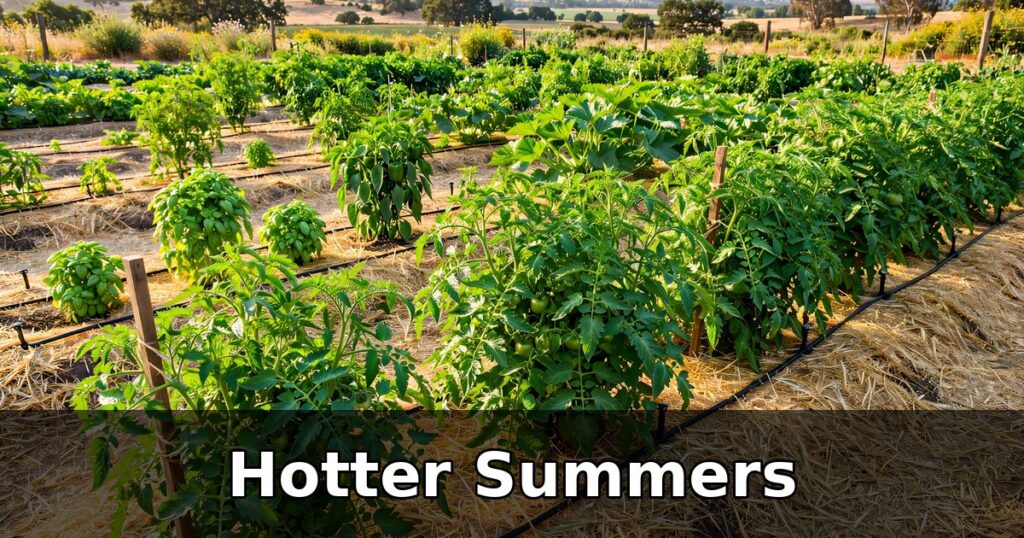
How to Prepare Your Garden for a Hotter Summer
Summers are getting hotter across much of North America, and gardens feel the change first. A garden that thrived under the summers of twenty years ago can struggle under the summers of today, not because the gardener has done anything wrong, but because the climate the garden was designed for has shifted. Longer stretches of days above 90 degrees Fahrenheit, warmer nights, and longer gaps between rains combine into a new set of conditions, and plants that were once reliable begin to wilt by mid-afternoon, drop blossoms without setting fruit, and attract pests that once arrived later in the season. Preparation is the response that works best, because most of the defences against heat must be in place before the heat arrives.
Key points
- Tomatoes prefer days of 70 to 85 degrees Fahrenheit. When days top 90 degrees for several days while nights stay above 72 degrees, pollen can fail and flowers drop without setting fruit.
- Water deeply, not often: wet the soil to 6 to 10 inches, and give vegetables about 1 inch of water per week, counting rainfall. Lawns need half to three-quarters of an inch.
- Mulch is the single most effective defence: 2 to 4 inches around vegetables, 3 to 5 inches of bark chips for landscape plantings.
- Shade cloth rated at 30 to 50 percent shade takes the edge off the afternoon sun while still admitting enough light for growth.
- Mow lawns at 3 inches or more, and let cool-season grass go dormant and brown in peak heat — it recovers when cooler weather returns.
Summers are getting hotter across much of North America, and gardens feel the change first. A garden that thrived under the summers of twenty years ago can struggle under the summers of today, not because the gardener has done anything wrong, but because the climate the garden was designed for has shifted.
Preparation is the response that works best, because most of the defences against heat must be in place before the heat arrives.
How heat stresses plants
Heat harms plants through several mechanisms at once, and understanding them explains why the remedies work. The most visible effect is water loss: as air temperature rises, the difference in water vapour concentration between the inside of a leaf and the surrounding air grows, and the plant loses water faster through the small pores, or stomata, on the leaf surface.
The second mechanism is damage to reproduction. Many vegetables set fruit only within a narrow temperature range, and heat disrupts pollination before it damages the leaves. North Carolina Cooperative Extension reports that tomatoes prefer daytime temperatures of 70 to 85 degrees Fahrenheit, and that when daytime temperatures top 90 degrees for several days in a row while nights stay above 72 degrees, tomato pollen can become nonviable and flowers drop without setting fruit.
Other extension services draw the line in similar places. Alabama Cooperative Extension describes blossom drop when day temperatures exceed 85 degrees and nights exceed 72 degrees, while Iowa State University Extension notes that nights below 55 degrees or above 75 degrees also interfere with fruit set.
| What heat does | How it shows up | What helps |
|---|---|---|
| Water loss through leaves | Wilting, scorched leaf edges, stalled growth | Deep watering, mulch, shade |
| Failed pollination | Flowers drop without fruit, especially tomatoes | Heat-set varieties, afternoon shade |
| Hot soil | Shallow roots suffer, water uptake falls | Mulch, shade, deep watering |
The third mechanism is heat in the soil itself. Bare soil in full summer sun can reach temperatures far above the air temperature, and roots suffer when soil temperatures climb.
Building soil that holds water
Soil is the foundation of heat resilience, and the work begins well before summer. Soil rich in organic matter holds substantially more water than depleted soil, because organic matter acts like a sponge, absorbing water during rain or irrigation and releasing it slowly to roots. Compost is the most practical way to add organic matter, and a layer of two to three inches worked into the top six to eight inches of a bed each spring raises the water-holding capacity steadily over successive seasons.
Watering deeply and at the right time
Watering is the most frequent garden task in summer, and the most common mistake is watering lightly and often. Shallow daily watering wets only the top inch or two of soil, and roots respond by staying near the surface, where the soil dries fastest and heats most. Deep, infrequent watering does the opposite: it wets the soil to a depth of six to ten inches, encourages roots to grow downward into cooler, moister soil, and leaves the surface dry enough to discourage fungal disease.
Oregon State University Extension recommends watering infrequently and deeply, to a depth of eight to ten inches, rather than lightly every day, and Kansas State University Extension gives a similar figure of six to eight inches for trees and shrubs. Kansas State University Extension puts the baseline at about one inch of water per week for a vegetable garden, counting rainfall, with daily or every-other-day watering during a heatwave when temperatures rise above 90 degrees Fahrenheit.
| What you are watering | How much per week | How deep |
|---|---|---|
| Vegetable garden | About 1 inch, counting rainfall | 6 to 10 inches |
| Trees and shrubs | Deep soak, less often | 6 to 8 inches |
| Lawn (to stay green) | Half to three-quarters of an inch | Deep, infrequent |
| Containers in a heatwave | Up to twice a day | Whole pot volume |
Lawns need less: Oregon State University Extension gives half to three-quarters of an inch per week, and notes that lawns can be allowed to go dormant and brown during peak heat, recovering when cooler weather returns. The finger test is a practical check: soil wet two to four inches down means watering can wait, while dry soil at that depth means water is needed.
Timing matters as much as quantity. Watering early in the morning, when temperatures are lower and wind is light, reduces evaporation and allows foliage to dry before night, which limits disease. Drip irrigation is the most efficient delivery method, because it places water directly at the soil surface near the roots, and it can be run under mulch so that almost none is lost to evaporation.
Mulch: the single most effective defence
If one practice deserves the title of most effective defence against summer heat, it is mulching. A layer of organic mulch over bare soil shades the surface, slows evaporation, moderates soil temperature, and suppresses weeds that compete for water. Kansas State University Extension recommends two to four inches of mulch around vegetable plants, using straw, shredded leaves, compost, or grass clippings, and notes that mulch reduces evaporation and regulates soil temperature, keeping plant roots cooler.
Oregon State University Extension recommends a somewhat deeper layer, three to five inches of bark chips or arborist trimmings, for landscape plantings, and the difference reflects the coarser material and the longer season for trees and shrubs.
Fresh wood chips can temporarily tie up nitrogen as they decompose, so they are better suited to paths and around established shrubs than to vegetable beds, where straw, shredded leaves, or finished compost are safer choices. Watering well immediately after mulching, and before a heatwave arrives, ensures that the soil beneath the mulch is moist when the hot weather begins.
Shade, wind, and the microclimate
Shade is the most direct way to reduce heat load on plants, and it can be provided temporarily or permanently. Shade cloth, a woven fabric that blocks a stated percentage of sunlight, is the most flexible option: a cloth rated at 30 to 50 percent shade, suspended above a bed on hoops or posts, lowers leaf temperature and reduces water loss while still admitting enough light for growth. The cloth should be mounted with an air gap above the plants, so that hot air can escape, and it can be removed in the morning and replaced in the afternoon, or left in place through a heatwave and removed when temperatures ease.
Vegetables that benefit most from afternoon shade include lettuce, spinach, peas, and other cool-season crops that bolt or turn bitter in heat, along with tomatoes and peppers during fruit set.
Choosing plants for hotter summers
Plant selection is the longest-term adaptation, and it begins with accepting that some favourites may no longer be reliable. Cool-season crops such as lettuce, spinach, peas, and broccoli bolt quickly when temperatures rise, and in a hotter climate they belong in spring and autumn, not in midsummer. Heat-loving crops take their place: tomatoes, peppers, eggplant, squash, beans, okra, sweet potatoes, and melons all thrive in warm soil and tolerate high air temperatures, provided water is adequate.
Mediterranean herbs such as rosemary, thyme, oregano, and lavender tolerate heat and drought once established, and their aromatic oils may even intensify in hot, dry conditions. Within a species, variety choice matters. Seed catalogues increasingly list heat-tolerant and heat-set varieties, bred to set fruit at higher temperatures than older varieties. For tomatoes, heat-set varieties can continue to produce when standard varieties drop blossoms, and for lettuce, slow-bolting varieties extend the harvest by weeks.
Native plants and species from Mediterranean climates are generally better adapted to hot, dry summers than plants from cool, moist regions, and Oregon State University Extension recommends Mediterranean-climate species and regional natives for water-wise gardens. Grouping plants with similar light and water needs together — right plant, right place — ensures thirsty plants do not sit beside drought-tolerant ones.
Succession planting spreads risk across the season. Rather than planting an entire crop at once, sowing a portion every two to three weeks ensures that if one sowing fails in a heatwave, later sowings can still succeed.
Containers, lawns, and trees
Container gardens face the harshest heat, because a pot holds a small volume of soil that heats and dries rapidly. Dark pots absorb more heat than light-coloured ones, and pots sitting on hot paving heat from below as well as from the side. The remedies are straightforward: use the largest pots practical, since a larger volume of soil changes temperature more slowly; choose light-coloured containers or shade the pots themselves with a board or a second, larger pot; group pots together so that they shade each other; and mulch the surface of the potting mix.
Watering containers twice a day may be necessary during a heatwave, and a saucer under the pot can hold a small reserve, although standing water should not be left for long, since it encourages root rot and mosquitoes. Lawns are the most water-hungry part of many gardens, and they are also the most forgiving of heat.
Oregon State University Extension notes that lawns can be allowed to go dormant during peak heat, and the alternative — keeping a lawn green through a heatwave — requires half to three-quarters of an inch of water per week, applied deeply. Mowing higher, at three inches or more, shades the soil, reduces evaporation, and encourages deeper roots.
Trees deserve attention before and during heat, because a mature tree represents decades of growth and cannot be replaced quickly. Deep watering of the root zone, using a soaker hose looped around the drip line, is far more effective than frequent shallow sprinkling, and a wide ring of mulch under the canopy, kept away from the trunk, conserves the moisture that is applied. Newly planted trees and shrubs are the exception to the rule against frequent watering: their root systems are still small, and they need water once a week, applied slowly enough to wet the entire root profile to a depth of at least six to eight inches.
A season plan: spring preparation through late summer
| When | What to do |
|---|---|
| Early spring | Work 2–3 inches of compost into beds; stockpile mulch; test drip lines and soaker hoses; order heat-tolerant varieties; place heat-sensitive crops where afternoon shade will fall |
| Late spring | Finish mulching before the soil heats; water deeply but not excessively so roots grow down; install shade-cloth supports before the first heatwave |
| Summer | Check soil with the finger test before watering; water in the early morning; put shade cloth up when a heatwave is forecast; harvest in the morning; do not fertilise stressed plants |
| Late summer | Remove spent summer crops and replant cool-season vegetables for autumn; add compost; write down what worked while the memory is fresh |
A garden prepared this way does not merely survive a hotter summer; it accumulates knowledge, soil, and structure that make each following summer easier than the last.
Raina





댓글 0
첫 댓글을 남겨보세요.