
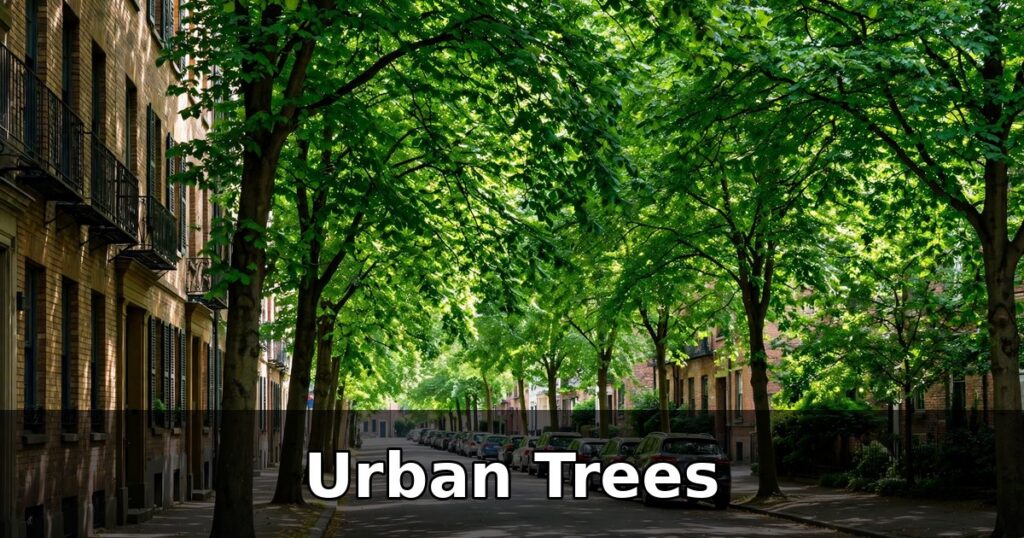
Urban Trees: The Cheapest Climate Infrastructure a City Can Plant
Cities are often described as concrete jungles, but that metaphor misses something important: a city without trees is hotter, less healthy, more flood-prone, and less pleasant to live in than a city…
Key points
- A 10 percent increase in tree canopy lowers air temperature by 0.8 degrees Celsius; a 30 percent increase lowers it by as much as 1.5 degrees Celsius, according to a 2025 study in npj Urban Sustainability.
- Tree canopy was the dominant cooling factor in that study, explaining 67 percent of the spatial variation in air temperature during a heatwave.
- Across 110 global cities, trees can reduce pedestrian-level temperatures by up to 12 degrees Celsius.
- Maximising canopy in 61 large cities would add 3,200 million cubic metres of water demand a year — but drought-tolerant species could cut that to 1,500 million cubic metres.
Cities are often described as concrete jungles, but that metaphor misses something important: a city without trees is hotter, less healthy, more flood-prone, and less pleasant to live in than a city with them. Trees shade buildings and streets, cool air through evaporation, absorb rainwater, filter air pollutants, store carbon, support birds and pollinators, and provide places for people to walk, play, and rest. Compared with seawalls, drainage tunnels, or air conditioning, trees are remarkably cheap to plant, though not free to maintain, and they provide multiple benefits at once.
Recent research has quantified cooling with unusual precision. A 2025 study in npj Urban Sustainability by Zaerpour, Papalexiou, and Pietroniro found tree canopy cover was the dominant cooling factor, explaining 67 percent of the spatial variation in air temperature measured across a citywide network during a heatwave. The study found that a 10 percent increase in tree canopy reduces air temperature by 0.8 degrees Celsius, while a 30 percent increase lowers it by as much as 1.5 degrees Celsius. Those figures refer to air temperature, the metric most relevant to human thermal comfort, rather than land surface temperature from satellites, which the study found overestimates urban heat by a factor of two, with surface urban heat island averaging 8.9 degrees Celsius compared with 4.6 degrees Celsius for canopy urban heat island.
How trees cool a street
Trees cool in two main ways, and both matter. The first is shade. A tree canopy blocks direct solar radiation from reaching pavements, walls, roofs, and people, preventing those surfaces from heating up and radiating heat back into the air. Shade is most effective at midday, when the sun is highest and surfaces would otherwise absorb the most energy. A shaded pavement can be dramatically cooler than an unshaded one, and a shaded building needs less air conditioning, reducing energy costs and waste heat.
The second way is transpiration: trees draw water from soil through their roots and release it as water vapour from their leaves, absorbing heat from the air as sweat cools skin. Transpiration is not constant through the day. Research on urban tree traits in Shanghai, published in the Journal of Applied Ecology in 2025 by Wang and colleagues, found that structural shading was most effective at midday, while nutrient-driven transpiration dominated in the morning and late afternoon, and that leaf nutrient traits, including nitrogen and phosphorus, explained more variation in cooling than canopy structure alone. That finding, based on nearly 4,000 trees across 77 species in Shanghai, suggests that planting the right trees, not just more trees, matters for cooling.
One study analysing 182 research articles across 110 global cities found trees can reduce pedestrian-level temperatures by up to 12 degrees Celsius, while another 2025 review of 128 eligible studies found urban trees can reduce air temperature by 0.5 to 5.8 degrees Celsius and surface temperature by 2 to 12 degrees Celsius, depending on canopy density and climate type. Those ranges are wide because cooling depends on species, size, health, water, urban form, and climate — a reminder that a single cooling number for all cities would be misleading.
How the cooling numbers compare
| Study or synthesis | Cooling found | What it measured |
|---|---|---|
| Zaerpour et al., 2025 (npj Urban Sustainability) | 0.8°C per 10% canopy; up to 1.5°C per 30% canopy | Air temperature during a heatwave |
| Zaerpour et al., 2025 | Canopy explains 67% of air temperature variation | Citywide network, heatwave |
| Zaerpour et al., 2025 | Surface heat island 8.9°C vs canopy heat island 4.6°C | Satellite surface vs air temperature |
| 182 articles, 110 cities (2025 synthesis) | Up to 12°C | Pedestrian-level temperature |
| 128-study review (2025) | 0.5–5.8°C air; 2–12°C surface | Air and surface temperature |
| Boston University, July 2025 | Canopy cooling 35% higher than cool roofs | Temperature reduction in Boston |
Beyond cooling: what else trees do
Cooling is the benefit most often quantified, but it is far from the only one. Trees intercept rainfall, slow runoff, and allow water to infiltrate soil, reducing stormwater volumes and flood risk. Their roots stabilise soil and reduce erosion. They filter air pollutants, including particulate matter, by trapping particles on leaves, though trees are not a substitute for reducing emissions at source. They store carbon in wood and soil, though far less per tree than forest trees.
Trees also affect health and wellbeing in ways that are harder to quantify. Neighbourhoods with more trees and green space tend to have residents who walk more, report better mental health, and experience lower stress, though income, safety, and other factors also shape those patterns. Trees provide habitat for birds, insects, and other wildlife, and shade for playgrounds, bus stops, and walking routes, making active transport more feasible in hot weather. For children, older adults, and outdoor workers, shade on a walking route or at a bus stop is a health intervention, not an amenity.
Why trees are cheap, and why they are not free
Trees are often called the cheapest climate infrastructure a city can plant, and in terms of upfront cost per unit of cooling, that claim has merit. A young tree may cost tens or hundreds of dollars, compared with thousands or millions for engineered cooling or drainage systems. A mature tree, once established, provides benefits for decades with relatively low annual maintenance, compared with mechanical systems that require energy, parts, and replacement.
But cheap to plant is not free to maintain, and that matters for city budgets and equity. A tree planted and then neglected, without watering, pruning, pest management, and protection, may die within a few years, wasting the initial investment. A tree planted in the wrong place, with insufficient soil volume or restricted roots, may damage sidewalks, pipes, or buildings, creating costs that outweigh its benefits. A species poorly suited to local climate, soil, or water may require excessive irrigation or fail as temperatures rise.
Water is a particular trade-off. Research by The Nature Conservancy found that increasing tree canopy cover in 61 large cities to maximum potential would add 3,200 million cubic metres of water demand a year, though drought-tolerant species could cut that to 1,500 million cubic metres. Those figures are modelled estimates, but they illustrate that maximising canopy everywhere, without regard to water, is not sustainable in dry cities. In arid and semi-arid cities, the right approach may be fewer, well-chosen, drought-tolerant trees, placed where they provide the most shade and cooling for people, rather than maximum canopy everywhere.
A July 2025 study from Boston University, comparing trees with cool roofs, illustrates another trade-off. It found that temperature reductions from expanding tree canopy in Boston were 35 percent higher than those from installing cool roofs, but that roofs on average had more potential to reduce heat exposure, because there were more opportunities to install them where populations were most vulnerable and space for planting was most limited. The researchers emphasised balance: trees provide benefits for mental health, flood prevention, biodiversity, and air quality, but whether canopy expansion is the best solution depends on local factors, including water. Sometimes, a combination of trees, cool roofs, shading structures, and reflective surfaces will protect more people than trees alone.
The equity problem: who gets trees
Perhaps the most important issue in urban forestry is not how much cooling trees provide, but who receives it. In many cities, tree canopy is unevenly distributed by income, race, and historical investment. Wealthier neighbourhoods, often with larger lots, parks, and street trees planted decades ago, have abundant canopy. Lower-income and historically disinvested neighbourhoods, and those with more renters and industrial land, often have far less. That disparity means the neighbourhoods most vulnerable to heat are also the least protected by trees. Heat, in that sense, is not just a meteorological problem. It is a legacy of planning decisions.
Addressing that disparity requires intentional, equity-focused planting. A city that plants 10,000 trees, but most of them in already green neighbourhoods, may increase total canopy while widening the gap. A city that prioritises planting in heat-vulnerable, low-canopy neighbourhoods, involves residents in species selection and stewardship, and ensures watering and maintenance for the critical first years is more likely to reduce heat inequity. Resident involvement matters, because trees planted without community buy-in may be vandalised, neglected, or resented.
Displacement, sometimes called green gentrification, is a real risk. When a neighbourhood gains trees, parks, and other amenities, property values and rents may rise, potentially displacing the very residents the greening was intended to help. That does not mean cities should avoid greening low-income neighbourhoods, which would perpetuate inequity. It means greening should be paired with housing protections and affordable housing investment, so existing residents benefit rather than being priced out. Trees alone cannot solve housing policy, but tree policy that ignores housing can cause harm.
Planting for the future, not just the present
Urban trees planted today will live, if they survive, through decades of warming, changing rainfall, pests, and diseases. Planting for the future requires thinking beyond current conditions. Cities are increasingly diversifying species to avoid overreliance on a single species that a pest or disease could wipe out, as happened with elm and ash trees in many North American cities. They are considering climate suitability in 2050, not just today, selecting species that can tolerate hotter, drier, or more variable conditions. They are also thinking about soil: providing sufficient soil volume so roots can grow and trees can reach maturity.
Maintenance is the unglamorous core of urban forestry. Watering during establishment, typically the first two to three years, is critical. Pruning prevents hazards and extends tree life. Monitoring for pests, diseases, and drought stress allows early intervention. Replacing dead trees promptly prevents gaps in canopy. Those activities require trained staff, equipment, and sustained budgets, not just one-off planting grants.
What is still uncertain
Cooling ranges are wide because context varies. The 0.5 to 5.8 degree air and 2 to 12 degree surface ranges from the 128-study review reflect real differences in species, size, health, water, urban form, and climate.
What this means
Trees are cheap cooling, but only if they survive. A young tree costs tens or hundreds of dollars; a mature tree delivers benefits for decades. But a neglected tree may die within a few years, wasting the investment.
Canopy is distributed unfairly. The neighbourhoods most vulnerable to heat are often the least protected by trees.
What should change
Pair greening with housing protection. Tree planting in low-income neighbourhoods should come with affordable housing investment and renter protections.
Mix trees with other cooling. In Boston, cool roofs had more potential to reduce heat exposure where planting space was limited.
Protect mature trees first. They provide far more cooling than young saplings and take decades to replace.
A tree planted well is infrastructure for decades
Urban trees will not solve climate change, stop heatwaves, replace emissions reductions, or protect a city from every flood. What they can do, at relatively low cost, is make cities cooler, healthier, and more liveable, street by street. That is why they are often called the cheapest climate infrastructure a city can plant, provided the city plants them equitably, maintains them diligently, and chooses wisely for a hotter future. A tree planted well today is infrastructure for decades; a tree planted poorly, or only where it is easy, is a missed opportunity.
Raina





댓글 0
첫 댓글을 남겨보세요.