
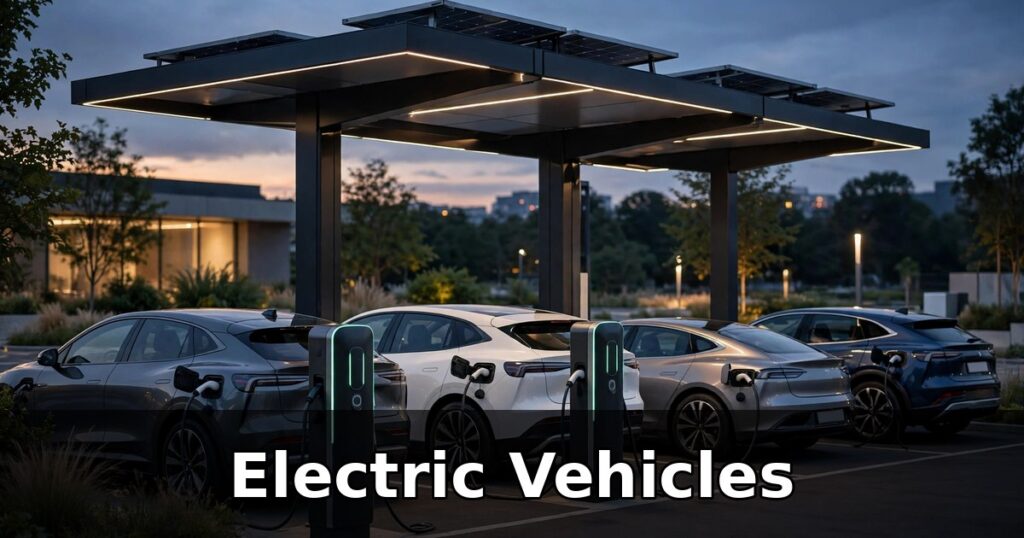
Electric Vehicles: Can the Grid Handle Millions of New Cars?
Every few years, the same question returns with new urgency: if everyone switches to an electric car, will the lights go out? It is a fair question, because transport has run on liquid fuel for more…
Key points
- The global public charging network added nearly 1.8 million chargepoints in 2025, a 33 percent increase that brought the total to more than 7 million.
- Public charging capacity would need to grow by almost ninefold to 2030 to support the sales implied by stated policies — yet electric vehicles were set to account for only about 2.5 percent of total global electricity demand in 2030.
- China held more than 65 percent of global public chargepoints at the end of 2025, and accounted for over 75 percent of global growth.
- Global electric vehicle adoption had surpassed 40 million units, giving vehicle-to-grid storage enormous theoretical scale — though the technology remains at pilot stage in most markets.
- The binding constraints are local, not national: specific transformers, specific corridors, and specific times of day.
Every few years, the same question returns with new urgency: if everyone switches to an electric car, will the lights go out? It is a fair question, because transport has run on liquid fuel for more than a century, and electricity grids were not built with millions of large, mobile batteries in mind. Yet the question is often asked in the wrong way. The real test is not whether the grid can survive a single evening when everyone plugs in at once. It is whether planners, utilities, and drivers can spread demand, build charging in the right places, and upgrade the local wires that actually constrain the system, while the electricity itself gets cleaner over time.
That distinction matters, because a national average can hide a local problem, and a local problem can be mistaken for a national crisis. A country can have plenty of generation capacity overall and still have a neighbourhood transformer that struggles if a dozen fast chargers appear on the same street without planning. Conversely, a street can cope perfectly well if most cars charge slowly overnight, when demand is low, even if the total number of electric cars keeps rising. Understanding electric vehicles and the grid therefore means looking at three different things at once: how much electricity cars need in total, when they need it, and where the network is weakest.
A milestone that frames the debate
According to the International Energy Agency, the global public charging network added nearly 1.8 million chargepoints in 2025, a 33 percent increase that brought the total stock to more than 7 million units by year-end. The IEA reported that this expansion matched the growth rate of the electric light-duty vehicle fleet and maintained the ratio of electric light-duty vehicles to public chargepoints at approximately 11 vehicles per chargepoint. Public charging capacity per electric light-duty vehicle increased from 4 kilowatts to 4.5 kilowatts between 2024 and 2025, and the average speed of public chargepoints rose by about 15 percent year-on-year, from just over 40 kilowatts in 2024 to nearly 50 kilowatts in 2025, driven by faster charging infrastructure.
That milestone does not, by itself, prove that the grid is ready everywhere. It does show that charging infrastructure is not standing still while vehicle sales grow. It also shows where the work is concentrated. The IEA figures reported in the same update noted that China accounted for more than 65 percent of global public chargepoints at the end of 2025, with its network growing from nearly 3.4 million chargepoints at year-end 2024 to over 4.7 million by year-end 2025, accounting for over 75 percent of global growth. In other words, the global average is heavily shaped by one very large market, and progress in other regions may look quite different.
The IEA’s Global EV Outlook 2025 added another important piece of context. According to reporting on that outlook, public charging capacity for light-duty electric vehicles would need to grow by almost ninefold to 2030 to support the sales implied by stated policies. At the same time, electric vehicles were set to account for only about 2.5 percent of total global electricity demand in 2030, while electric cars were set to exceed 40 percent of new car sales. That combination is the heart of the story: total electricity demand from cars may remain modest in global terms, while the need for chargers, grid connections, and smart management grows much faster.
Why total demand is not the whole story
It is tempting to compare the electricity used by cars with total electricity use and conclude that the problem is solved. If cars use only a small share of all electricity, how could they possibly strain the system? The answer is timing and location. Electricity systems must balance supply and demand every second. A power station cannot easily store its output for later unless it is paired with storage, and a grid cannot deliver more power through a wire than that wire was designed to carry. So a modest annual total can still create a sharp peak if millions of drivers return home, plug in, cook dinner, and turn on heating or cooling at the same time.
This is why utilities talk less about total energy and more about capacity, flexibility, and load shape. Energy is the total amount used over time. Capacity is the maximum rate at which power can be delivered at any moment. A grid can have enough energy over a year and still fail at 6 p.m. on a cold, still evening if too much capacity is demanded at once. Electric vehicles add both energy and potential peak capacity demand, but smart charging can separate the two, delivering the energy slowly while keeping the peak low.
The local grid is where the challenge lives
Much of the public debate focuses on power stations and national grids, but many engineers will point first to the distribution network: the substations, transformers, and cables that bring power into neighbourhoods, workplaces, and motorway service areas. These assets were often sized decades ago for homes without electric cars, heat pumps, and large air-conditioning loads. Replacing or upgrading them takes time, planning permission, skilled labour, and money, and the work is less visible than building a new power station.
Smart charging, tariffs, and vehicle-to-grid
One of the most promising answers is also one of the least glamorous: charge at the right time. Smart charging allows a charger, a car, or an energy supplier to delay, pause, or slow charging in response to grid conditions or price signals. A driver who plugs in at 6 p.m. but does not need a full battery until 7 a.m. gives the system twelve hours of flexibility. The charger can wait until demand falls, or until wind output rises, and still deliver a full battery by morning. Done at scale, this turns a potential problem into a resource.
Vehicle-to-grid technology goes a step further. In principle, a parked electric car could discharge a small amount of stored energy back to the grid during a peak, then recharge later when conditions ease. According to the IEA’s Global EV Outlook 2025, global electric vehicle adoption had surpassed 40 million units, which gives a sense of the potential scale of this distributed storage resource. In practice, vehicle-to-grid remains at pilot and early commercial stage in most markets. Questions remain about battery wear, standards, payment, and whether drivers will accept their car being used as a grid asset. It should therefore be treated as a future option to develop carefully, not as a present-day solution that can be assumed in every plan.
Cleaner cars need cleaner electricity, but the order matters
A common criticism of electric vehicles is that they simply move emissions from the exhaust pipe to the power station. That criticism has some truth in it, but it misses the direction of travel. An electric car charged from a coal-heavy grid will have a smaller climate benefit than the same car charged from a grid rich in wind, solar, nuclear, or hydro power. It may still offer local air-quality benefits, because it produces no exhaust emissions where it is driven, but its full climate benefit depends on how electricity is generated.
That dependence cuts both ways. As grids add more renewable capacity, every electric car already on the road becomes cleaner without any change to the vehicle itself. A petrol or diesel car, by contrast, is locked into its fuel for its whole life. The climate case for electric vehicles therefore rests on a parallel transition: clean the grid and electrify transport at the same time, rather than waiting for one to finish before starting the other. It also means that regions should not be judged by a single snapshot. A grid that is still carbon-intensive today may be on a clear path to lower emissions, and the lifetime emissions of a car bought today will reflect the grid of the next decade or more, not only the grid of its first year.
What a grid-ready transition actually requires
If the goal is a grid that can handle millions of new cars without constant crisis, several pieces need to move together. First, network operators need better visibility of where adoption is happening and where chargers are being requested, so upgrades can be targeted rather than reactive. Second, permitting and connection processes for chargers and substations need to be faster, without weakening safety or local consultation. Long waits for a grid connection are now one of the most common complaints from charging operators, and they delay projects that are otherwise ready to build.
Third, building standards and street design need to catch up. New homes, workplaces, and apartment buildings should be built with charging in mind, including cabling, capacity, and space for future chargers, because retrofitting is usually more expensive than building it in from the start. Fourth, public charging needs to be reliable, fairly priced, and easy to use, with clear information about availability and speed. A charger that is broken, blocked, or confusingly priced does not help a driver, even if it appears on a map.
The short answer, with caveats
Can the grid handle millions of new cars? The evidence so far suggests a qualified yes, provided the transition is managed rather than left to chance. Total electricity demand from cars is likely to remain a modest share of overall demand for years, even as sales grow rapidly. The binding constraints are more likely to be local: specific transformers, specific corridors, and specific times of day. Those constraints are real, but they are also solvable with planning, smart charging, targeted upgrades, and cleaner generation.
The risk is not a sudden, nationwide blackout caused by electric cars alone. It is a slower failure: charging deserts in some neighbourhoods, long connection queues for depots and hubs, high prices that discourage adoption, and a grid that lags behind vehicle sales in the places where demand grows fastest. Avoiding that outcome requires coordination between carmakers, chargepoint operators, network companies, local authorities, and drivers themselves. It also requires humility about forecasts. A single year’s sales, weather, or policy change should not be mistaken for a long-term climate trend, and a projection for 2030 should not be presented as if it had already happened.
Electric vehicles are not a magic solution to climate change on their own. They are one part of a larger shift toward cleaner electricity, more efficient transport, better public transport, walking, cycling, and less car-dependent planning where that is possible. Within that larger shift, the grid question is best understood not as a reason to delay electrification, but as a reason to plan it well. The cars are coming. The question is whether the wires, the chargers, and the rules that govern them will be ready in the right places, at the right times, and at a price people can afford.
Raina





댓글 0
첫 댓글을 남겨보세요.