
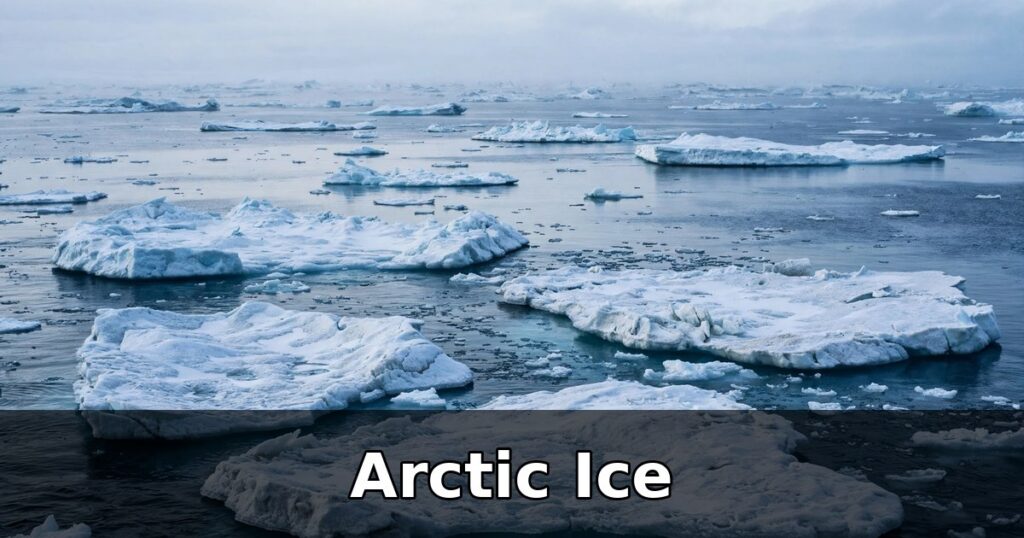
Arctic Sea Ice: Why Disappearing Ice Matters Far Beyond the Pole
Every September, Arctic sea ice reaches its annual minimum, after a summer of melting, before the long polar night allows ice to grow again through winter. That minimum is one of the most closely…
Key points
- On 10 September 2025, the Arctic sea ice annual minimum was 4.60 million square kilometres, tied for the tenth-lowest extent in the 47-year satellite record, according to NASA and the National Snow and Ice Data Center.
- A tenth-lowest ranking is not a recovery. In a record stretching back less than five decades, a year that still ranks among the ten lowest shows how much the baseline has shifted.
- The ice is not only smaller in summer, but thinner and younger: thick, old multiyear ice has declined, leaving a cover dominated by thinner first-year ice.
- Bright ice reflects sunlight; dark open water absorbs it. Losing ice therefore amplifies Arctic warming, a feedback known as Arctic amplification.
Every September, Arctic sea ice reaches its annual minimum, after a summer of melting, before the long polar night allows ice to grow again through winter. That minimum is one of the most closely watched indicators in climate science, not because a single year’s figure tells the whole story, but because, tracked over decades, it reveals a clear and consequential change.
On September 10, 2025, according to NASA and the National Snow and Ice Data Center, the Arctic sea ice annual minimum was 4.60 million square kilometres, tied for the tenth-lowest extent in the 47-year satellite record. A tenth-lowest ranking can sound reassuring, as if the ice had somehow recovered. It has not.
In a record that stretches back less than five decades, a year that still ranks among the ten lowest is a sign of how much the baseline has shifted. Earlier decades routinely produced larger summer minima. Today, even a year that is not record-breaking sits near the bottom of the record. That is the pattern to watch: not one dramatic year, but a long-term decline punctuated by ups and downs, in which low-ice years have become normal and high-ice years have become rare.
What Arctic sea ice actually is
Arctic sea ice is frozen seawater floating on the Arctic Ocean. It is not the same as the Greenland ice sheet, which sits on land, or as glaciers, which are formed from snow compacted over centuries. Sea ice forms when ocean water freezes, grows through winter, and partly melts in summer. Some ice survives from one year to the next, becoming thicker, older multiyear ice. Much of it is first-year ice, thinner and more vulnerable to melting the following summer.
That distinction between first-year and multiyear ice matters. As the Arctic has warmed, the proportion of thick, old ice has declined, leaving a cover dominated by thinner ice that melts more easily and grows back less robustly. A thinner ice pack is more mobile, more easily broken up by storms, and more sensitive to warm ocean water from below.
Sea ice also plays a role that goes beyond its own extent. Bright ice reflects sunlight back to space, a property known as albedo. Open, dark ocean water absorbs far more solar energy. When ice melts and exposes more open water, that water absorbs more heat, which can melt more ice, a feedback that amplifies warming in the Arctic. This is one reason the Arctic has warmed faster than the global average, a phenomenon often called Arctic amplification. It is not a separate, mysterious process, but a consequence of how ice, ocean, and atmosphere interact, along with changes in atmospheric circulation and heat transport from lower latitudes.
The September minimum in context
| Measure | What it shows |
|---|---|
| Minimum date, 2025 | 10 September 2025 |
| Minimum extent, 2025 | 4.60 million square kilometres |
| Ranking | Tied tenth-lowest in the 47-year satellite record |
| Source | NASA and the National Snow and Ice Data Center |
| Satellite record length | 47 years, beginning in the late 1970s |
The September 10, 2025 minimum should be read in that longer context. Satellite records began in the late 1970s, which means the record captures a period during which human-caused warming was already under way, but it does not capture a pristine, pre-industrial Arctic. Even so, the decline within that record is striking. Early years in the record show substantially larger summer minima, and the lowest years cluster in recent decades.
A tied tenth-lowest year in 2025 is not a recovery; it is a continuation of a pattern in which low-ice summers have become the norm. It is also important to distinguish a single year’s minimum from the long-term trend. Weather in a given summer — cloud cover, wind patterns, ocean temperatures, and the amount of ice that survived the previous winter — can push the minimum up or down.
It is also worth noting what the satellite record measures and what it does not. Satellites measure extent, the area with at least a certain concentration of ice, rather than the total volume of ice. Two years can have similar extents but very different thicknesses. A year with a relatively large extent but thin ice may actually contain less ice overall than a year with a slightly smaller extent but thicker ice.
Why ice loss affects weather far from the Arctic
It is tempting to treat the Arctic as remote, a place whose changes matter mainly to polar bears and research stations. That view misses how connected the climate system is. The temperature difference between the cold Arctic and the warm tropics helps drive atmospheric circulation, including the jet stream that steers weather across the mid-latitudes.
Ocean connections matter too. Meltwater from sea ice itself does not raise sea level significantly, because sea ice already floats, much like ice in a glass does not raise the water level when it melts. The concern is different: changes in Arctic ice and ocean temperatures can influence ocean circulation, freshwater input to the North Atlantic, and the conditions that affect weather and sea level elsewhere.
For communities in the Arctic itself, the consequences are immediate and practical. Sea ice has long served as a platform for hunting, travel, and cultural practices for Indigenous peoples, and as a buffer that protects coastal settlements from waves and storms. When ice forms later, melts earlier, or becomes thinner and less predictable, travel becomes more dangerous, hunting seasons shift, and coastal erosion can accelerate because open water allows larger waves to reach shorelines for longer periods.
Wildlife, ecosystems, and a changing ocean
The ecological consequences of sea ice loss are profound, and they ripple through food webs that depend on ice in different ways. Algae that grow on the underside of sea ice form the base of a food web that supports zooplankton, fish, seals, and the larger animals that depend on them. When ice melts earlier or forms later, the timing of algal blooms can shift, with knock-on effects for animals whose breeding or feeding cycles evolved around a particular seasonal rhythm.
Polar bears are often used as a symbol of Arctic change, and for good reason: they depend on sea ice as a platform from which to hunt seals. Less ice, and ice that breaks up earlier, means less hunting time and longer fasting periods, particularly for bears in the southern parts of their range. Seals, walruses, and seabirds face their own pressures, as ice habitat changes and as open-water species move northward, bringing new competition and new diseases.
None of these changes happens in isolation. As the Arctic Ocean warms and loses ice, sub-Arctic fish and other species expand their ranges, altering ecosystems that have existed in their current form for a long time. It is important to avoid a simple narrative in which every Arctic species is doomed, or in which ecosystems will simply adapt without loss. Some species may benefit from longer open-water seasons, at least temporarily. Others will decline.
What is still uncertain
A single year does not set the trend. Natural variability still plays a role, and researchers are careful to separate it from the long-term trend. A summer with persistent winds that push ice together, or with cloudy conditions that reduce melting, can produce a higher minimum than the previous year, even in a warming climate. Such a rebound does not signal a reversal of the trend, just as a particularly low year does not, on its own, prove that the trend is accelerating. The trend is established by looking across decades, by checking that multiple datasets agree, and by comparing observations with physical understanding of how warming affects ice.
The jet-stream link is still being tested. Some research suggests a weaker Arctic-to-tropics temperature difference can make the jet stream wavier or more persistent, helping weather patterns linger. That remains an active area of research, and no single heatwave, cold spell, or rainy period can be attributed to Arctic ice loss alone.
Extent is not volume. Satellites measure the area with at least a certain concentration of ice, not total volume. Thickness estimates from satellites, aircraft, and field work are needed to complete the picture, and they confirm the thinning that extent alone understates.
When the first largely ice-free summer arrives is not known. Scientists have long discussed a largely ice-free Arctic summer, meaning a September in which sea ice extent falls below a very low threshold, leaving only scattered ice along coastlines and in the Canadian Arctic Archipelago. Projections of when this might first occur vary, depending on emissions, natural variability, and how models represent ice processes. A projection is not an observed fact, and it should not be reported as a certainty for a particular year.
What a future with less summer ice could mean
What can be said is that, if warming continues, such summers are expected to become more frequent, and eventually routine, unless emissions are reduced enough to stabilise temperatures. A largely ice-free summer would not mean the Arctic Ocean becomes a warm sea. It would still be cold, dark in winter, and ice-covered for much of the year. But it would mark a profound transformation in the character of the Arctic, with implications for shipping, resource extraction, geopolitics, and ecosystems.
What this means
Rankings can mislead. Tenth-lowest in 47 years sounds moderate, but in a record where low-ice summers have become the norm, it is evidence of a shifted baseline, not of recovery.
Thin matters as much as small. The loss of thick multiyear ice leaves a thinner, more mobile pack that breaks up more easily and melts faster, even in years when winter extent looks large on a map.
The Arctic is not remote in effect. Through albedo, the jet stream, ocean circulation, Greenland ice, and permafrost, changes at the pole feed back into weather, sea level, and greenhouse gases worldwide — and into the daily safety and food security of Arctic communities first.
A measure in millions of square kilometres
The September 2025 minimum is a reminder, measured in millions of square kilometres, that the Arctic is not a static backdrop. It is a dynamic, sensitive part of the Earth system, and its changes are already reshaping weather, ecosystems, and human life, far beyond the pole.
Watching the minimum each year matters, but understanding the decades-long story behind it matters more. That story is one of loss, but also of connection: what happens in the Arctic does not stay in the Arctic.
Raina





댓글 0
첫 댓글을 남겨보세요.