
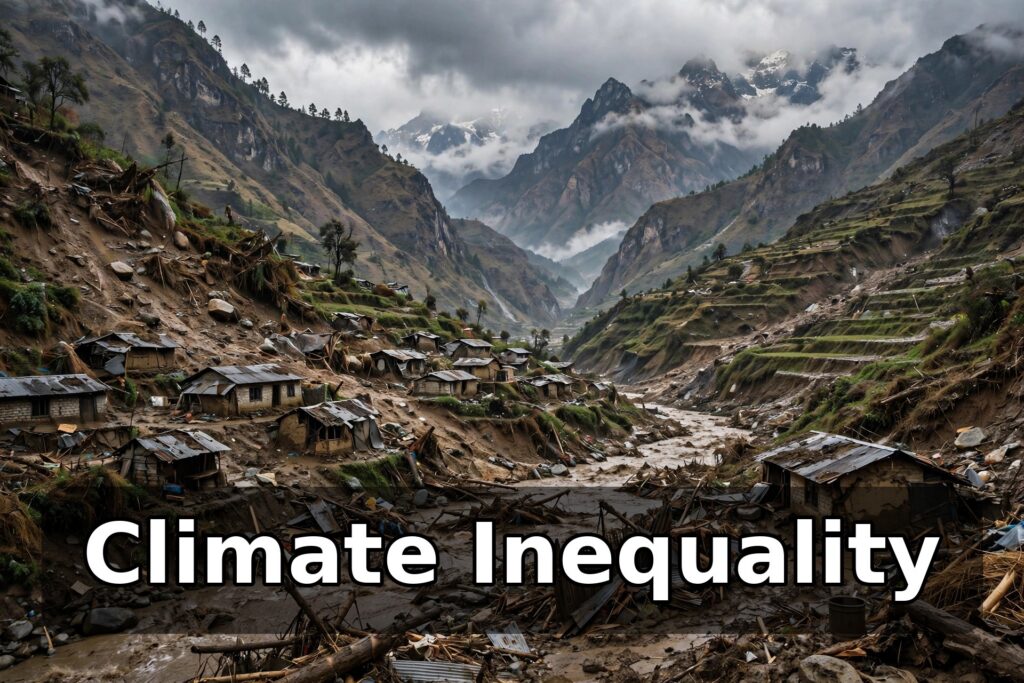
Who Bears the Cost of Climate-Linked Disasters in Regions That Contributed Least to Warming?
The Guardian examines Nepal-Tibet flood damage through a climate-inequality lens: communities that contributed least to warming face glacier disasters, and early warning, recovery funding, and loss-and-damage support are how the costs could be shared more fairly.
Key points
- The Himalayan region is warming faster than the global average, its glaciers are retreating, and the lakes left behind can fail catastrophically as glacial lake outburst floods.
- The communities in the path — in Nepal, Tibet and neighbouring regions — have carbon footprints that are a tiny fraction of those in wealthy industrialised countries, and a negligible historical contribution to warming.
- Early warning can turn a mass-casualty event into a property disaster — but systems are often absent or inadequate in remote mountain regions.
- The international loss-and-damage framework exists to fund unavoidable impacts, yet implementation has been slow, funding inadequate, and procedures complex.
When a flood tears through a mountain valley, the immediate questions are about rescue, shelter and survival. But behind those urgent questions lies a deeper one about fairness: who bears the cost of climate-linked disasters, and is it just that the people who suffer most are often those who contributed least to the warming that made the disaster more likely?
This question has been examined through the lens of flood damage in the Nepal-Tibet border region, where glacial disasters have devastated communities that have almost no share in the emissions driving global warming. The story is at once a scientific one, about glaciers and floods, and a moral one, about who pays for a crisis they did not create.
The Himalayan region is warming faster than the global average, and its glaciers are retreating. As glaciers shrink, they leave behind lakes dammed by unstable walls of rock and ice debris. When those natural dams fail — whether through a landslide, an earthquake, an ice avalanche, or simply the pressure of accumulated water — the result is a glacial lake outburst flood: a sudden, violent release of water, mud and debris that races downstream, destroying bridges, homes, hydropower plants and farmland in its path.
These floods are among the most destructive events in mountain regions, because they arrive with little warning and with enormous force.
The science of a glacier disaster
Understanding why these floods happen requires understanding what warming does to a glacier. A glacier is a river of ice, flowing slowly downhill under its own weight. In a stable climate, the ice gained from snowfall at high altitude roughly balances the ice lost to melting at lower altitude, and the glacier’s position is roughly steady.
As temperatures rise, melting increases, the glacier thins and retreats, and meltwater accumulates in depressions left behind by the retreating ice. These new lakes grow larger as the glacier retreats further, and the moraine dams that hold them back — piles of loose rock and debris deposited by the glacier — were never engineered to hold back water. They are accidents of geology, and they can fail catastrophically.
Warming also destabilises the slopes above and around glaciers. Permafrost — permanently frozen ground that binds mountain slopes together — thaws as temperatures rise, loosening rock that can then slide into a glacial lake, generating a wave that overtops or breaches the dam. A single landslide into a lake can therefore trigger a flood that devastates a valley far below, even if the dam itself was not obviously weak.
| Link in the chain | What happens |
|---|---|
| 1. Warming | The Himalayan region warms faster than the global average |
| 2. Glacier retreat | Melting increases, glaciers thin and retreat |
| 3. Lake formation | Meltwater accumulates in depressions left by retreating ice; lakes grow larger |
| 4. Unstable dams | Moraine walls of loose rock and debris were never engineered to hold back water |
| 5. Slope instability | Thawing permafrost loosens rock that can slide into a lake |
| 6. Outburst flood | A landslide, earthquake, ice avalanche or water pressure breaches the dam; water, mud and debris race downstream |
The chain of causation runs from global warming to glacier retreat to lake formation to slope instability to a flood, and each link makes the next more likely. The communities in the path of these floods are often remote, poor and dependent on the very rivers that threaten them.
They farm terraced fields in valley bottoms, live in villages strung along roads that follow the river, and increasingly rely on hydropower projects built on the same rivers. When a flood arrives, it does not only destroy homes; it destroys the infrastructure on which livelihoods depend — irrigation channels, bridges that connect villages to markets, and power plants that supply electricity and income.
An inequality written into the atmosphere
The injustice at the heart of this story is stark. The communities of the Himalayas — in Nepal, Tibet and neighbouring regions — have carbon footprints that are a tiny fraction of those in wealthy industrialised countries. Their energy use is minimal, their consumption is modest, and their historical contribution to the greenhouse gases warming the planet is negligible. Yet they face some of the most dramatic and immediate consequences of that warming, as their glaciers retreat and their valleys flood.
This pattern repeats around the world. The regions most exposed to climate disasters — low-lying island nations facing sea-level rise, arid regions facing drought, mountain communities facing glacial floods — are disproportionately those that emitted least. The wealthy countries whose industrialisation filled the atmosphere with carbon dioxide are, on average, better protected by geography, wealth and infrastructure, and better able to recover when disasters do strike.
Climate change thus acts as a multiplier of existing inequality, transferring risk from those who created it to those who did not. The moral argument follows directly: if those who benefited from emissions bear responsibility for the consequences, then they owe support to those who suffer them.
That argument has a formal expression in international climate negotiations, in the principle of common but differentiated responsibilities, and in the more recent framework of loss and damage — the recognition that some climate impacts are now unavoidable and that the countries suffering them deserve compensation and support for recovery.
Early warning: a life-saving gap
One of the most concrete ways to reduce the human cost of glacial floods is early warning. A glacial lake that is monitored — with sensors measuring water levels, satellite imagery tracking its growth, and communication systems to alert downstream communities — can give people time to evacuate before a flood arrives. Minutes or hours of warning can be the difference between a disaster that destroys property and one that takes lives.
Yet early warning systems in remote mountain regions are often absent or inadequate. Installing and maintaining sensors in harsh, high-altitude environments is expensive and technically difficult. Communicating warnings to scattered villages with limited mobile coverage requires investment in infrastructure that poor regions cannot afford alone. And even where warnings exist, communities need evacuation plans, safe routes and drills to act on them effectively.
The gap between what is technically possible and what is actually in place is a direct measure of the inequality at issue: the technology to save lives exists, but it has not been deployed where it is most needed. International support for early warning is therefore one of the most cost-effective and morally urgent forms of climate assistance.
It does not prevent the flood, but it prevents the flood from becoming a mass-casualty event, and it does so at a fraction of the cost of post-disaster reconstruction. The case for funding early warning systems in glacier regions is not only humanitarian; it is also practical, because every life saved and every bridge preserved reduces the eventual bill for recovery.
Recovery funding and loss and damage
When a flood has struck, the question turns to recovery: who pays to rebuild homes, restore farmland, repair bridges and reconstruct power plants? For a poor mountain community, the cost of a single major flood can exceed years of local income, and without external support, recovery may be partial or impossible. Families may be permanently displaced, farmland may be abandoned, and villages may shrink or disappear.
The international loss-and-damage framework was created to address exactly this situation: to provide funding for the unavoidable impacts of climate change, distinct from funding for adaptation (which aims to prevent harm) and mitigation (which aims to reduce emissions). But the framework’s implementation has been slow, its funding inadequate, and its procedures complex.
Communities that need help quickly often face bureaucratic delays, and the amounts available fall far short of the losses incurred. The gap between the principle of loss and damage and its practice is itself a source of frustration and injustice.
Beyond formal funding, there are questions of responsibility that loss and damage raises but does not fully resolve. Should the companies whose products generated the emissions contribute? Should wealthy countries’ contributions reflect their historical emissions? Should support take the form of grants, which do not add to debt, or loans, which burden already struggling communities? These questions are politically contentious, but they are unavoidable if the costs of climate disasters are to be shared fairly rather than left with those least able to bear them.
What is still uncertain
Loss-and-damage funding is unresolved in practice. The framework exists, but how much will be paid, by whom, how quickly, and as grants or loans are all contested — and the amounts available fall far short of the losses incurred.
Early warning is not only technology. Sensors and satellite imagery can track a lake, but warnings only save lives if villages have evacuation plans, safe routes, drills and mobile coverage to receive them.
Any single flood has many triggers. A dam can fail through landslide, earthquake, ice avalanche or water pressure, and a landslide into a lake can trigger a flood even where the dam itself was not obviously weak — so the next trigger cannot be predicted from the last one.
What this means
The costs of warming are not distributed according to responsibility for it. They fall on the poor, the remote and the vulnerable, while the benefits of the emissions that caused them accrued to the wealthy and the powerful. The Nepal-Tibet floods are a single case, but they illuminate a pattern that runs through the whole climate crisis.
Adaptation and assistance can reduce the suffering, but only mitigation addresses the cause. Early warning, recovery funding and loss-and-damage support matter enormously, and they do not slow the retreat of the glaciers. Reducing emissions is what makes the floods less frequent over time.
The gap between principle and practice is itself the injustice. Common but differentiated responsibilities and loss and damage are agreed in principle; the test is whether funding arrives quickly, adequately and without adding debt to communities that have already lost years of income to a single flood.
What should change
Deploy early warning where the risk is greatest. Sensors, satellite monitoring, communication systems, evacuation plans, safe routes and drills in remote glacier regions — funded internationally, because poor regions cannot afford them alone.
Make loss-and-damage funding match the scale of losses. Funding that arrives quickly, in adequate amounts, and as grants rather than loans that burden already struggling communities.
Settle the responsibility questions. Contributions that reflect historical emissions, and a clear answer on whether the companies whose products generated the emissions contribute, so the costs are shared fairly rather than left with those least able to bear them.
Cut emissions so the glaciers retreat more slowly. Adaptation and assistance reduce suffering; only mitigation reduces how often these floods happen.
The distribution of costs is a choice
The communities of the Himalayas did not choose to live beneath retreating glaciers, and they did not choose the warming that is melting them. They are living with the consequences of choices made elsewhere, by people who will never see their valleys flood.
Whether the world responds to that injustice with the urgency and generosity it demands will be one of the defining moral tests of the climate era. The floods themselves are a product of physics. The distribution of their costs is a product of politics — and politics can change.
Raina





댓글 0
첫 댓글을 남겨보세요.