
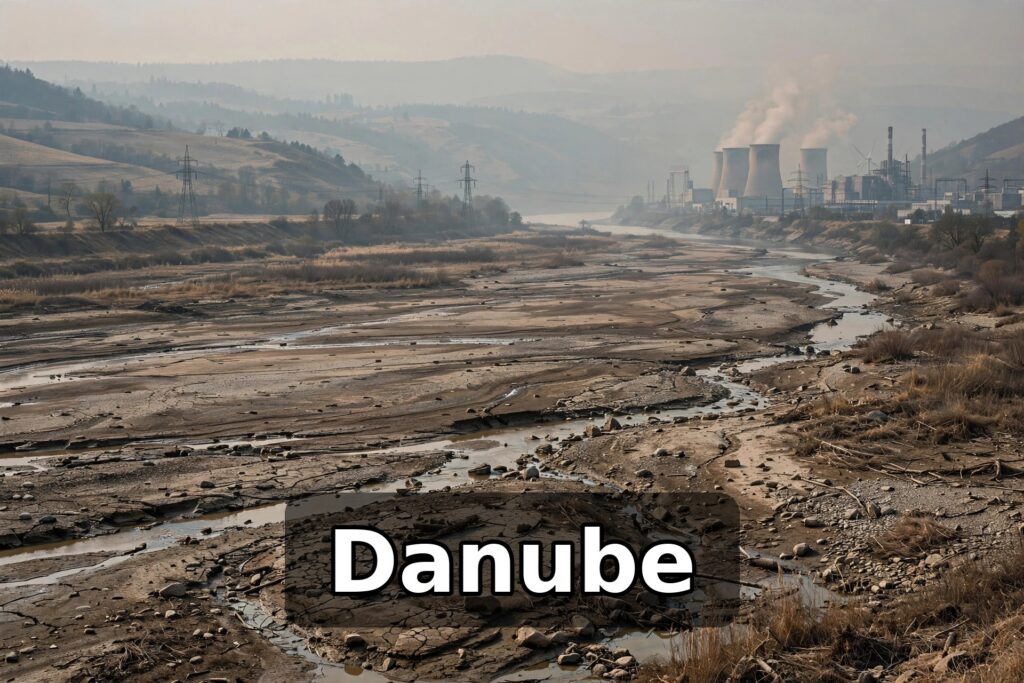
When the Danube Runs Low, Why Can Drought Threaten Electricity Production?
The Guardian reports that a low Danube threatens more than farms and drinking water: when rivers fall, power plants lose the cooling water they need, turning drought into an electricity problem as well.
Key points
- The Danube flows for nearly 3,000 kilometres through or past ten countries before emptying into the Black Sea, past Vienna, Bratislava, Budapest, and Belgrade.
- A large share of Europe’s power generation depends on water twice over: as energy in hydroelectric dams and as coolant for thermal power plants, including gas, coal, and nuclear facilities.
- When river levels fall and river temperatures rise, plants may have to reduce output at exactly the moment hot weather pushes electricity demand upward.
- Drought squeezes the grid on two fronts at once: less water turning turbines and less water cooling thermal plants.
- Wind and solar need almost no cooling water — a genuine advantage in a dry summer, when sunshine is abundant even as rivers fall.
When a great river runs low, the first images that come to mind are usually cracked riverbeds, stranded boats, and thirsty fields. The Danube, which winds through Central and Southeastern Europe past capitals, farms, and industrial towns, carries all of those associations. But as the Guardian has reported, a low Danube threatens something less visible and arguably more far-reaching: the electricity supply itself. When water levels fall, the river cannot do one of its quietest jobs — cooling the power plants that keep the lights on.
That connection surprises many people, because electricity is usually imagined as something that comes from a switch, a grid, or a fuel. In practice, a large share of Europe’s power generation still depends on water in two ways: as a source of energy in hydroelectric dams, and as a coolant for thermal power plants, including gas, coal, and nuclear facilities. When a drought lowers a river, both functions are strained at once, and the strain arrives in the same season when demand for electricity is often rising, as people run fans, air conditioning, and irrigation pumps.
A river that feeds, waters, and cools
The Danube is one of the world’s great working rivers. It rises in Germany’s Black Forest region and flows eastward for nearly three thousand kilometres through or past ten countries before emptying into the Black Sea. Along the way it passes Vienna, Bratislava, Budapest, and Belgrade, waters some of Europe’s most productive farmland, and supports industries, fisheries, and cities that together are home to tens of millions of people. It is also a transport artery, carrying barges loaded with grain, coal, and manufactured goods. When such a river runs low, the effects are never confined to one sector.
The Danube’s role in agriculture is the most familiar. Its basin covers vast stretches of cropland, and its water feeds irrigation systems, livestock, and the soil moisture that crops depend on. When rainfall is scarce and the river drops, farmers face a double squeeze: less water available for irrigation, and drier soils that demand more water than usual. Harvests suffer, and with them the incomes of farming communities and the price and availability of food further down the chain. A drought year in the Danube basin is therefore felt at the dinner table far beyond the farms themselves, as reduced yields feed into regional food markets.
The third pressure point is the one most easily overlooked: cooling water for power generation. Thermal power plants produce electricity by generating heat and converting it, and they need a steady supply of cool water to carry waste heat away. Much of that water comes from rivers. When river levels are low, there is simply less water to draw. When river temperatures are also high — as they often are during the same heat waves that cause drought — the water that is available is less effective at cooling, and regulations may limit how much warm water a plant can discharge back into the river, to protect aquatic life. The result is that plants may have to reduce output at exactly the moment when hot weather is pushing electricity demand upward.
How power plant cooling actually works
To understand why a river matters to a power station, it helps to picture what a thermal plant does. Whether it burns gas or coal or splits uranium atoms, the core process is the same: heat is used to make steam, the steam drives a turbine, and the turbine generates electricity. After passing through the turbine, the steam must be condensed back into water so the cycle can repeat, and that condensation requires cooling. In most large plants, river water does that job.
There are two main cooling designs, and drought affects them differently. Once-through systems draw large volumes of river water, pass it through the plant’s condensers, and return it to the river slightly warmer. They are efficient and simple, but they are also the most exposed to low water: if the river is too low to supply the intake, or too warm to absorb the discharge without harming aquatic life, the plant must cut back. Recirculating systems, which use cooling towers, withdraw far less water but still depend on a reliable supply to replace what evaporates from the towers. In a severe drought, even tower-cooled plants can face constraints, because the make-up water they need may be restricted.
| Cooling design | How it works | How drought hits it |
|---|---|---|
| Once-through | Draws large volumes of river water, passes it through condensers, returns it slightly warmer. | Most exposed: too little water for the intake, or river too warm to absorb discharge safely, forces output cuts. |
| Recirculating (cooling towers) | Withdraws far less water; towers cool it, with make-up water replacing what evaporates. | Less exposed, but still constrained when make-up water is restricted in a severe drought. |
Nuclear plants illustrate the stakes most sharply. A nuclear reactor cannot simply be switched off and on like a light; its output is most valuable when it runs steadily, and unplanned reductions ripple through the grid. Yet nuclear plants are among the largest users of cooling water, and several European reactors have had to reduce output during hot, dry summers because the rivers beside them were too low or too warm. The image of a nuclear plant throttled by a river surprises people who think of nuclear power as independent of weather. In reality, it is one of the most water-dependent energy sources in existence.
Why low water and high demand arrive together
The cruel timing of river droughts is part of the problem. The same weather pattern that dries out a river basin — persistent high pressure, clear skies, and heat — also drives people indoors to air conditioning and drives farmers to irrigate. Electricity systems that were designed around the assumption that rivers would deliver steady cooling water find themselves squeezed from both sides: less cooling capacity and more demand.
This is not a hypothetical chain of events. Across Europe in recent dry summers, low river levels have forced energy operators to watch water levels and temperatures day by day, adjusting output and planning around constraints that have nothing to do with fuel supply. A power station can have all the gas or uranium it needs and still be unable to run at full capacity if the river beside it cannot cool it. In that sense, drought acts on the electricity system the way a blocked air vent acts on an engine: the machine is fine, but it cannot shed heat, so it must slow down.
Hydroelectric generation faces its own version of the same problem. Dams depend on water flowing through turbines, and when inflows fall, reservoirs shrink and output drops. A river system in drought therefore loses generating capacity on two fronts at once: less water turning turbines, and less water cooling thermal plants. The grid must then make up the difference from elsewhere — from other regions, other fuels, or stored energy — often at higher cost and sometimes with higher emissions. When the replacement power comes from fossil fuels, a drought can perversely increase emissions at the very moment when climate stress is highest.
The Danube basin’s geography amplifies the effect. Because the river crosses so many borders, a drought in one part of the basin can constrain power plants in several countries simultaneously, while the electricity grids of those countries are interconnected and share the shortfall. A low Danube is therefore not a local inconvenience; it is a regional energy event, and its effects can travel along transmission lines far from the riverbank.
What resilience looks like
The Danube’s story is a reminder that modern infrastructure is more interdependent than it appears. Water, food, and energy are often managed by separate agencies, separate ministries, and separate markets, but a drought collapses those distinctions. A farmer’s irrigation pump, a city’s drinking water, and a power plant’s cooling intake all draw on the same river, and when the river shrinks, they compete for the same shrinking resource.
That interdependence points to the kind of planning that drought-prone regions increasingly need. Power systems can reduce their dependence on river cooling by investing in alternative cooling technologies, such as dry cooling or hybrid systems that use air when water is scarce. They can diversify generation toward wind and solar, which need almost no cooling water at all — a genuine advantage in a dry summer, when sunshine is abundant even as rivers fall. And they can build storage, from batteries to pumped hydro, that can cover shortfalls during hot, dry spells without calling on a thirsty river.
Water managers can coordinate releases and withdrawals across agriculture, drinking water, and energy rather than treating each demand in isolation. A reservoir operated with all three needs in mind can be more valuable than one operated for a single purpose, and cross-border cooperation along a river like the Danube is essential, since water withdrawn upstream is water denied downstream. International river commissions exist for exactly this reason, but droughts test whether their agreements hold when every country is under stress.
The question behind the question
The deeper question raised by a low Danube is about the assumptions built into energy planning. For decades, power systems were designed around the idea that water would be available where and when it was needed. Rivers were treated as a free and reliable input, and the possibility that a river might fail to deliver was priced as a rare inconvenience rather than a recurring risk. Recent dry summers have challenged that assumption, and planners are beginning to treat water availability as a variable to be managed rather than a constant to be assumed.
That shift has implications far beyond the Danube. Rivers around the world cool power plants, irrigate farms, supply cities, and carry trade, and many of them are under growing pressure from rising temperatures, changing rainfall patterns, and increasing demand. The Danube is a visible case because it is so large and so shared, but the same logic applies to rivers everywhere. A power system that depends on a river is only as resilient as that river.
As long as electricity generation leans on rivers for cooling, a drought will remain an energy event as well as a water event. The Danube running low is not only a warning about farms and taps. It is a warning about the hidden plumbing of the power system — and about how much of modern life depends on rivers staying full enough, and cool enough, to keep the current flowing. The next time a heat wave settles over Europe and the Danube begins to fall, the question will not only be whether there is enough water to drink or to grow food. It will also be whether there is enough water to keep the lights on.
Raina





댓글 0
첫 댓글을 남겨보세요.