
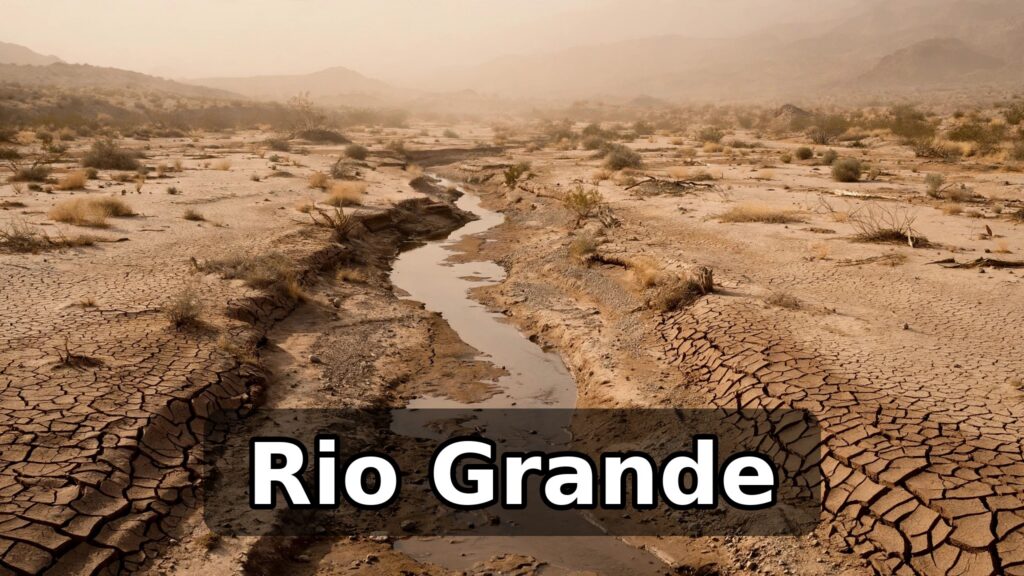
The Rio Grande Is Shrinking: Is Drought Only Part of the Water Crisis?
Wall Street Journal reporting presents the Rio Grande crisis as long-term drought combined with unsustainable water use, affecting the river, reservoirs, agriculture, and local economies, so drought alone does not explain the shrinking river.
Key points
- The Rio Grande crisis is shaped by long-term drought and unsustainable water use together — drought alone does not explain its full scale.
- When dry conditions persist for years, reservoirs are drawn down again and again without a chance to recover.
- Demand has grown beyond what the river can sustain even in normal years, so a wet period brings only temporary relief.
- Agriculture, cities, ecosystems, and local economies all compete for the same shrinking supply, under legal rights agreed when water seemed more abundant.
- A durable response must manage demand — efficiency, planning, and ecosystem flows — not simply wait for rain.
A river that is shrinking tells more than one story at a time. The Rio Grande, long a source of water for farms, cities, and ecosystems along its course, is under sustained pressure. The Wall Street Journal has examined a crisis shaped by long-term drought and by unsustainable water use, affecting the river itself, the reservoirs that store its water, the agriculture that depends on it, and the local economies built around it.
The central question is deceptively simple: is drought only part of the story? The short answer, in the reporting, is yes. Drought matters enormously. But drought alone does not explain the full scale of the problem. How water is taken, shared, stored, and used matters just as much. A river can survive a dry period if demand is managed carefully. It struggles far more when a dry period arrives in a system that was already using water faster than the river could reliably supply.
A river under long-term pressure
Drought is often imagined as a single dry season, or a year without enough rain. The pressure on the Rio Grande is better understood as long-term. When dry conditions persist over many years, the effects accumulate. Soils dry out, tributaries contribute less water, and reservoirs that were meant to buffer against a bad year are drawn down again and again without a chance to recover.
In a river system, that accumulation matters. A reservoir is not an endless reserve. It is a store that must be refilled. If inflows remain low while outflows continue, the store shrinks. If that pattern repeats, the river downstream receives less water, and the margin for coping with the next dry period becomes thinner. What begins as a weather problem gradually becomes a structural problem, embedded in how the whole system operates.
Drought is real, but it is not the whole explanation
It would be wrong to minimise drought. Without sufficient rain and snow, a river cannot maintain its flow, no matter how well it is managed. Drought reduces the water available to everyone, and it sharpens every disagreement about who should receive what remains. In that sense, drought is the background condition that makes all other pressures harder to bear.
Yet focusing only on drought can be misleading, because it suggests that the crisis will end when the rain returns. If water use has grown beyond what the river can sustain even in normal years, then a wet period may bring temporary relief without solving the underlying imbalance. The river may rise, reservoirs may recover somewhat, and the sense of urgency may fade, only for the same pressures to return with the next dry period.
Unsustainable water use, as described in the reporting, means that demand has, over time, outpaced reliable supply. That can happen gradually, through decisions that each seem reasonable on their own: expanding irrigated farming, supplying growing cities, supporting industry, and maintaining established water rights. Together, however, those decisions can create a system that depends on more water than the river can provide in the long run. Drought then exposes a problem that was already developing, rather than creating it from nothing.
| Driver | How it shrinks the river |
|---|---|
| Long-term drought | Less rain and snow, drier soils, smaller tributary flows, reservoirs that cannot refill. |
| Unsustainable use | Demand outpaces reliable supply even in normal years, so the system has no margin. |
| Reservoir drawdown | Stored water lets high use continue while the downstream river already suffers. |
| Competing demands | Farms, cities, industry, and ecosystems each claim water the river cannot supply at once. |
Reservoirs: buffers that can also hide the problem
Reservoirs play a central role in this story, and a complicated one. On one hand, they are essential tools. They store water in wet periods for use in dry ones, they help manage floods, and they provide a degree of stability that a free-flowing river alone cannot offer. Without reservoirs, agriculture and cities along the Rio Grande would be far more exposed to every swing in weather.
On the other hand, reservoirs can hide the severity of a water imbalance. As long as stored water remains, it is possible to continue using water at an unsustainable rate without immediately feeling the consequences. The river downstream may already be suffering, ecosystems may already be stressed, and future supplies may already be shrinking, even while taps still run and fields are still watered. By the time a reservoir visibly falls to a concerning level, the system may already be in a difficult position.
Agriculture at the front line
Agriculture is both deeply dependent on the Rio Grande and deeply affected by its decline. Farming along the river has historically relied on irrigation, turning dry land into productive fields. When river flows fall and reservoir levels drop, farmers may receive less water, receive it later, or face greater uncertainty about how much will be available in a given season.
That uncertainty affects decisions that must be made months in advance. A farmer must decide what to plant, how much land to cultivate, and whether to invest in a crop that will need water throughout the season. If water supplies are unreliable, those decisions become riskier. Some farmers may plant less, switch to crops that need less water, leave fields fallow, or invest in more efficient irrigation. Each of those choices has costs, and none of them is a simple solution.
More efficient irrigation can help, but it is not a complete answer on its own. Efficiency can reduce the amount of water needed to grow a given crop, but it can also change how much water returns to the river or to groundwater. If efficiency gains are used to expand farming rather than to reduce total water use, the overall pressure on the river may remain. Technology matters, but it works within a larger system of incentives, rights, and demand.
Cities, growth, and competing demands
Cities along and near the Rio Grande face their own version of the same pressure. Urban populations need reliable drinking water, and growing cities need to plan for future demand. When river supplies shrink, cities must look for alternatives, improve efficiency, reuse water where possible, or compete more intensely for a shrinking resource.
That competition is not abstract. Water allocated to one use is water not available to another, at least in the short term. A city that secures more water may leave less for farming or for the river ecosystem. A farming region that retains its historical water rights may limit what a growing city can obtain. These tensions are sharpened by drought, but they exist because demand from multiple sectors has grown around a river whose long-term supply is limited.
Ecosystems and the river itself
A river is not only a pipeline for human use. It is also a living system. The Rio Grande supports habitats, wildlife, and plant communities that depend on flowing water, seasonal variation, and connected river channels. When flows fall dramatically, or when sections of river dry up, those ecosystems suffer. Fish, birds, and other wildlife may lose habitat. Wetlands may shrink. The river’s ability to support life, and to provide services such as natural filtration and flood moderation, can decline.
This ecological dimension is sometimes treated as secondary to human needs, especially during a crisis. But it is connected to human wellbeing in practical ways. A degraded river is less able to recover when water returns. It may be more vulnerable to pollution, erosion, and invasive species. It may also lose the cultural and recreational value that communities attach to a living river. People do not only use a river for irrigation and drinking water. They fish, walk beside it, and regard it as part of their landscape and identity.
Protecting some flow for the river itself is therefore not only an environmental preference. It is part of maintaining a river system that can continue to serve human needs over time. A river that is drained to the point of ecological collapse may be much harder, and much more expensive, to restore than a river that is managed to retain a basic level of health even during dry periods.
Why legal rights and history matter
Water along the Rio Grande is not distributed by need alone. It is shaped by legal rights, historical agreements, and institutions that developed over many years. Some users hold older rights, others newer ones. Some agreements were made when water seemed more abundant, or when populations and farming were smaller. Changing those arrangements is legally and politically difficult, even when the river itself has changed.
This history helps explain why the crisis is so hard to resolve. A solution that seems fair from a purely hydrological perspective, such as reducing total use to match long-term supply, may conflict with established rights and expectations. A solution that protects existing rights may leave the river itself without enough water. Negotiating between those positions requires more than technical knowledge. It requires trust, compromise, and a willingness to accept that the future may look different from the past.
Is drought only part of the story? What a fuller answer requires
Returning to the central question, the reporting suggests a fuller answer: drought is a major driver, but unsustainable water use is a second, equally important driver. The crisis is the product of their interaction. Drought reduces supply. Unsustainable use keeps demand high. Together, they shrink the river, lower reservoirs, strain agriculture, and stress local economies.
That framing matters for solutions. If drought were the only cause, the main response would be to wait for wetter weather, or to hope that climate conditions improve. If unsustainable use is also a cause, then solutions must include managing demand: using water more efficiently, aligning farming and urban growth with reliable supply, protecting flows for ecosystems, and revisiting arrangements that no longer match the river’s reality.
None of those solutions is easy, and none will work in isolation. Efficiency without demand limits may not reduce total use. Demand limits without support for affected farmers and communities may create hardship and resistance. Ecosystem protection without attention to human needs may be politically unsustainable. A durable response will likely combine several approaches, phased over time, with support for the people and communities most affected by change.
A river that forces a choice
The shrinking Rio Grande forces a choice that many river systems will face in a changing climate: continue using water as if supply were unlimited, or adapt use to the river that actually exists. The first option may preserve familiar patterns in the short term, but it risks a sharper crisis later, when reservoirs fall further and the river can no longer support competing demands. The second option involves difficult change, but it offers a chance to build a water system that can endure dry periods without collapsing.
Drought, then, is not only part of the water crisis. It is the condition that reveals it. It shows, with uncomfortable clarity, that a river cannot sustain every historical demand at once when its long-term supply is smaller than assumed. Recognising that reality, and acting on it fairly, is the central challenge for everyone who depends on the Rio Grande, from farmers and cities to ecosystems and the communities that call the river home.
Raina





댓글 0
첫 댓글을 남겨보세요.