
When Canadian Wildfire Smoke Reaches U.S. Cities, Who Is Breathing the Pollution?
Canadian wildfire smoke can travel through Toronto into northeastern U.S. cities, turning a distant fire into a local air-quality problem that falls hardest on outdoor workers, children, older adults, people with existing health conditions, and residents with limited access to filtered indoor air, making fair preparation a public-health responsibility.
Key points
- Wildfire smoke can travel from Canada through Toronto into cities in the northeastern United States, turning a distant fire into a local air-quality problem.
- Fine particles in smoke can reach deep into the lungs, aggravating asthma, chronic lung disease, and heart conditions.
- Exposure is uneven: outdoor workers, children, older adults, and people with existing health conditions face the greatest risk.
- Housing and income decide how much protection a household has — a sealed, filtered home versus a leaky home with no air filtration.
- No single city can control smoke arriving on the wind; preparation, warning systems, and cleaner-air refuges are what a city can control.
Wildfire smoke does not stop at a border. When large fires burn in Canada, the smoke they produce can rise into the atmosphere and travel for a very long distance, carried by winds that pay no attention to maps. Reuters has reported on smoke moving from Canada, through Toronto, and into cities in the northeastern United States.
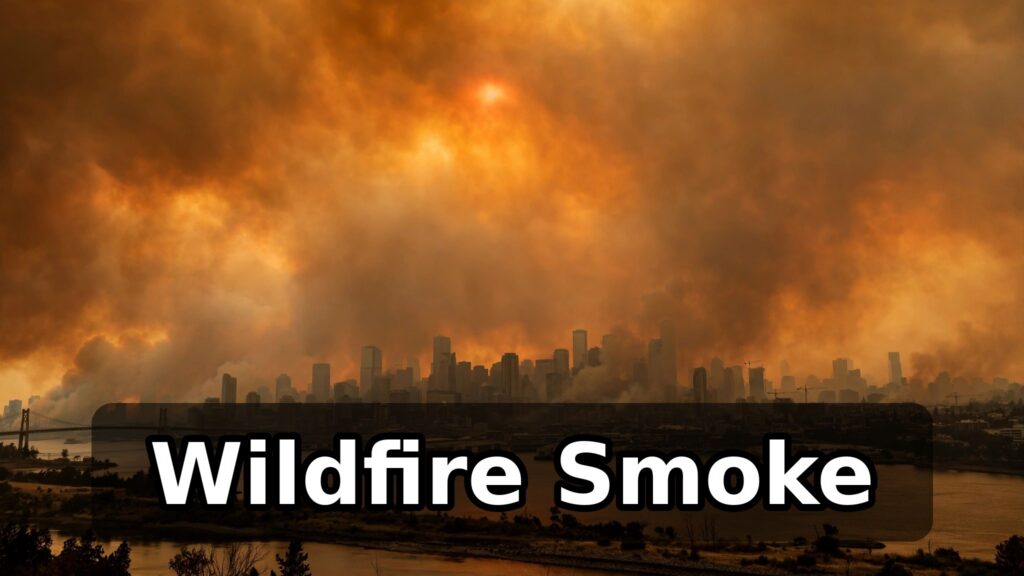
For people living far from the flames, the result can feel strange and unsettling. The sky turns hazy, the sun looks dim and orange, and the air smells faintly of burning wood, even though no fire is burning nearby. That distance can create a false sense of safety. A fire that is far away is easy to treat as someone else’s emergency. Smoke, however, turns a distant fire into a local air-quality problem.
The question is not only where the smoke goes, but who is breathing it once it arrives, why some people face a much greater risk than others, and what cities can fairly do about a form of pollution that arrives from somewhere else.
Why smoke travels so far
Wildfire smoke is made up of tiny particles and gases released when vegetation burns. Some of those particles are small enough to remain suspended in the air for a long time. Once they are lifted high into the atmosphere, winds can carry them across regions and even across countries before they settle or disperse. A plume that begins over a remote forest can therefore become, days later, the haze over a busy city street.
The path smoke takes depends on weather patterns. A steady flow of air can act like a conveyor belt, moving smoke from forested areas in Canada toward populated areas to the south and east. Along the way, the smoke may thin out, but it does not necessarily become harmless. Even diluted smoke can reduce visibility, irritate the lungs, and worsen air quality in cities that are already dealing with traffic exhaust, industrial emissions, and summer heat.
When smoke combines with existing urban pollution, the result can be worse than either source alone, especially on hot, still days when air does not clear easily. This is why a fire in one country can become a public-health conversation in another. The flames may be remote, but the air is shared. Smoke reminds us that the atmosphere is a single, moving system, and that the consequences of fire are not confined to the area that burns.
What is actually in wildfire smoke
Burning vegetation releases a mixture of gases and particles, including very fine particles that can be inhaled deeply into the lungs. Unlike larger dust, these fine particles do not simply settle in the nose or throat. They can reach deeper parts of the respiratory system, where they can cause irritation and inflammation.
For most healthy adults, a short period of smoky air may cause only temporary discomfort: a scratchy throat, watery eyes, a cough, or a headache. For people with existing conditions, the effects can be more serious. Smoke can aggravate asthma, worsen chronic lung disease, and strain the heart. It can make breathing harder during ordinary activity, increase the need for medication, and, in some cases, lead to medical care that might not otherwise have been needed.
Who is most exposed
| Group | Why the risk is higher |
|---|---|
| Outdoor workers | Construction, delivery, farm, and landscaping workers breathe smoky air for a full working day, often while doing physical labour that increases how deeply and rapidly they breathe. |
| Children | Lungs are still developing, they breathe more rapidly relative to body size, and they spend more time playing outdoors. |
| Older adults | More likely to have existing heart or lung conditions that smoke can aggravate. |
| People with asthma or heart disease | Even a moderate decline in air quality can make ordinary activities feel harder. |
| Pregnant people and people recovering from illness | May need extra care, although individual risk varies. |
When smoke reaches a city, exposure is not evenly distributed. People who spend much of their day outdoors are often among the first to feel it. Construction workers, delivery workers, farmworkers, landscapers, and people who exercise or commute on foot or by bicycle cannot simply close a door and wait for the air to clear. For them, a smoky day is not an inconvenience. It is a full working day spent breathing polluted air.
Children are another group of concern. Their lungs are still developing, and they tend to breathe more rapidly than adults relative to their body size. They also spend more time playing outdoors, sometimes without recognising that the air is unhealthy. Older adults, and people living with asthma, chronic lung disease, or heart conditions, may also be more sensitive to smoke.
Housing, income, and the right to clean indoor air
Income and housing matter enormously when smoke arrives. A well-sealed home with filtered air can reduce exposure considerably. A home with leaky windows, no air filtration, and no air conditioning offers far less protection. People who cannot afford air purifiers, replacement filters, or the electricity to run them may breathe more smoke indoors as well as outdoors.
This creates a quiet divide during smoke events. One household can create a relatively clean indoor refuge, work from home, order groceries for delivery, and wait out the haze. Another household may have no choice but to go out to work, to use public transport, or to live in a building where smoke seeps in through gaps and shared ventilation. People without stable housing have even fewer options. For them, advice to stay indoors may be meaningless without a safe indoor place to go.
Neighbourhood geography adds another layer. Areas near busy roads, industrial sites, or other sources of pollution may already have poorer air quality before smoke arrives. Adding wildfire smoke on top of that baseline can push the total burden higher than in cleaner neighbourhoods. In that sense, wildfire smoke does not create inequality from nothing. It exposes and deepens inequalities that are already present in cities, in housing, and in work.
Why cities far from the fire still need to pay attention
It can be tempting for a city far from a wildfire to treat smoke as a brief and unusual event. The haze arrives, news coverage spikes, and then the wind changes and the sky clears. But repeated smoke episodes can have a cumulative effect, especially for people with existing health conditions. A single smoky week may pass, but a pattern of recurring smoke seasons raises a longer-term question about what clean air means in a changing climate.
Cities also face practical challenges. Air-quality warnings need to reach people in time to be useful, and the advice needs to be realistic. Telling everyone to stay indoors is simple, but it is not possible for everyone. Outdoor workers still need to work. People without housing have no indoor refuge. Schools, hospitals, and care homes need plans that go beyond a general warning, including decisions about outdoor activities, ventilation, and support for vulnerable residents.
Schools, hospitals, and public spaces
Public institutions face difficult trade-offs during smoke events. Schools must decide whether to keep children indoors, cancel sports, or adjust recess. Those decisions protect health, but they also disrupt learning and play, and they may be harder for schools with limited indoor space or poor ventilation. Hospitals and care homes must protect patients and residents who are already vulnerable, while also managing staff who may be travelling through smoky air to reach work.
A cross-border problem with no simple owner
The movement of smoke from Canada into the northeastern United States is a reminder that environmental problems rarely respect political boundaries. A fire management decision, a land-use policy, or a changing climate in one region can affect the air in another region, in another country, in a matter of days. That shared exposure raises questions about responsibility that have no easy answer.
No single city can control the smoke that arrives on its winds. A city government cannot extinguish a fire hundreds of miles away, and it cannot change the direction of the wind. What it can control is how prepared it is: warning systems, protections for outdoor workers, support for people with health conditions, access to cleaner indoor air, and clear communication that reaches all residents.
At a broader level, cross-border smoke also points to the importance of cooperation. Sharing air-quality information, forecasting smoke movement, and coordinating public-health advice can help cities on the receiving end prepare earlier and respond more effectively. Long-term cooperation on forest management, climate policy, and fire prevention matters too, although those efforts unfold over years, not during a single smoke event.
What fair preparation looks like
A fair response to wildfire smoke starts with recognising who bears the greatest burden. That recognition should shape practical choices. Clean-air spaces should be located where need is greatest, not only where they are easiest to provide. Workplace protections should cover the workers who cannot choose to stay inside. Health advice should be specific enough for people with asthma, heart disease, or other conditions to know what to do, rather than offering only general reassurance.
Individual actions still matter. Limiting outdoor exertion when air quality is poor, sealing gaps where possible, using a filter if one is available, checking on older neighbours or neighbours with health conditions, and following local health guidance can all reduce risk. But individual action has limits. A person cannot filter a whole city, cannot change a work schedule alone, and cannot buy their way out of a housing system that leaves their home exposed. That is why personal advice must be paired with public responsibility.
Beyond one smoke season
In the end, the story of Canadian wildfire smoke reaching American cities is not only a story about fire. It is a story about connection. The air moves, the pollution moves with it, and the people who breathe it are often those with the least power to avoid it. Recognising that uneven burden is the first step toward responding fairly when the next plume of smoke arrives.
It is also a story about a changing relationship between distance and risk. In the past, a fire far away might have seemed irrelevant to a city. Today, a fire far away can change the colour of the sky, the smell of the air, and the health of residents in another country. That shrinking of distance should change how we think about environmental responsibility. What happens in one forest, one region, or one country no longer stays there.
If smoke seasons become more frequent or more intense, cities will need to treat smoke preparedness as a regular part of public health, not as an emergency exception. That means investing in forecasting, ventilation, workplace policy, public refuge spaces, and communication systems that reach everyone. It also means keeping the focus where it belongs: not only on the dramatic sky, but on the people breathing the air beneath it, especially those who have the fewest options for protecting themselves.
Raina





댓글 0
첫 댓글을 남겨보세요.