
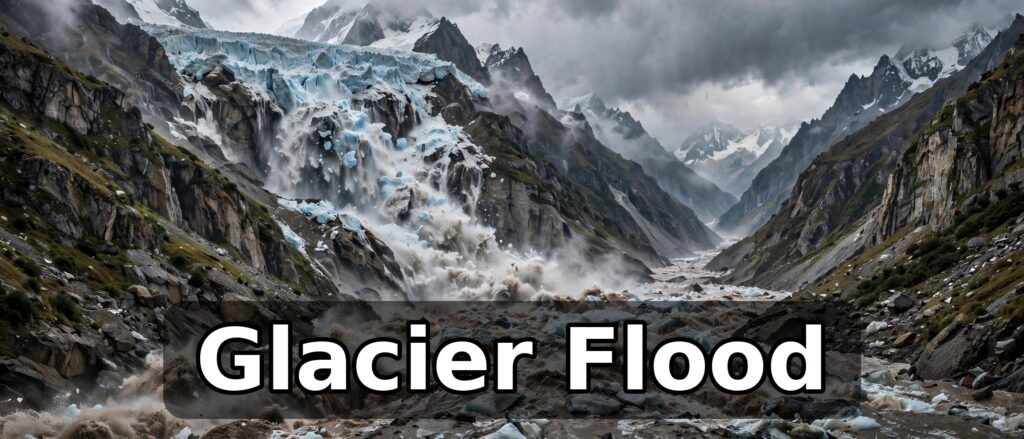
What Happens When a Glacier Collapse Sends a Deadly Flood Downstream?
The Guardian covered a deadly glacier collapse and flood on the Nepal-Tibet border, and a follow-up study raised the possibility — not certainty — that warming destabilised the glacier, a hypothesis that highlights both the hazards of mountain valleys and the need for monitoring, warning, and preparedness downstream.
Key points
- A glacier collapse can send a surge of water, ice, rock, and mud downstream in minutes, leaving villages, roads, and bridges almost no time to react.
- The event on the Nepal-Tibet border, covered by the Guardian, was a deadly flood of this kind.
- A follow-up study raised the possibility that warming destabilised the glacier — a possibility, not a certainty, and that distinction must be preserved.
- Reducing the risk means monitoring, hazard mapping, early warning, and community preparedness together; no single measure can eliminate it.
High in the mountains, where glaciers cling to steep slopes and valleys, a collapse can turn a quiet landscape into a disaster in minutes. Ice and rock break loose, plunge into a lake or river, and send a surge of water, debris, and mud racing downstream. Villages, roads, bridges, and hydropower infrastructure in the valley below may have almost no time to react.
That is the kind of event reported on the Nepal-Tibet border, where the Guardian covered a glacier collapse and flood that proved deadly. A follow-up study, as briefed, raised the possibility that warming destabilised the glacier. That causal link must be kept as a possibility, not as certainty. The distinction matters, both for scientific honesty and for the communities trying to understand what happened and how to reduce the risk next time.
A flood born in ice
Most people picture floods as the result of heavy rain or a river bursting its banks. A glacier-collapse flood, sometimes called a glacial lake outburst flood or a related debris flow depending on the exact mechanism, can be different in origin, speed, and composition.
The basic sequence often goes like this. A glacier, weakened or destabilised, sheds a large mass of ice, sometimes mixed with rock. That mass falls, often from height, into a glacial lake or into a river valley. The impact displaces water suddenly, creating a wave or surge. If the lake is held back by a moraine — a ridge of rock and debris left behind by the glacier — the surge can overtop or breach that natural dam. Once the dam is breached, the lake drains rapidly, sending a torrent downstream.
The flood that follows is rarely just water. It carries ice blocks, boulders, gravel, sand, and mud, and it can scour the valley floor, undercut slopes, and trigger further landslides as it passes. Its front may arrive as a wall of debris-laden water, far more destructive than clear water alone, because the debris adds weight and abrasive force. Bridges can be torn away, roads buried, fields stripped of topsoil, and buildings damaged or destroyed even if they sit above the normal river level.
Speed is a critical factor. In steep mountain valleys, a flood can travel downstream very quickly, leaving little time for warning. Unlike a river flood driven by days of rain, which may rise gradually and allow time for evacuation, a collapse-driven flood can arrive with frightening suddenness, especially for communities close to the source. Distance helps — the farther downstream, the more the flood may spread and lose energy — but in narrow valleys, the surge can remain concentrated and destructive for a considerable distance.
Why the Nepal-Tibet border region is vulnerable
The Himalayan region, including the border area between Nepal and Tibet, is one of the most glacier-rich and also one of the most hazard-prone mountain regions in the world. Several factors combine to create that vulnerability.
First, the terrain is extreme. Glaciers sit high above deep valleys, often perched on steep slopes or feeding lakes that sit well above settlements. That elevation difference means that when ice or water is released, gravity accelerates it downhill, giving it enormous energy by the time it reaches inhabited areas. Villages, roads, and infrastructure are often located in valley bottoms, precisely where floodwaters and debris are channelled.
Second, the region is geologically active and geomorphologically dynamic. Earthquakes, landslides, and erosion are part of the landscape’s ongoing evolution. Glacial lakes form, grow, and sometimes drain as glaciers retreat and meltwater accumulates behind moraines or ice dams. Those dams are not engineered structures; they are piles of loose rock and ice that can fail if overtopped, eroded, or shaken.
Third, the climate is changing in ways that affect glaciers. Glaciers in the Himalayas, like glaciers in many parts of the world, have been retreating in recent decades as temperatures have risen. Retreat can create new lakes, enlarge existing ones, and expose unstable slopes that were previously supported by ice. Meltwater can accumulate in places where it previously did not, increasing the volume of water that could be released if a dam fails or a collapse occurs.
Fourth, human exposure is growing. Roads, hydropower projects, trekking routes, and settlements have expanded into mountain valleys, placing more people and infrastructure in the path of potential floods. A flood that might once have affected only a remote valley may now threaten a road that is a lifeline for trade, a power plant that supplies electricity, or a village that has grown over time. Vulnerability is therefore not just a matter of geology; it is also a matter of where people live and work.
What a glacier collapse actually involves
The phrase “glacier collapse” can cover several different processes, and researchers typically try to determine which one occurred in a given event. One possibility is a calving or icefall event, in which a portion of a glacier breaks off and falls, often from a steep ice front or hanging glacier. The falling ice can generate a powerful impact if it lands in water, or a debris flow if it lands on a slope and mobilises rock and sediment.
Another possibility is a larger glacier detachment, in which a substantial section of a glacier slides off its bed and moves downslope as a mass. Such detachments are rarer and less well understood, and they can involve a combination of ice, rock, and water moving together at high speed.
The possibility that warming destabilised the glacier
| How warming could destabilise a glacier | What it would do |
|---|---|
| Thinning | A thinner glacier may be less able to support its own weight on a steep slope, and may develop cracks that propagate more easily |
| Meltwater lubrication | Surface meltwater flowing into cracks can reach the glacier bed, reduce friction, and let the glacier slide more easily |
| Permafrost thaw | Ice in cracks and pores of surrounding rock thaws, so the rock becomes looser and more prone to failure |
| Larger glacial lakes | Higher lake levels undercut ice, erode moraine dams, and increase the volume of water available for a flood |
| Retreat and debuttressing | A glacier retreating from a slope leaves that slope unsupported; newly exposed rock may be fractured and unstable |
According to the briefing for this article, a follow-up study raised the possibility that warming destabilised the glacier involved in the Nepal-Tibet border flood covered by the Guardian. That wording — possibility, not certainty — is important and should be preserved.
How could warming destabilise a glacier? There are several plausible mechanisms, each of which researchers would examine. Warming can thin a glacier, reducing its thickness and changing the stresses within the ice. A thinner glacier may be less able to support its own weight on a steep slope, or may develop cracks that propagate more easily. Thinning can also change how a glacier interacts with the rock beneath it, potentially altering the friction that holds it in place.
Warming can increase meltwater, both on the surface and beneath the glacier. Surface meltwater can flow into cracks, widening them and reaching the glacier bed, where it can lubricate the interface between ice and rock and reduce friction. That lubrication can make a glacier slide more easily, especially if meltwater accumulates in pockets or channels under pressure.
Warming can also affect permafrost in the surrounding rock. Many high-mountain slopes are held together in part by ice in cracks and pores. As that ice thaws, the rock can become looser and more prone to failure. A slope that was stable when frozen may become unstable as it warms, and a glacier perched on or against such a slope may lose part of its support.
Without that detailed evidence, the responsible statement is the one the follow-up study reportedly made: warming may have destabilised the glacier. It is a hypothesis to be investigated further, not a settled explanation. Treating it as certain would overstate the science and could mislead efforts to prevent future disasters, which need to consider all possible factors, not just one.
Other factors that can destabilise a glacier
Even if warming played a role, it is unlikely to have been the only factor. Glacier stability is influenced by a web of geological, hydrological, and meteorological conditions.
The shape of the glacier and its bed matters. A glacier on a steep slope, or on a bed that slopes in a way that encourages sliding, is inherently more prone to detachment than a glacier on a gentle slope. The presence of weak rock layers, faults, or fractures beneath the ice can create planes along which the glacier or surrounding rock can fail.
The human cost downstream
When a glacier-collapse flood reaches a valley, the human cost can be severe, even if the number of people directly in the path is relatively small compared with floods in lowland cities. Remote mountain communities often have limited warning systems, limited evacuation routes, and limited access to emergency services. A road that is the only way out may itself be washed away. Communication networks may be damaged by the same flood that threatens lives.
Monitoring, warning, and prevention: what is possible
Reducing the risk of glacier-collapse floods involves several layers of work, none of which can eliminate risk entirely, but each of which can help. Monitoring is the first layer. Satellites can track glacier movement, thinning, lake growth, and changes in surface features over time. Ground-based sensors, where they can be installed and maintained, can measure lake levels, water pressure, and ground movement. Repeated surveys can reveal whether a glacier is accelerating, whether a lake is growing rapidly, or whether a slope is showing signs of instability. In remote areas, satellite monitoring is often the most practical option, because it does not require constant field presence.
How to talk about warming and a single disaster
The Nepal-Tibet border flood raises a broader question that applies to many disasters: how should we talk about climate change and a single event? The careful approach is to distinguish between three levels of statement. The first is that glaciers in many regions are retreating as the climate warms — a broad, well-supported observation based on many glaciers over many years. The second is that warming could destabilise a particular glacier through mechanisms like thinning, meltwater lubrication, permafrost thaw, or lake growth — a plausible hypothesis that needs to be tested for that glacier. The third is that warming definitively caused a particular collapse — a strong claim that requires specific evidence for that event and should not be made without it.
The follow-up study, as briefed, made a statement at the second level: it raised the possibility that warming destabilised the glacier. That is a scientifically responsible way to frame a hypothesis, and it invites further research rather than closing the question. Journalists, policymakers, and readers should preserve that framing, rather than upgrading possibility to certainty in headlines or summaries.
Looking ahead
For now, the most important message for people downstream of glaciers is practical, not theoretical. Know the hazard, know the warning signs, know the evacuation route, and take warnings seriously even if a flood has not happened in living memory. Glaciers can appear permanent, but they are in motion, and the valleys below them are shaped by that motion — sometimes gradually, and sometimes, tragically, all at once.
Raina





댓글 0
첫 댓글을 남겨보세요.