
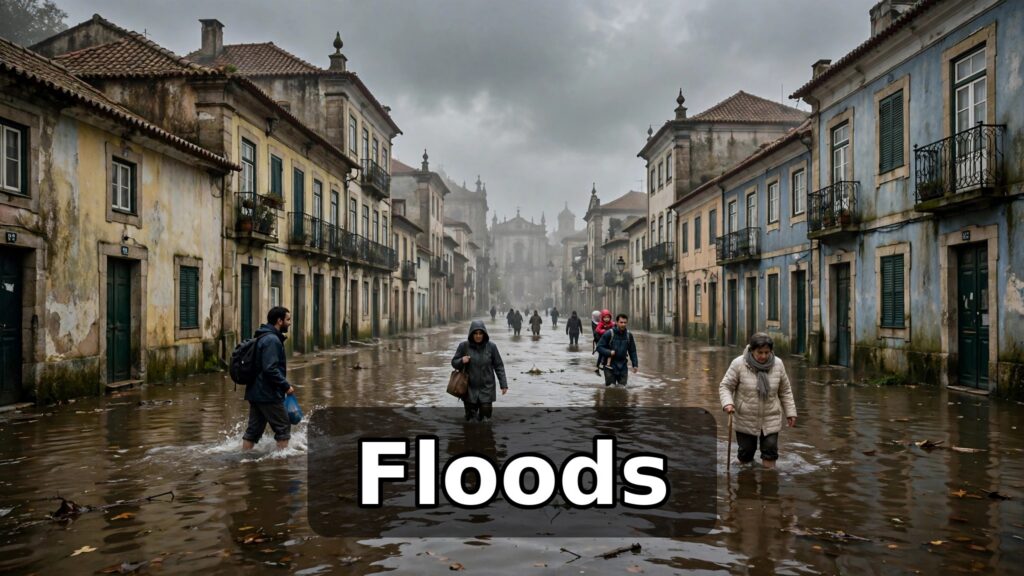
After Portugal’s Floods, Who Can Afford Climate Disaster Protection?
Reuters reported that after the 2026 floods, Portugal moved toward a natural-disaster insurance system — a case study in how weather disasters become housing-cost and household and national finance problems, why insurance spreads costs without reducing them, and why affordability is ultimately a question of fairness.
Key points
- After the 2026 floods, Reuters reported that Portugal began moving toward a natural-disaster insurance system.
- A home that floods can become effectively uninsurable: premiums rise beyond what the household can pay, and the home’s value falls because any buyer faces the same calculation.
- Insurance spreads costs; it does not reduce them. Real protection also requires prevention: flood defences, building rules, restored wetlands, and early warning.
- The test of any system is the household in the lowest, worst-drained street: can it afford to be protected, and can it recover without falling into lasting debt?
When floodwater recedes, the damage it leaves behind is not only physical. Walls can be dried and roads repaired, but the financial damage lingers: a ruined home, a business that cannot reopen, a family that cannot afford to rebuild in the same place. After the 2026 floods, Reuters reported, Portugal began moving toward a natural-disaster insurance system — an attempt to answer a question that now confronts countries everywhere. When climate disasters strike more often, who can actually afford protection?
Portugal’s move is worth examining closely, not because Portugal is unique, but because it is representative. A flood that once would have been treated as a rare emergency is now forcing a permanent redesign of how a country pays for disaster. That redesign touches housing, household budgets, municipal finance, and national budgets all at once. It raises questions that go far beyond insurance technicalities: who lives where, who bears the cost of risk, and what fairness requires when the climate that shaped a country’s settlements no longer behaves as it once did.
The long financial timeline of a flood
It is tempting to think of a flood as a weather story that ends when the water drains away. For the people who lived through it, the story continues in bills. In the first days, the costs are visible and urgent: cleaning, drying, emergency repairs, temporary accommodation. In the weeks that follow, the costs become structural: replacing floors, walls, wiring, and appliances; restocking a shop; repairing a vehicle.
In the months that follow, the costs become systemic: a mortgage that continues even though the home is uninhabitable, a business loan that cannot be serviced because revenue has stopped, a rent that must still be paid for a property that cannot be lived in. And in the years that follow, the costs become permanent: a home that is worth less because it is now known to flood, a neighbourhood that loses shops and services because businesses did not return, a family that carries debt incurred during recovery long after the water is gone.
The uninsurability trap
Among the most consequential forms of lingering damage is the loss of insurability itself. A home that has flooded is, in the eyes of an insurer, a home that is likely to flood again. If floods are becoming more frequent, that judgment becomes harder to argue against. Premiums rise to reflect the higher risk, and at some point they rise beyond what the household can pay. The home then becomes effectively uninsurable: not because insurance is legally unavailable, but because it is practically unaffordable.
This creates a trap. A family that cannot afford insurance also cannot afford to rebuild after the next flood, and cannot sell the home for enough to move somewhere safer, because the market has already discounted the flood risk. They are locked into a risky place by the very fact that it is risky. The trap deepens with each flood, as the property loses more value and the household’s resources are further depleted by recovery costs. What began as a weather event becomes a wealth event, stripping assets from the households least able to lose them.
Municipal budgets consumed by recovery
The same squeeze operates at the level of towns and cities. A municipality that must repair roads, bridges, drainage systems, and public buildings after a flood faces an immediate bill that can consume a large share of its annual budget. That bill arrives at the same time as lost revenue: businesses closed, property values falling, residents displaced. The municipality must therefore spend more while receiving less, and it must borrow or cut other services to bridge the gap.
The most damaging consequence is what does not get funded. Money spent on repairing the last flood is money not spent on preventing the next one: upgrading drainage, maintaining river channels, restoring wetlands, or enforcing building rules in flood-prone areas. A municipality trapped in a cycle of repair cannot invest in prevention, and without prevention, the next flood causes similar damage, requiring similar repair, consuming the next budget in turn. The cycle is self-reinforcing, and it is hardest to break for the poorest municipalities, which have the smallest budgets and often the most exposed infrastructure.
Portugal’s move: pooling the risk
Portugal’s response, as Reuters reported, is to build a system for natural-disaster insurance. The idea is straightforward: spread the cost of disaster across a wide pool, so that no single household or town bears the full weight of a flood alone. In a well-designed system, everyone contributes, and those who suffer receive enough to recover. Such systems exist in various forms in several countries, and they are often created after a disaster reveals that the existing arrangements do not work.
Affordability versus sustainability
Designing such a system is harder than announcing one. The central tension is affordability versus sustainability. If premiums are set high enough to cover rising disaster costs, many households — especially the poorest — cannot pay them. If premiums are kept low, the system may not have enough money when the next disaster arrives. Governments can subsidise the gap, but that transfers the cost to taxpayers, raising questions about who ultimately pays for climate risk.
Who bears the cost? Unequal exposure
The question of who can afford protection has no single answer, because the costs of climate disasters fall unevenly. Wealthier households can buy insurance, elevate their homes, or move to safer ground. Poorer households often live in the most exposed places — low-lying areas, ageing buildings, neighbourhoods with poor drainage — and have the least ability to pay for protection or recovery. When insurance becomes expensive or unavailable, these households are left with the worst of both worlds: the highest risk and the least protection.
Insurance spreads costs; prevention reduces them
An insurance system, however well designed, cannot by itself solve the problem of rising disaster risk. Insurance spreads costs; it does not reduce them. If floods keep getting worse because rivers are unmanaged, drainage is inadequate, and building continues in flood-prone areas, then insurance premiums will keep rising until the system strains. Real protection requires prevention alongside insurance: better flood defences, stricter rules about where homes are built, restored wetlands that absorb floodwater, and early warning systems that give people time to act.
The distinction is the most important idea in the whole disaster-protection debate. Insurance does not make a flood smaller. It does not lower a river, strengthen a levee, or move a house to higher ground. It takes the cost of a flood that has already happened and distributes it across many people and across time, so that no one bears it all at once. That is a valuable function — it is what makes recovery possible — but it does not change the total cost. If the total cost keeps rising because floods keep getting worse, then even a perfectly designed insurance system will face ever-rising claims, ever-rising premiums or subsidies, and ever-greater strain.
Prevention, by contrast, reduces the total cost. Every measure that keeps water out of a home, slows a river’s rise, or gives people time to move their belongings reduces the damage that insurance must cover. Prevention and insurance are therefore complements, not substitutes. Insurance without prevention is a system that pays for ever-larger losses until it breaks. Prevention without insurance leaves the victims of the next flood — and there will be a next flood, even with the best prevention — without help to recover. A country needs both, and it needs them designed together, so that insurance rewards prevention and prevention reduces the burden on insurance.
Prevention alongside insurance
What does prevention look like in practice? It begins with defences, but it does not end there. Flood defences — levees, barriers, improved drainage, river-channel maintenance — are the most visible form of prevention, and they are essential where large numbers of people already live in flood-prone areas. But defences have limits: they are expensive, they require maintenance, and they can fail, sometimes catastrophically, if they are overtopped or breached. A defence that gives residents a false sense of absolute safety can be more dangerous than no defence at all, if it encourages building and complacency behind a barrier that will one day be overwhelmed.
Building rules are the second pillar. Where new homes are built, and how they are built, determines the flood risk of the next generation. Rules that restrict building in the most flood-prone areas, require new homes in moderate-risk areas to be elevated or flood-resistant, and ensure that drainage is adequate for the development it serves, can prevent new risk from being created even as old risk is managed. These rules are often politically difficult, because they constrain landowners and developers, but they are among the most cost-effective prevention measures available.
Natural solutions are the third pillar, and they are often undervalued because they do not look like engineering. Wetlands, floodplains, and restored river meanders absorb floodwater, slowing its rise and reducing its peak. Forests and vegetation on slopes hold soil and slow runoff. These natural systems provide flood protection as a byproduct of their ecological function, and they do so without the maintenance burden of a concrete structure. Restoring them is a practical investment in the landscape’s capacity to absorb water before that water reaches a town.
Early warning is the fourth pillar, and it is the one that most directly saves lives and movable property. A warning that arrives hours before a flood gives people time to move to safety, to move vehicles and valuables to higher ground, and to protect what can be protected. A warning system that reaches everyone — including people without smartphones, people in isolated properties, and people who do not follow official channels — reduces both human and financial loss. Early warning does not prevent a flood, but it prevents a flood from becoming a catastrophe, and it is among the cheapest forms of protection available.
What this means
This inequality is not only a household problem. It is a national finance problem. When large numbers of people cannot recover from a disaster, the costs do not disappear. They surface as emergency spending, as lost tax revenue, as declining property values, and as pressure on public services. A country that fails to protect its most vulnerable residents ends up paying for that failure anyway, often at a higher price and in a more chaotic way.
There is also a longer-term national cost that is harder to quantify but no less real: the erosion of confidence. When households and businesses lose faith that a place can be protected, or that recovery will be supported, they invest less, move away, or demand higher returns for staying. That loss of confidence can hollow out a region more thoroughly than any single flood, turning a recoverable disaster into a lasting decline. A credible disaster-protection system — one that combines insurance with prevention and that demonstrably helps people recover — is therefore not only a humanitarian measure. It is an economic measure, preserving the confidence on which investment, lending, and community life depend.
Raina





댓글 0
첫 댓글을 남겨보세요.