
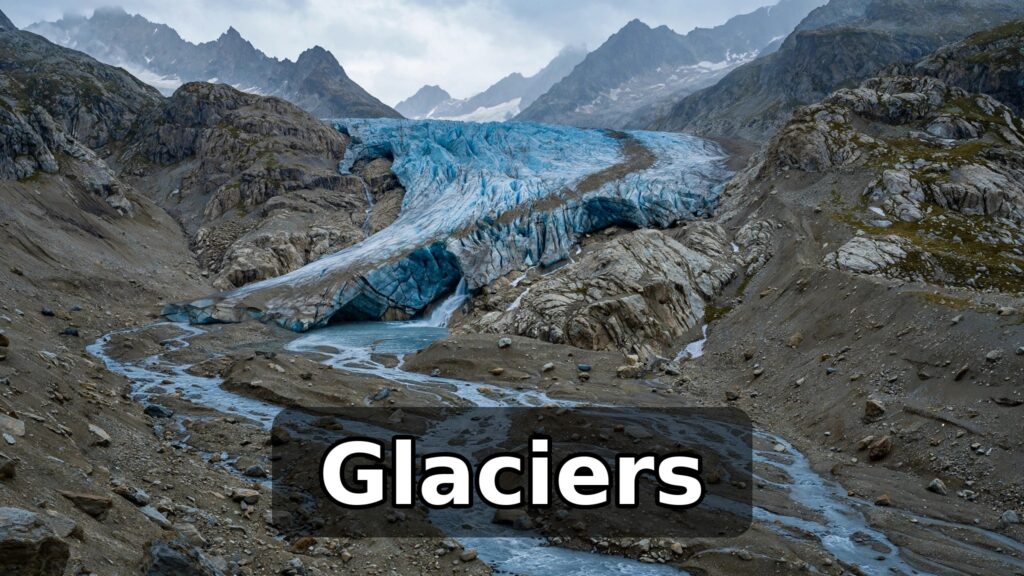
When Alpine Glaciers Shrink, What Happens to Rivers and Water Supplies?
AP reporting on Slovenia's greatly shrunken glaciers shows how the loss of Alpine ice threatens the rivers, water supplies, and ecosystems that depend on glaciers releasing meltwater through the dry summer months, and why that water-tower function is so hard to replace once it is gone.
Key points
- Glaciers act as frozen reservoirs, storing winter snow as ice and releasing it slowly through the warm months.
- Slovenia’s glaciers have shrunk greatly, reduced to remnants of what they once were, according to Associated Press reporting.
- A rapidly melting glacier can release more water for a time — spending its savings — before late-summer flow falls away.
- Small glaciers are especially sensitive: a modest rise in temperature can mean losing more ice in summer than winter can replace.
High in the Alps, glaciers have long acted as frozen reservoirs, storing winter snow as ice and releasing it slowly through the warm months. That slow release is what keeps mountain rivers flowing in late summer, when rain is scarce and demand is highest. Now that system is breaking down. The Associated Press has reported on Slovenia’s glaciers, which have shrunk greatly, and on the concerns that their decline raises for water supplies and ecosystems.
The story of one small country’s vanishing ice is, in miniature, the story of mountain regions around the world. Slovenia’s glaciers are not the largest in the Alps, and that is precisely why they matter as a warning. Large ice masses can absorb a bad year or two and still look, from a distance, much as they did before. Small glaciers cannot hide their losses.
Glaciers as water towers
To understand why shrinking glaciers matter, think of them as water towers. In winter, snow piles up on a glacier faster than it melts. In summer, the ice melts gradually, feeding streams and rivers long after the last snowfall. This timing is the glacier’s great gift: it delivers water exactly when it is needed most, during the dry, hot months when farms need irrigation, towns need drinking water, and power plants need flow for hydroelectric generation.
A glacier collects precipitation in the cold season, when water is abundant but least needed, and holds it in solid form, immune to evaporation, until the warm season, when demand rises and other sources fall away. Rain, by contrast, arrives when it arrives. Snow on low ground melts early and runs off quickly. Only high, cold storage stretches the water year into the dry season in this way.
Why timing matters as much as volume
A river’s annual flow can look healthy on paper while still failing the people who depend on it, if the water arrives at the wrong time. A flood in spring does not compensate for a dry riverbed in August. Crops do not need water averaged over the year; they need it during growth and ripening. A town does not need its yearly supply delivered in a single wet month; it needs a reliable tap through the hottest weeks.
Glaciers solve this mismatch by delaying water. Winter snow that falls on a glacier does not rush downstream. It compacts into ice, and that ice melts slowly, day by day, through the summer. The result is a river that carries a steadier base flow through the season when rain is least reliable. In a dry summer, when lowland rivers shrink and wells fall, a glacier-fed river keeps going.
As glaciers shrink, this smoothing effect weakens. The river becomes more dependent on immediate rainfall and on snow that melts early, which means it becomes more variable: higher when it rains, lower when it does not, and less predictable from one week to the next. For a farmer deciding when to plant or a water manager deciding how much to release from a reservoir, unpredictability is itself a cost.
Spending the savings: the deceptive phase
When a glacier shrinks, the first effect on downstream rivers is not always a decline. It can be the opposite, and that is one of the most dangerous features of glacier loss. A rapidly melting glacier may actually release more water for a time, as if it were spending its savings. The ice that took decades or centuries to accumulate is drawn down quickly, and rivers downstream run fuller than they otherwise would.
That phase does not last. Savings, by definition, run out. Once the ice is gone, the late-summer flow it once guaranteed goes with it, and rivers that once ran steadily can dwindle to a trickle in the driest weeks. The transition can be abrupt in human terms: a river that seemed reliable for years begins to fail in dry summers, not because rainfall suddenly collapsed, but because the hidden reserve that used to cover the gap is no longer there.
This pattern creates a serious planning trap. If communities, farms and power producers expand their water use during the period of accelerated melt, they build their livelihoods on a flow that is temporary. When the meltwater peak passes, those commitments remain, but the water that supported them does not. A full river below a shrinking glacier is not necessarily a sign that all is well. It may be a sign that the glacier is losing mass faster than ever.
Why small glaciers are especially sensitive
Slovenia’s glaciers are small compared with the great ice fields of the central Alps, and that smallness makes them especially sensitive. The AP’s reporting describes glaciers that have shrunk greatly, reduced to remnants of what they once were. For a small glacier, even a modest rise in temperature can mean the difference between surviving a summer and losing more ice than the winter can replace. Year after year of that imbalance adds up, until the glacier is no longer really a glacier at all — just a patch of ice that no longer flows.
Small glaciers tend to sit at lower elevations, closer to the warming air of the valleys, and they have less thickness to spare. A large glacier can lose a layer from its surface and still retain a deep core; a thin glacier can lose the same layer and lose a large share of its whole body. Small glaciers also have less area at high, cold altitude where snow can still accumulate even in a warm year.
The fate of small glaciers matters beyond their own valleys because they are indicators. They respond quickly to warming, so they show, sooner than larger ice masses, what a given level of warming means in practice. When small glaciers disappear, they signal that conditions have crossed a threshold at which ice at that elevation can no longer sustain itself, and they preview the pressures that larger glaciers will face if warming continues.
Rivers running lower in summer
The most direct consequence of glacier loss is a change in the rhythm of rivers. Mountain rivers fed by glaciers have a distinctive pattern: steady flow through the summer, sustained by melting ice. As glaciers shrink, that pattern flattens. Spring flows may arrive earlier, as snow melts sooner, and summer flows may fall away just when they are needed most.
When snow melts sooner, rivers rise earlier, and that water may pass downstream before crops need it or before reservoirs are ready to capture it. Flood risk in spring can rise even as summer water security falls, producing the paradox of a region that experiences both more early water and less late water in the same year.
For communities downstream, this shift is not abstract. Farmers who plan irrigation around late-summer river levels may find less water available. Towns that draw drinking water from mountain streams may face shortages in dry spells. Hydroelectric plants that depend on steady summer flow may generate less power exactly when demand for cooling is highest. The glacier’s role as a natural regulator is lost, and nothing built by humans fully replaces it.
Who depends on that summer flow
Farmers are the first group. Mountain and foothill agriculture often depends on irrigation in the driest months, when rain cannot be counted on and when crops are most sensitive to water stress. A farmer does not need a river that is generous in spring and empty in August. The farmer needs water in August, and a glacier was one of the few sources that could promise it.
The second group is towns and villages that draw drinking water from mountain streams and springs fed by glacial melt. For these communities, summer low flow is a public-health and daily-life problem. Restrictions on water use, declining pressure, and in the worst cases the need to truck water in, all become more likely when the natural summer base flow declines.
The third group is hydropower producers and, through them, everyone who uses electricity. Hydropower that depends on glacier-fed rivers is most valuable in summer, when air-conditioning demand rises. If summer flow falls, generation falls at precisely the moment when the grid most needs it. Glacier loss thus connects, through the power grid, to households and businesses far from any mountain.
Ecosystems caught in the change
Rivers are not only water supplies. They are habitats. Cold, steady glacial meltwater supports species adapted to those conditions: particular fish, insects and plants that thrive in cold, oxygen-rich streams. When meltwater declines and water temperatures rise, those species lose the conditions they need. Some may move upstream, following the cold water higher, but there is only so far up a mountain a stream can go.
Can anything replace a glacier?
Engineers can build reservoirs, and reservoirs do store water. But a reservoir is not a glacier. A glacier collects snow across a wide, high area and releases it without pumps, pipes or maintenance. A reservoir must be built, filled and managed, and it loses water to evaporation in exactly the hot months when water is scarcest. Reservoirs help, but they are a partial and expensive substitute for a natural system that worked for free.
The honest conclusion is that adaptation can soften glacier loss, but it cannot fully replace a glacier at the scale at which glaciers once worked. The gap between what reservoirs, groundwater and efficiency can provide and what a healthy glacier once provided is the measure of what is being lost, and it is a gap that grows as more ice disappears.
Why glacier fate is decided globally
The deeper answer is that glacier loss cannot be engineered away at scale. The only way to preserve the water-tower function of glaciers is to slow the warming that is melting them. That requires cutting emissions globally — a task far larger than any single mountain valley. For Slovenia and other Alpine countries, this is a sobering reality: the fate of their glaciers is decided not only in their own valleys, but in energy and transport choices made around the world.
This is not a counsel of helplessness. Local action matters: local adaptation determines how much harm a given amount of glacier loss causes, and local protection of watersheds, forests and water infrastructure can make communities more resilient. But local action cannot, on its own, cool the air over a glacier. A valley can manage its water wisely and still lose its ice if global temperatures keep rising.
The view from the valley
Slovenia’s shrinking glaciers are easy to overlook on a world map. They are small, remote, and far from the great population centres. But they are an early warning. Small glaciers are the first to go, and their disappearance shows what awaits larger ice masses if warming continues. The rivers that run from them, the farms they water, and the ecosystems they sustain are all part of a system that is quietly unravelling.
When a glacier shrinks, the question is not only what happens to the ice. It is what happens to everything downstream: the river in late summer, the town’s water supply, the fish in the stream, and the farmer waiting for water that no longer comes. The answer, in Slovenia as elsewhere, is that the loss of ice is also a loss of security — and that security, once gone, is very hard to win back.
Raina





댓글 0
첫 댓글을 남겨보세요.