
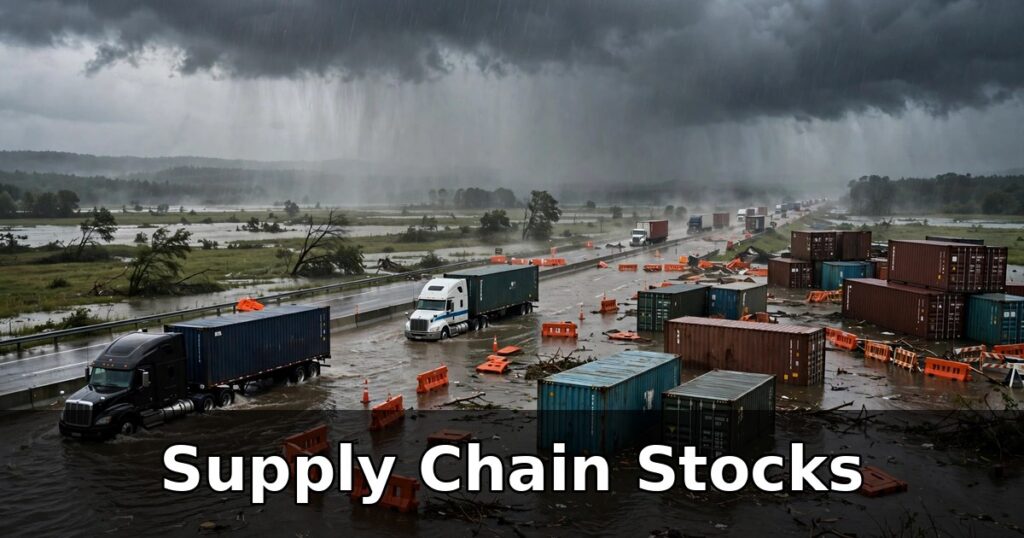
Floods and Supply Chains: Which Stocks Get Hit First When Roads Close
Key points
- The 2011 floods in Thailand knocked out about 25 percent of the world’s hard drive manufacturing capacity.
- A Western Digital 2-terabyte drive that sold for $69.99 before the flood reached $249.99 in less than a month.
- In October 2022, low water on the Mississippi River pushed St. Louis barge rates to a record $105.85 a ton.
- When floods close a road or a river, the stocks hit first are the ones with a single chokepoint and no inventory buffer.
Contents
- Too much water: Thailand, 2011 — floods supply chains stocks
- Too little water: the Mississippi, 2022 — floods supply chains stocks
- Who gets hit first — floods supply chains stocks
- What the research says about floods supply chains stocks
- What is still uncertain about floods supply chains stocks
- A supply chain checklist for floods supply chains stocks
- What this means for floods supply chains stocks
- The road is the business — floods supply chains stocks
A flood does not have to damage a company’s factory to damage its stock. It only has to close the road the factory depends on. Modern supply chains are built on the assumption that goods move on schedule, and a flood breaks that assumption in a single place — a highway, a rail line, a river — and the break travels outward through every company that uses it.
The order of the damage is predictable. The companies hit first are the ones that depend on a single chokepoint and hold the least inventory. The ones hit second are their customers, who discover that a part they assumed would arrive has not. The ones hit last are the retailers and consumers, who find the shelves empty or the prices higher.
Two floods, a decade apart, show the pattern in its purest form. One was too much water. The other was too little. Both closed a transport artery, and both repriced entire industries.
Too much water: Thailand, 2011 — floods supply chains stocks
The floods that struck central Thailand in late 2011 were the region’s worst in 50 years. They inundated industrial parks north of Bangkok, including the factories where a large share of the world’s hard disk drives were made. Western Digital’s main plant in Ayutthaya was flooded under almost two metres of water. It took seven weeks to restart production.
The floods knocked out about 25 percent of the world’s hard drive manufacturing capacity. Thailand produced 40 to 45 percent of the world’s hard drives, and about half of that capacity was hit directly. Seagate’s own plants were spared, but its subcomponent suppliers were not. The whole industry, concentrated in one flood plain, stopped at once.
The price response was violent. A Western Digital 2-terabyte Caviar Green drive that sold for $69.99 before the flood reached $249.99 in less than a month, and settled at about $119.99 months later — still 70 percent above the pre-flood price. Average selling prices across the industry rose about 28 percent in the fourth quarter of 2011 and the first quarter of 2012, while unit shipments fell 29.1 percent in the fourth quarter from 174 million in the third. Research firm IDC estimated that PC shipments could be crimped by as much as a fifth in the first quarter of 2012.
The paradox is that the hard drive makers themselves profited. Western Digital reported sales of $3.04 billion and net profit of $483 million in the quarter ending March 2012, a net margin of 16 percent. Seagate reported sales of $4.45 billion and net profit of $1.15 billion, a margin above 25 percent. Scarcity raised their prices faster than it cut their volumes. The companies that suffered were the PC makers, who could not get the drives they needed.
Too little water: the Mississippi, 2022 — floods supply chains stocks
Eleven years later, the problem was the opposite: not enough water. A flash drought across the Midwest dropped the Mississippi River to record lows during the corn and soybean harvest. The river gauge at Memphis fell to minus 10.76 feet on 18 October 2022, the lowest since 1988. Barges had to carry lighter loads, tow sizes were cut, and parts of the river closed for 12 to 36 hours at a time.
The cost of moving grain by water soared. The St. Louis barge spot rate peaked at $105.85 a ton in the week of 11 October — against a pre-drought average maximum of about $27 a ton. Even after falling back, the rate was 130 percent higher than a year earlier and 260 percent above the three-year average. Close to 60 percent of U.S. grain exports travel down the Mississippi system by barge, so the bottleneck hit at the worst possible moment: harvest.
The pattern repeated the following year. In the third quarter of 2023, downbound grain volumes on the Mississippi system totalled 3.9 million tons — 35 percent lower than the same quarter a year earlier and 53 percent lower than the previous five-year average. Low water had become a recurring event, not a one-off.
Who gets hit first — floods supply chains stocks
| Position | Why it is hit first | Example |
|---|---|---|
| Single-source supplier | One factory, one flood plain, no alternative | Hard drive plants in Thailand, 2011 |
| Just-in-time manufacturer | Days of inventory; a missed delivery stops the line | PC makers waiting on drives, 2011 |
| Bulk commodity shipper | No alternative route at the same cost | Grain barges on the Mississippi, 2022 |
| Retailer | Empty shelves arrive weeks later, then higher prices | PC prices up 70% after the flood |
| Scarce-goods seller | Shortage raises prices faster than it cuts volume | Drive makers’ margins rose in 2012 |
The table shows the rule. The first to fall are the companies with no slack: one factory, one route, a few days of stock. The last to fall are the consumers, who feel it as a higher price rather than a missing product. And in the middle sit the paradoxical winners — the companies whose product becomes scarce, and therefore more valuable.
What the research says about floods supply chains stocks
A 2025 study in Water Resources Research (Pratson, Foster and Characklis) examined the Mississippi barge spikes of 2022, 2023 and 2024 and reached a surprising conclusion. The researchers built a model to test whether the rate spikes were caused by the low water or by high fuel costs over the same period. Their result: fuel costs were the dominant reason for the spike, and the flash droughts accounted for 16 percent or less of the peak rates.
The finding does not mean the drought did not matter. It means the price of moving grain is set by more than one variable, and the variable that looks like the cause is not always the one doing the work. In 2012 and 2013, the authors note, similar low-water events did not produce rate surges — because fuel was cheap. The drought closed the river. The fuel price set the bill.
The lesson for investors is to check the second variable. A flood that closes a road is a visible event. The fuel price, the inventory level and the alternative route are the quiet ones, and they often decide how much the visible event actually costs.
What is still uncertain about floods supply chains stocks
Floods end, but the repricing lingers. Hard drive prices stayed about 70 percent above pre-flood levels for months after production recovered, because the industry had consolidated and the survivors kept their pricing power. The flood ended. The higher prices did not.
Alternative routes exist but cost more. Grain that cannot move by barge moves by rail or truck, at a higher price. The question is not whether goods move, but how much the detour costs — and who pays it.
Inventory is a choice. Companies that hold more stock survive a flood better, but they pay for the warehouse and the capital. Just-in-time manufacturing is efficient in normal times and fragile in a flood.
Concentration is the real risk. The Thailand flood hurt because so much of one industry sat in one flood plain. The same concentration exists today in semiconductors, batteries and rare earths. The next flood will find the next concentration.
A supply chain checklist for floods supply chains stocks
Map the chokepoints. Ask where a company’s critical parts are made and how they travel. A single factory in a flood plain is a risk, even if the company itself is headquartered somewhere safe.
Count the inventory days. Companies disclose inventory in their filings. Fewer days of stock means a shorter fuse when a route closes.
Check the alternative. Is there a second route, a second supplier, a second port? If the answer is no, the company is one flood away from a stoppage.
Watch the river gauges. The Mississippi gauge at Memphis and the Rhine gauge at Kaub are public, updated daily, and free. They are the earliest warning of a transport bottleneck.
What this means for floods supply chains stocks
Floods are transport events before they are damage events. The stock market reacts to the closed road, not to the water. The road is what connects the factory to the customer.
Scarcity can help the scarce. The companies that lose volume can gain margin, as the drive makers did in 2012. The losers are the ones downstream who cannot get what they need.
Check the second variable. The visible cause is rarely the whole cause. Fuel, inventory and alternatives decide how much a flood actually costs.
The road is the business — floods supply chains stocks
A supply chain is only as strong as its narrowest crossing, and a flood finds that crossing every time. The stocks that fall first are the ones with no other way across. The ones that survive are the ones that built a second road before the water came.
Sources
- U.S. Department of Transportation
- Federal Emergency Management Agency
- U.S. Securities and Exchange Commission
Raina




댓글 0
첫 댓글을 남겨보세요.