
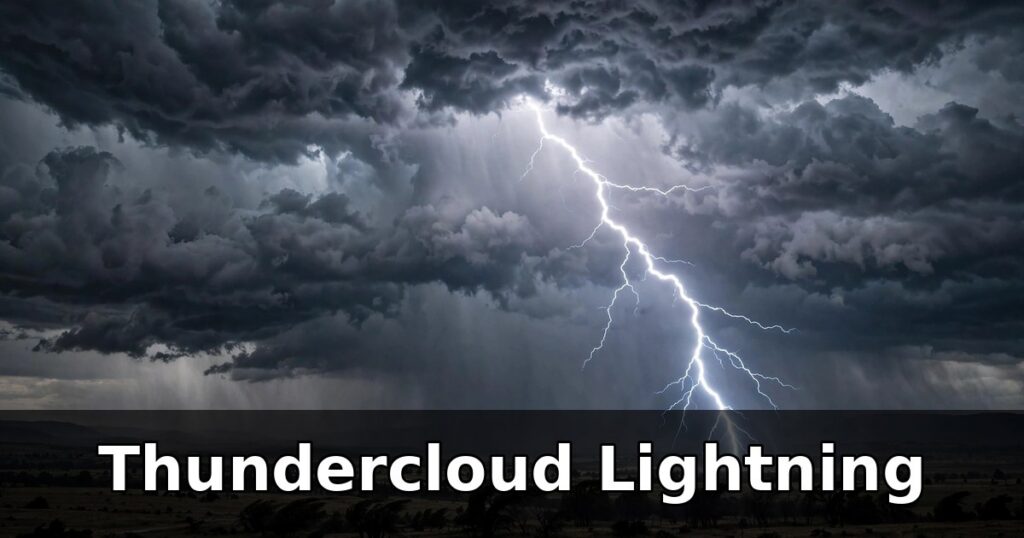
What Happens Inside a Thundercloud Before Lightning Strikes?
Key points
- Lightning flashes about 44 times every second somewhere on Earth — roughly 1.4 billion flashes a year.
- Inside a thundercloud, collisions between ice crystals and soft hail (graupel) separate electric charge, building a voltage of hundreds of millions of volts.
- The visible bolt is the return stroke, racing upward at up to 150,000 km per second and heating the air to about 30,000 °C — five times hotter than the Sun’s surface.
- Lightning kills an estimated 24,000 people a year worldwide, yet in the United States deaths have fallen to about 20 a year.
Lightning looks instantaneous: a flash, a crack of thunder, and it is over. The reality is a chain of events that takes minutes to build and less than a second to release. Inside a thundercloud, air, water and ice are sorted by violent updrafts into layers of electric charge, until the atmosphere — normally an excellent insulator — can no longer hold the charges apart.
Building the cloud
A thunderstorm begins with instability. Warm, humid air near the ground rises rapidly, cooling as it climbs. The water vapour it carries condenses into cloud droplets, releasing heat that makes the rising air even more buoyant. The updraft accelerates, and the cloud grows upward into a towering cumulonimbus that can reach 10 to 15 kilometres high — tall enough that its top spreads out into the familiar anvil shape.
Inside that tower, the air is anything but calm. Updrafts can exceed 100 kilometres per hour in strong storms, carrying small droplets high above the freezing level, while heavier particles fall back down through the rising air. The cloud becomes a churning mixture of water droplets, ice crystals, supercooled liquid water — droplets that stay liquid well below freezing — and soft hail pellets called graupel.
It is this mixture, and the collisions within it, that makes lightning possible. A cloud made only of liquid water droplets rarely produces lightning — ice is the essential ingredient.
Charge separation: the ice collision engine
The main charging zone in a thunderstorm sits in the middle of the cloud, where temperatures range from about −15 °C to −25 °C. Here, rising ice crystals collide with falling graupel in the presence of supercooled droplets, and each collision transfers a tiny amount of electric charge.
The direction of the transfer depends on temperature. In the heart of the charging zone, the lighter ice crystals pick up a positive charge and are carried upward by the updraft, while the heavier graupel picks up a negative charge and stays lower or sinks. The result is a cloud with a positively charged top and a negatively charged middle and base — with a smaller pocket of positive charge near the bottom, a structure scientists call the tripole.
The mechanism is known as non-inductive charge separation, because it needs no pre-existing electric field to work. Laboratory wind-tunnel experiments by Takahashi (1978) and Saunders and colleagues (1991) established the details, including the reversal temperature near −15 °C at which graupel switches from charging positively to charging negatively. Each collision moves only a tiny charge, but a storm contains billions of collisions every second, and the charge builds steadily over minutes.
As the negative charge accumulates in the cloud base, it repels electrons in the ground below, leaving the Earth’s surface positively charged beneath the storm. The electric field between cloud and ground grows until it reaches hundreds of millions of volts — far beyond anything a power station produces.
The numbers inside a flash
| Quantity | Value |
|---|---|
| Cloud top height | 10–15 km |
| Main charging zone | −15 to −25 °C |
| Voltage before discharge | Several hundred million volts |
| Stepped leader step length | 50–100 m per step |
| Stepped leader speed | ~200,000 m/s |
| Return stroke speed | 100,000–150,000 km/s |
| Channel temperature | ~30,000 °C |
| Energy per cloud-to-ground flash | 1–5 gigajoules |
| Peak current | Up to 200,000 amperes |
| Return strokes per flash | Typically 3–5 |
The stepped leader: a path made in jumps
When the field grows strong enough, the air itself begins to break down. A channel of ionised air called a stepped leader starts down from the cloud’s negative charge region. It is invisible to the human eye, and it does not travel smoothly: it advances in a series of rapid jumps, each 50 to 100 metres long, at a speed of about 200,000 metres per second.
As the leader approaches the Earth, the positive charge on the ground concentrates on tall objects — trees, buildings, poles — and streamers of positive charge reach upward to meet it. The moment one of those upward streamers connects with the descending leader, the circuit is complete.
What happens next is what the eye actually sees. A surge of current called the return stroke races up the ionised channel from the ground to the cloud at 100,000 to 150,000 kilometres per second — between a third and a half of the speed of light. It is the return stroke, not the leader, that produces the brilliant flash. A single flash typically contains 3 to 5 return strokes, which is why lightning often appears to flicker.
Why lightning is so hot — and so loud
The return stroke heats the narrow channel to about 30,000 °C, roughly five times hotter than the surface of the Sun. The air in and around the channel expands explosively, faster than the speed of sound, and that shock wave is thunder.
Thunder is also a measuring tool. Sound travels at about 343 metres per second in air, so counting the seconds between the flash and the thunder gives the distance: roughly three seconds per kilometre, or five seconds per mile.
A cloud-to-ground flash releases 1 to 5 gigajoules of energy, with peak currents reaching 200,000 amperes in extreme cases. Most of that energy goes into heat, light and the shock wave. Only a small fraction reaches the ground as current — but that fraction is enough to split trees, start fires and kill.
Not all lightning reaches the ground
Most lightning never touches the Earth at all. Flashes within a single cloud, or between two clouds, are the most common kind, discharging the charge built up by the same collision engine without ever finding a path to the ground. Cloud-to-ground flashes are the minority — and the most dangerous to people.
Even within cloud-to-ground lightning there are variations. Most ground flashes carry negative charge downward, but about a tenth carry positive charge from the cloud top, and these positive flashes tend to be stronger and longer-lasting. They are also the kind most likely to strike far from the rain, in the clear air beyond the storm’s edge — the source of the saying “a bolt from the blue.”
Some storms produce flashes of extraordinary scale. The longest single flash ever recorded stretched 829 kilometres from eastern Texas to near Kansas City on 22 October 2017, and was certified by the World Meteorological Organization in 2025. The longest-lasting flash endured for 17.1 seconds over Uruguay and northern Argentina on 18 June 2020.
What the research says
The collision-charging picture is well established by decades of laboratory work, and the stepped leader and return stroke have been measured by high-speed cameras and lightning-mapping arrays. But one piece of the puzzle remains unsolved: how the very first spark starts.
Weather balloons and research aircraft flying through active thunderclouds have never measured electric fields strong enough to break down clean air on their own. Something must amplify the field locally — perhaps the sharp tips of ice crystals, or showers of high-energy particles from cosmic rays triggering runaway electron avalanches. It is a plausible mechanism, but it is not yet proven, and lightning initiation remains an active research question.
Satellite observations have transformed the global picture. NASA’s Optical Transient Detector and Lightning Imaging Sensor found that lightning flashes about 44 times per second worldwide — roughly 1.4 billion flashes a year. More than 2,000 thunderstorms are active around the world at any given moment, concentrated over tropical land, with central Africa among the most lightning-active regions on Earth.
What is still uncertain
The first spark is unexplained. Charge separation is understood; the trigger that turns a strong field into a conducting channel is not. Until the initiation problem is solved, lightning physics has a gap at its very beginning.
Positive lightning is poorly sampled. Positive ground flashes are rarer but more destructive, and they strike further from the storm core. Their charging mechanism is less well measured than the common negative kind.
How lightning will change with warming is unclear. Warmer air holds more moisture and can fuel stronger updrafts, which might mean more lightning — but the relationship between temperature, storm structure and flash rate is not a simple one, and different models give different answers.
Global death tolls are estimates, not counts. The widely cited figure of about 24,000 deaths a year rests on published data from a few dozen countries. Most lightning deaths happen to farmers and herders in places that publish no lightning statistics at all, so the true toll is uncertain within a wide range.
Environmental impact
Lightning is one of nature’s main ignition sources for wildfire. In remote forests, a single strike can start a fire that burns for weeks before anyone notices. In a warming climate with drier fuels, the fires lightning starts are becoming harder to control — though the share of fires caused by lightning versus human ignition varies greatly by region, and human causes dominate in many populated areas.
Lightning also changes the chemistry of the air. The extreme heat of the channel splits nitrogen and oxygen molecules, which recombine into nitrogen oxides. These compounds help form ozone in the lower atmosphere and influence the lifetime of methane, a potent greenhouse gas.
The toll on people is uneven. NASA’s estimate puts global lightning deaths at about 24,000 a year, with 240,000 injuries. In the United States, by contrast, deaths have fallen sharply: the National Weather Service recorded 20 deaths in 2025, against 340 in 1940. Better forecasts, sturdier buildings and public education explain the decline — and the gap between rich and poor countries is a measure of how much protection depends on infrastructure rather than luck.
What this means
Lightning is a process, not an event. The flash lasts a fraction of a second, but it is the end of minutes of quiet sorting inside the cloud — ice rising, graupel falling, charge accumulating collision by collision until the air itself gives way.
Distance is no protection. Positive flashes and megaflashes can strike far from the rain, and a storm can be dangerous long before its rain arrives. The safety rule used by weather services — when thunder roars, go indoors — exists because the strike can come from a part of the sky that looks clear.
What should change
Warning systems should reach the places that need them most. Much of the global death toll falls on rural communities in Africa and Asia with little access to forecasts or safe shelter. Low-cost detection networks and community warning systems would save more lives than any advance in lightning physics.
Building codes should treat lightning as a design load. In lightning-prone regions, protection systems, safe shelters and grounded structures are as much a part of resilience as flood defences or earthquake standards.
The initiation mystery deserves an answer. Solving how the first spark forms would improve both forecasting and protection — and it would close one of the oldest open questions in atmospheric science.
The spark at the end of a sorting machine
A thundercloud is a sorting machine: updrafts lift ice crystals one way, gravity pulls graupel the other, and every collision leaves a trace of charge behind. Given a few minutes, the sorting builds a voltage of hundreds of millions of volts across kilometres of sky. The stepped leader finds a path, the return stroke erases the imbalance in a blinding surge, and the air, heated five times hotter than the Sun’s surface, answers with thunder.
Raina





댓글 0
첫 댓글을 남겨보세요.